
Alaska Railroad tells House committee it is financially self‑sustaining, outlines major capital projects and readiness to support Alaska LNG
Get AI-powered insights, summaries, and transcripts
Subscribe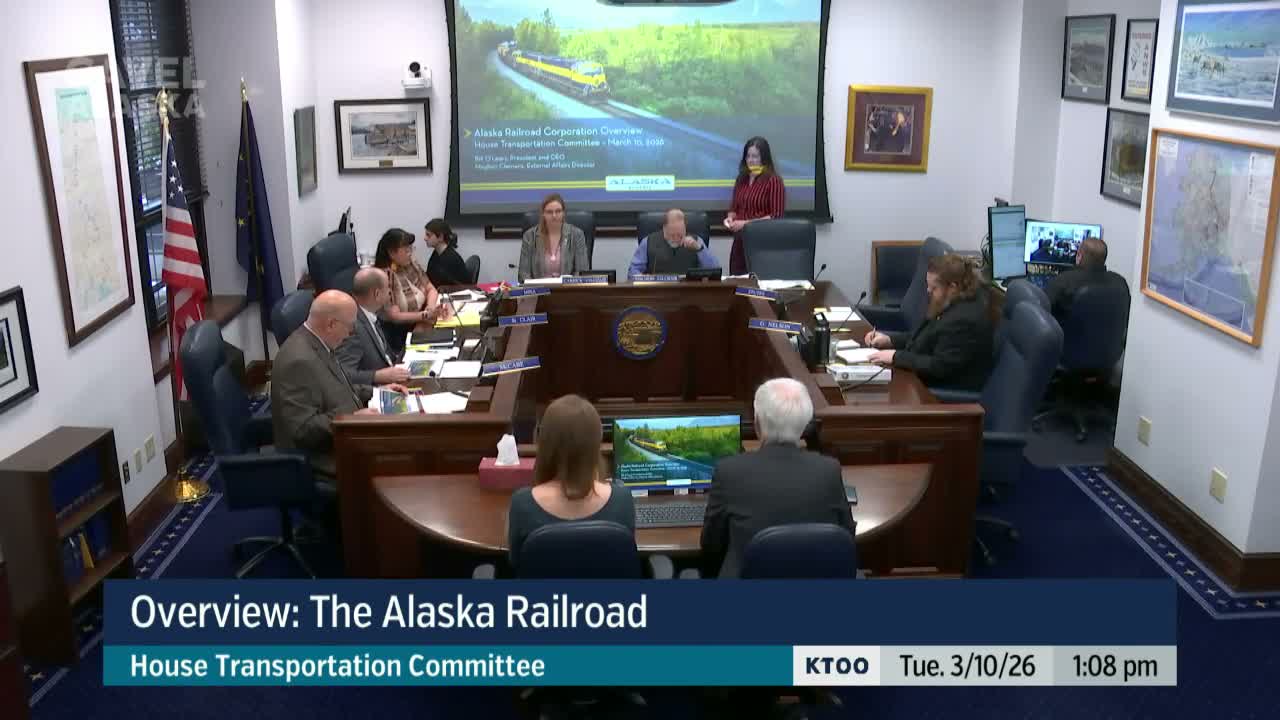
Summary
Alaska Railroad leaders told the House Transportation Committee the railroad operates as a self‑sustaining public corporation, outlined capital programs (track, bridges, Seward passenger dock), pending federal grants and bond tools, and said the railroad is prepared to support Alaska LNG logistics once the developer issues a final investment decision.
Bill O'Leary, president and chief executive officer of the Alaska Railroad, and Megan Clement, the railroad's external affairs director, briefed the Alaska House Transportation Committee on March 10 in Juneau on the railroad's operations, capital programs and financing tools.
O'Leary told lawmakers the Alaska Railroad is a public corporation created by statute (AS 4.240) and operates as a self‑sustaining business whose net earnings are reinvested in infrastructure. "We are set up to, as I like to say, look, smell, taste, and feel like private enterprise," he said. The railroad reported moving just shy of 4,000,000 tons of freight in 2025, an increase of roughly 300,000 tons from the prior year, and said passenger movements remain an important revenue contributor.
The presentation listed major capital priorities and recent grant activity. The railroad described a roughly $25 million annual track rehabilitation program (targeting about 40,000–50,000 ties replaced each summer), an ongoing bridge program to replace or rehabilitate more than 100 bridges (a program the presenters described as a roughly half‑billion‑dollar effort), and several pending competitive grant applications. Leaders said they have an applied $32,000,000 request to repair the Hurricane Gulch Bridge and a MERAD/PIDP grant application to clear the Whittier Tunnel to enable double‑stack freight service.
O'Leary and Clement reiterated progress on the Seward passenger dock: a $137,000,000 new double‑berth pier and terminal building funded through port improvement fees with Royal Caribbean as anchor tenant. "Construction is underway now," the presenters said, and they expect completion in May. They also described a $50,000,000 shore‑power project tied to a $45,000,000 grant and a $5,000,000 developer match to fund electrification and battery storage for the port.
On real estate, committee members heard the railroad manages roughly 36,000 acres transferred at the time of federal divestiture; roughly half is used for operations and half is leased at fair market value. Presenters cited Ship Creek redevelopment, new leases and a downtown trail connection as examples of how real estate supports net income and stabilizes finances.
Members pressed the railroad about passenger data and cruise contracts. Committee member Representative McCabe objected to counting cruise‑charter passengers as Alaska Railroad passengers, saying: "I object to counting them as your passengers, because they're really not." The railroad said its public passenger counts include both Alaska Railroad ticketed passengers and passengers on cruise‑charter cars and agreed to provide a breakout of those figures going forward.
On large‑scale projects and financing, O'Leary described the railroad's role in potential rail extensions (Port MacKenzie, the Northern Rail Extension and the multi‑billion‑dollar Northern Continental Corridor) and said the railroad formed a rail expansion reserve fund with an initial allocation of $1,400,000 and an ongoing commitment of 6% of annual net income to fund studies and early steps. For Alaska LNG specifically, he said the railroad has moved pipe through Seward for other projects and would be prepared to scale operations. "We can do this. It's as simple as that," O'Leary said of the railroad's logistics capability.
O'Leary also reviewed longstanding statutory authorities and recent tax‑code developments relevant to financing. He described the Alaska Railroad Transfer Act (ARTA) and recalled a 2003 legislative authorization the Legislature made available but did not use. He said the railroad sought and received a Treasury/IRS revenue ruling (January 15) recognizing the railroad's ability to act as a conduit issuer of tax‑exempt debt in support of natural‑gas‑pipeline‑related facilities, subject to legislative authorization. He said the railroad would consider deploying about $10,000,000 of capital for spurs and terminal improvements when a project sponsor issues a final investment decision.
Committee members asked for follow‑up materials, including statutory citations referenced in the presentation and a passenger‑count breakout separating Alaska Railroad ticketed passengers from cruise‑charter guests. The presentation concluded without formal action; the committee recessed to the next agenda item.