Port of Alaska modernization update: Tesla Megapacks ordered, Cargo Terminal 1 construction to start March 16

Senate Resources Committee · March 11, 2026

Get AI-powered insights, summaries, and transcripts

Subscribe
AI-Generated Content: All content on this page was generated by AI to highlight key points from the meeting. For complete details and context, we recommend watching the full video. so we can fix them.

Summary

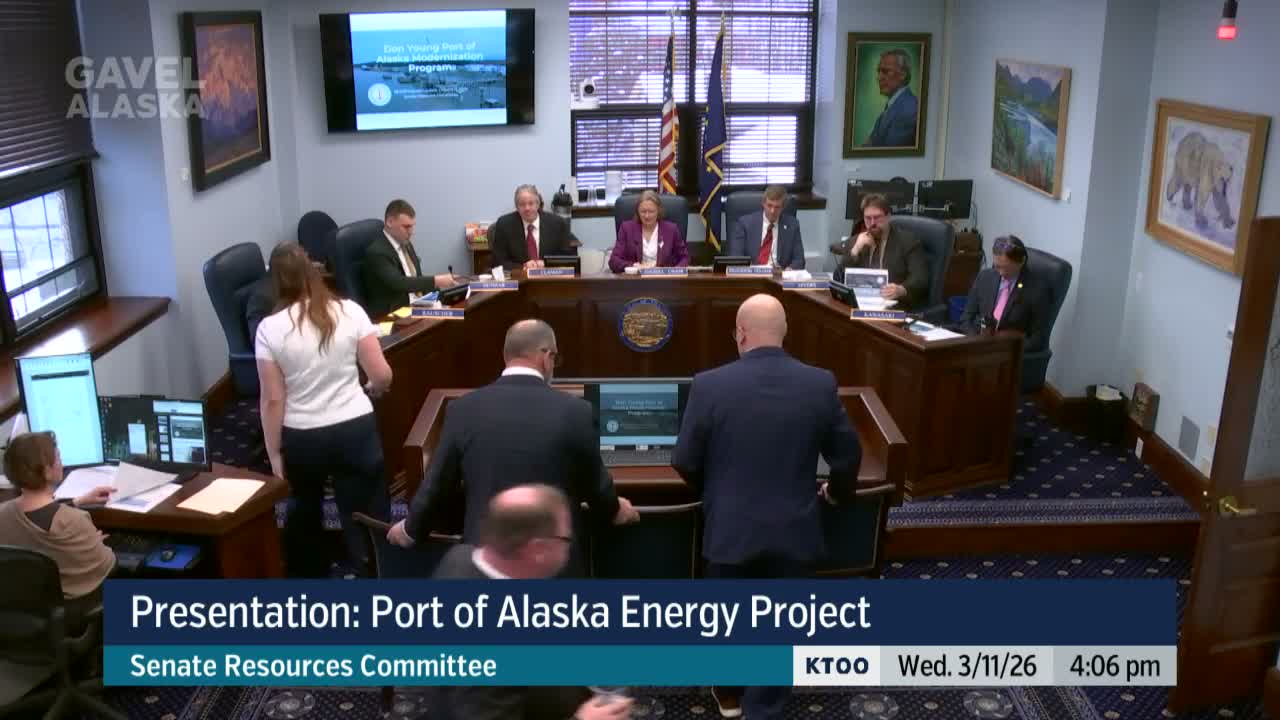
Don Young Port Director Terry Emmatum and Jacobs Engineering consultant Eric Adams told the Senate Resources Committee that two Tesla Megapacks will provide short-duration backup for new ship-to-shore cranes, Cargo Terminal 1 construction begins March 16, and crane arrival and partial dock use are scheduled for August 2028.

Terry Emmatum, director of the Don Young Port of Alaska, and Eric Adams, program management consultant with Jacobs Engineering, told the Senate Resources Committee on March 11 that the Port Modernization Program (PAMP) is moving into a construction phase and that a battery energy storage system (BEST) is central to crane safety and port resilience. "The Don Young Port of Alaska is not simply a municipal asset. It is a statewide infrastructure," Emmatum said, framing the modernization as critical to fuel, food and supply chains across Southcentral Alaska.

Eric Adams explained BEST and its near-term scope: phase 1 is under contract, will include two Tesla Megapacks on order and is designed to provide short-duration backup primarily to "safe out" the new ship-to-shore cranes if primary power is lost. "Phase 1 of the BEST program will only be able to allow to safe out the cranes that I talked about," Adams said, adding that the installed Phase 1 capacity under contract is roughly 15,400 kilowatt-hours. He said the substation and BEST must be operational before cranes arrive; crane delivery is scheduled for August 2028.

Adams reviewed the PAMP schedule: contractors were awarded work in June 2025, construction on the substation/BEST portion starts in 2026 with final completion for that scope planned for August 2028, and Cargo Terminal 1 is slated to start construction on Monday, March 16, 2026. He said design work for Cargo Terminal 2 is kicking off and that the port's completed projects to date include the petroleum and cement terminal and a new administration building.

Committee members asked technical and operational questions: battery chemistry and supplier (Adams said the Phase 1 Megapacks are Tesla units and engineering details will be provided), how long the batteries could sustain crane operations (Adams said Phase 1 provides roughly an hour of crane "safe-out" time and that Phase 2 is under study), and whether modernization increases capacity or unloading speed (Adams and Emmatum said larger cranes and improved systems should increase throughput and flexibility).

On the Murad/MARAD lawsuit tied to port finances, Emmatum said the case is in appellate stages and that the municipality's claimed decommissioning costs make the municipality's ask larger than an initial $3.61 billion figure; he said discussions with MARAD and the Department of Justice are pending and declined to provide a settlement amount. "We have asked for more than that because we had decommissioned costs," Emmatum said.

The committee also asked about removed pilings and demolition material; Adams said the Terminal 1 contractor receives demolition material and that much of the metal will likely be shipped to Seattle recyclers under contract terms, though exact quantities were not provided.

Why it matters: The port handles the majority of fuel and consumer goods arriving in Southcentral Alaska; port outages or capacity constraints can affect supply chains, military logistics and airport fuel deliveries. Emmatum and Adams said BEST and the new terminals are intended to reduce operational risk, improve crane safety during outages and expand handling capacity for larger vessels. The presentation concluded with the committee thanking the witnesses and a brief adjournment.