
AEA updates committee on Renewable Energy Fund round, SEPA funding oversight and rural bulk-fuel awards
Get AI-powered insights, summaries, and transcripts
Subscribe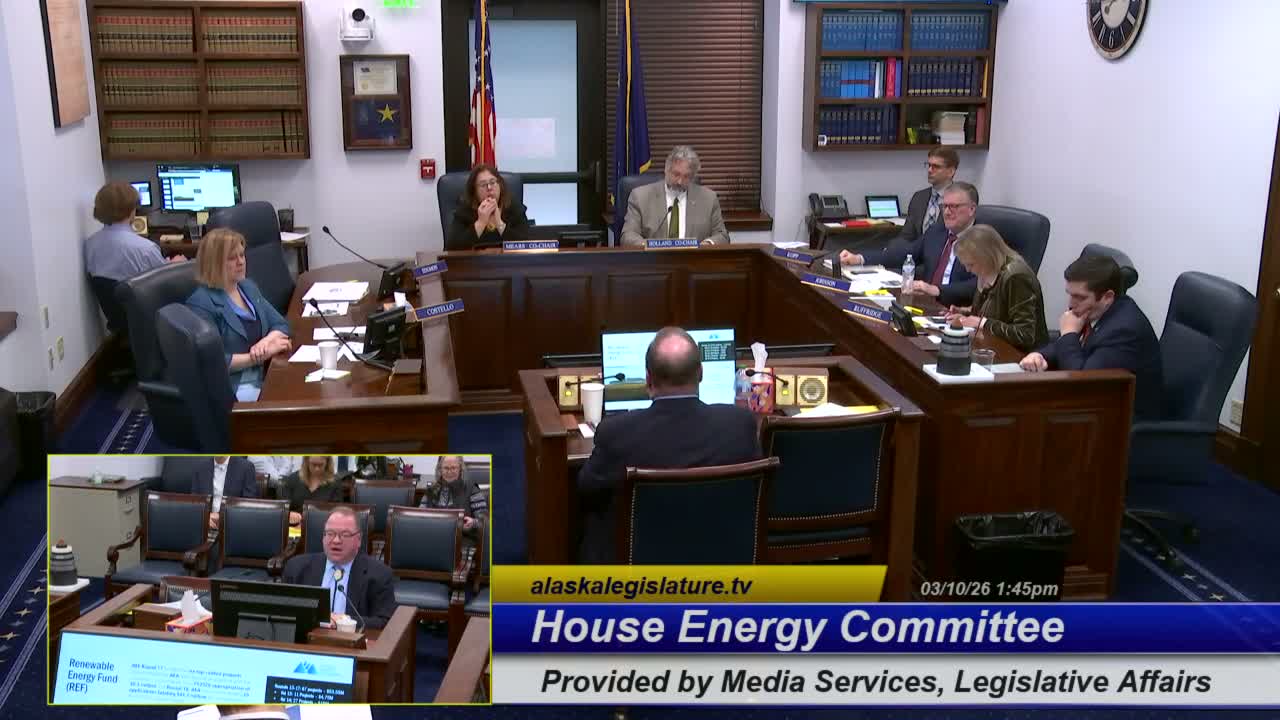
Summary
AEA briefed the committee on REF Round 17/18 (29 applicants in round 18), an SEPA application that was adjusted from a $4M to $2M recommendation because of cost-area rules, and a separate EPA $100M award (with $50M sub-awarded to AEA/AVEC) targeted to vulnerable bulk-fuel facilities.
Curtis Thayer summarized the Renewable Energy Fund (REF) and related rural programs for the House Energy Committee. He said Round 17 funded six top-ranked projects and that Round 18 received 29 applicants; REF evaluations include technical, economic and regional criteria and historically more than 80% of REF dollars have gone to rural Alaska. Thayer said the REF program has supported 110 operational projects and 56 in development, with total state investments exceeding $333 million and an estimated displacement of about 120 million gallons of diesel fuel.
Thayer outlined one administrative correction in Round 18: a SEPA applicant that had been recommended $4 million in the past was reclassified in the current review as being in a low-cost area, which caps REF awards at $2 million under program rules. Thayer said the prior $4 million recommendation was an oversight and that the corrected recommendation reflected the low-cost area cap.
Committee members asked for more detail on how many jobs and how much energy the REF projects create; Thayer said Northern Economics produced analysis showing the Bradley diversion would produce roughly 2,000 jobs during construction and that AEA can supply detailed project-by-project metrics on energy output and diesel displacement.
On rural infrastructure, Thayer described AEA’s circuit rider program (four staff who respond to rural electrical emergencies and provide training) and noted deferred maintenance: roughly $300 million in deferred maintenance for eligible powerhouses (about $6 million per powerhouse on average) and over $1 billion in deferred maintenance for bulk-fuel facilities. He said AEA and the Denali Commission are implementing an EPA award: the EPA provided $100 million, awarded to the Alaska Native Tribal Health Consortium, with $50 million sub-awarded to AEA and Alaska Village Electric Cooperative (AVEC) for project management to upgrade the state’s most vulnerable bulk-fuel and powerhouse facilities. Thayer said the EPA funds are limited to bulk-fuel facility work and do not permit diverting that money to other purposes.
Committee members requested follow-up materials: a project-by-project energy and jobs accounting for REF applicants, the list of most vulnerable facilities used for the EPA sub-award, and clarifications about REF funding options in the governor’s budget.