Get Full Government Meeting Transcripts, Videos, & Alerts Forever!
Get email alerts on the Jail Capacity topic
No spam. Unsubscribe anytime.
Benton County explores misdemeanor pod, office reconfiguration and tax options to address jail overcrowding
Summary
Judicial and law‑enforcement leaders told the court the county jail is persistently over capacity and presented a menu of responses — converting or expanding existing space, building a new misdemeanor pod (estimated ~$20M for ~300 beds), or pursuing dedicated sales‑tax changes — while flagging statutory and political obstacles.
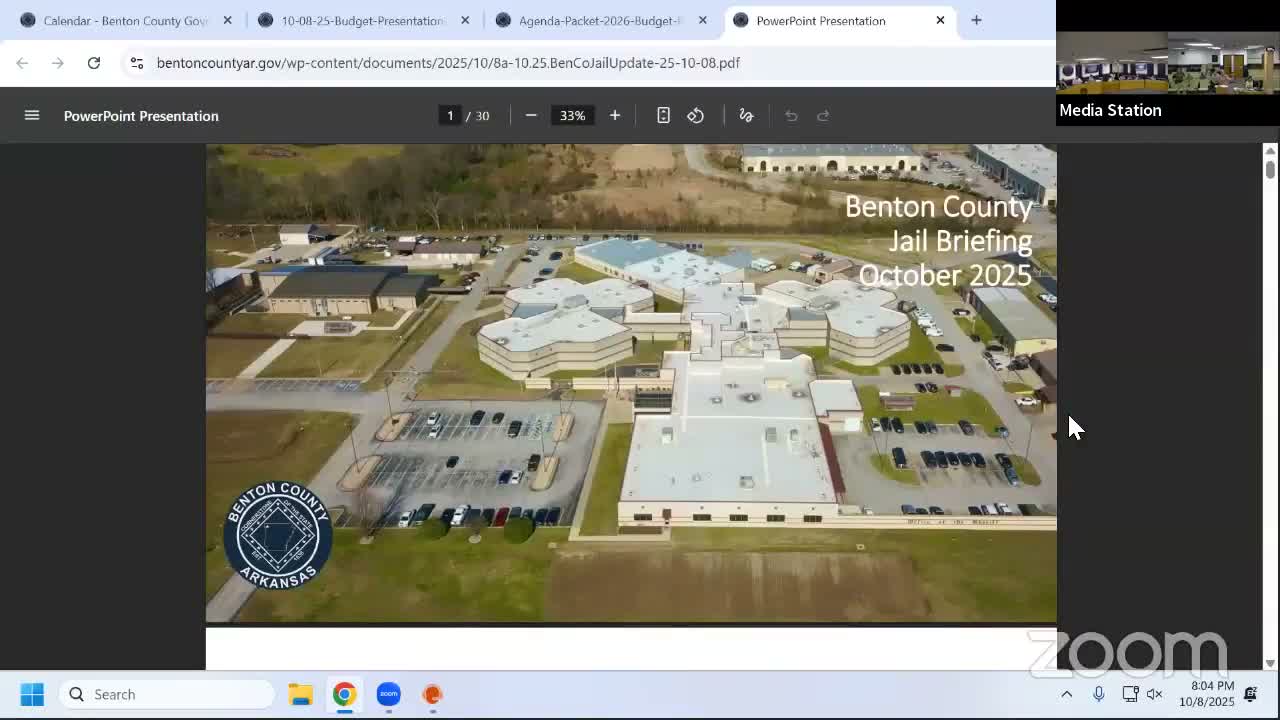
Benton County officials used the second half of their Oct. 8 budget session to give a sustained briefing on jail overcrowding and possible responses, underscoring the scale and cost of the problem.
Judge (presenter) and the sheriff described current overcrowding driven by population growth and an ongoing shift toward holding more felony inmates. The presentation included historic bed‑count trends, a consultant’s felony bed projection, and a sheriff’s office dashboard that consistently shows occupancy above capacity. “The jail is already over capacity,” the judge said, adding that an additional criminal judgeship anticipated for 2027 will add pressure.
Options under consideration ranged from operational and intergovernmental measures to capital projects: 1) convert part of the current sheriff’s office footprint into a misdemeanor housing pod (a lower‑cost, shorter‑term “flip‑flop” option that could add an estimated 150–200 beds but requires building a new sheriff’s office first); 2) build a standalone misdemeanor pod (an IPOD of about 300 beds, conceptually estimated at roughly $20M in current dollars, not including associated kitchen, laundry and sewer upgrades); and 3) pursue a larger felony expansion or a broader jail project (estimates in prior plans reached tens of millions or higher).
Funding paths discussed included interlocal contracts with cities to cover operating costs for misdemeanor beds (a per‑capita contract was proposed), reallocation of countywide sales tax (statutory and municipal opposition risks were emphasized), raising the road millage (constitutional limits and statutory splits with some cities restrict use), or asking voters for a dedicated sales‑tax increment (eighth/quarter‑cent scenarios were modeled). Prosecuting attorney Brian Sexton and others noted Washington County’s quarter‑cent model provides substantially more jail operating capacity in that county’s budget.
Court discussion covered political feasibility and the time horizons: an IPOD could be operational in roughly two years if built new, while the sheriff‑office flip required building and moving staff first and could extend three to four years before new inmate capacity is available. Several justices cautioned that a voter measure without a clear, compelling message and coalition risks failing again, and that any new revenue dedicated solely to operations would not cover large capital costs needed for felony expansion.
Next steps: the court directed staff to pursue feasibility work and more precise cost estimates (construction and operating) for the most viable options, to explore interlocal contract scenarios with cities, and to return with modeled budgets showing impacts with and without proposed capital/operating revenues.