Get Full Government Meeting Transcripts, Videos, & Alerts Forever!
Get email alerts on the Property Tax topic
No spam. Unsubscribe anytime.
Benton County sees sharp rise in property-tax base; officials weigh budget impact
Summary
County assessor and collector reported significantly higher taxable values for 2025 collectible in 2026 — officials said the county’s taxable assessed value rose mid‑teens year‑over‑year, boosting potential revenue by several million dollars and prompting questions about how to use the funds and whether to alter pay and capital plans.
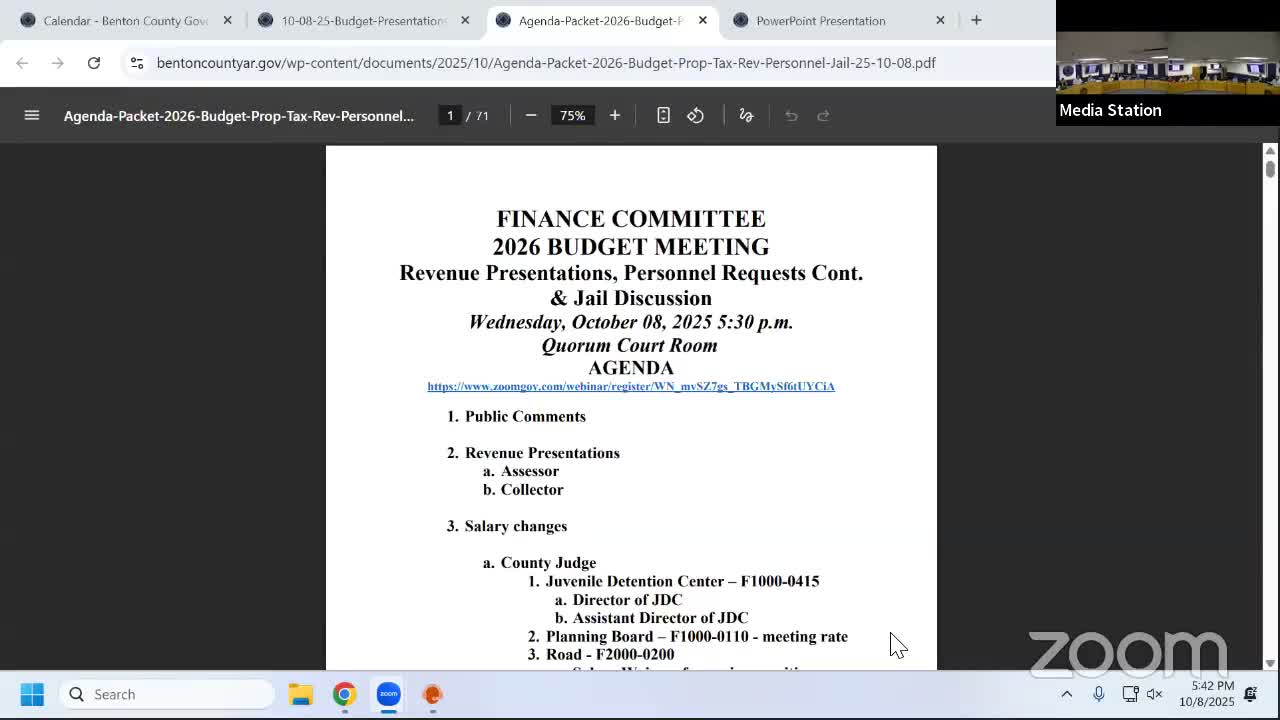
Benton County’s tax picture brightened on Oct. 8 as the assessor’s office and the collector’s office presented new estimates showing substantially higher taxable values for 2025 collectible in 2026. Rod, the assessor’s presenter, told the quorum court that Benton County’s taxable assessed value increased about 13.3% year over year and that the county’s aggregate taxable base could generate roughly $558.4 million in gross potential tax revenue when applying the 2024 millage example. Amber White, financial administrator in the collector’s office, told the court the office used an 87.5% average collection rate in its projections and estimated county general current‑tax revenue at roughly $36.6 million for 2025 with a projected $42.9 million in 2026.
Those newly tallied sums prompted the court to re‑examine near‑term budget choices. “We pull three abstracts every tax year,” the assessor presentation explained, describing how new construction, sales, and Amendment 79 (the property‑tax relief measures for homesteads) move a taxable base between appraisal and collection years. Amber White said the collector will close tax books Oct. 31 and begin delinquent collections Oct. 16; she emphasized that rollbacks and delinquency rates materially affect the dollars ultimately collected.
The court’s initial reaction focused on how much of the apparent gain will be collectible and how to incorporate the amounts into the 2026 budget. “We’re not making decisions tonight. We are still information gathering,” the Chair said, reminding members that final collection figures will be clearer in later October and November. County officials noted that some of the raw increase reflects a one‑time return from a prior rollback and that the county often budgets conservatively until final settlements are available.
The new projections led members to discuss several policy choices. The county judge and other members flagged possible uses ranging from offsetting projected personnel raises to accelerating capital set‑asides for a jail expansion. One justice suggested earmarking the additional funds into a capital account so money is not committed elsewhere before a formal plan is in place. The collector’s office and assessor agreed to supply follow‑up data — detailed collection‑rate scenarios, delinquent estimates, and the final net settlement — so the court can model budget outcomes under multiple assumptions.
Next steps: staff will provide refined projections in the coming weeks and the court scheduled a focused finance meeting for Oct. 14 to move from information gathering toward decision points that will shape the FY‑2026 budget.