Get Full Government Meeting Transcripts, Videos, & Alerts Forever!
Get email alerts on the County Budget topic
No spam. Unsubscribe anytime.
Benton County finance committee sends 2026 budget to Quorum Court after heated debate over staffing and jail funding
Summary
The finance committee voted 12–1 to forward the proposed 2026 budget to Quorum Court after a lengthy debate over a 7.4–7.8% increase, a $4 million reserve for jail operations and an unsuccessful motion to strip 16 newly proposed positions from the general‑fund budget.
Benton County’s Finance Committee voted on Nov. 12 to send the proposed 2026 county budget to Quorum Court after an extended debate over staffing levels, spending growth and a set‑aside for jail operations.
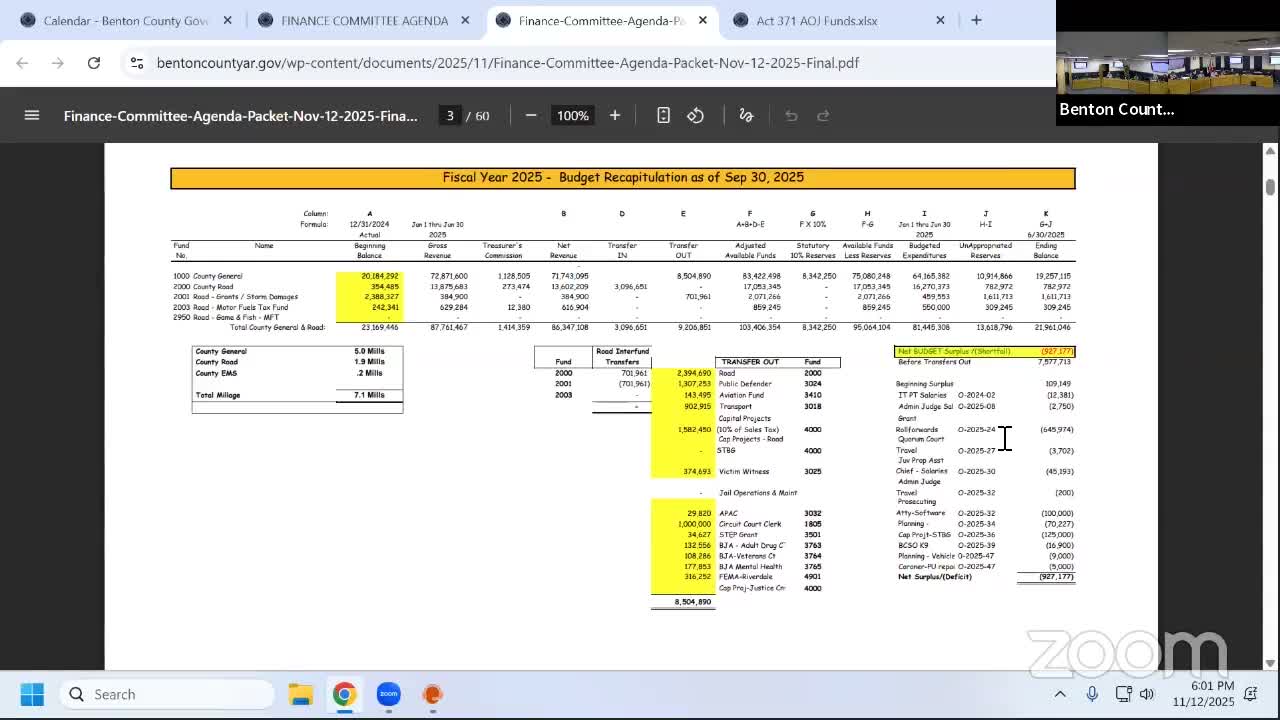
Chair Todd opened the meeting and, after hours of presentations and discussion, the committee approved a motion to forward the budget to Quorum Court by roll call: 12 yeas, 1 nay and 2 absent. Earlier in the evening staff reported the county was “sitting at $927,177 deficit” in the October budget snapshot and walked committee members through fund summaries, grant activity and planned appropriations.
Why it mattered: committee members split over whether the proposed increase — described in committee materials as roughly 7.4–7.8% above the prior year — was reasonable. Supporters said growth reflected county needs and one‑time allocations (including a $4 million reserve earmarked for jail operations). Critics said the percentage exceeded typical inflation and urged more metrics before expanding headcount.
Contentious motion and outcome: a member moved to remove 16 proposed general‑fund positions (including deputies and several facilities and APAC roles) from the 2026 budget. The motion was debated and then failed on roll call, 2 in favor, 11 opposed and 2 absent. The defeat left the personnel additions in the budget that the committee forwarded to Quorum Court.
What supporters said: members backing the budget said much of the increase is tied to public‑safety needs and previously agreed priorities. One committee member noted that a large portion of the general fund supports law‑enforcement and judicial functions and that reducing the budget to inflationary growth would likely require cuts to public safety.
What critics said: opponents urged a more conservative approach, recommended building clearer metrics to justify new positions and questioned whether some items should be phased in. Several members supported funding a comprehensive compensation study to make future personnel decisions data‑driven.
Next steps: the proposed budget will be considered by the full Quorum Court in the November session; appropriation ordinances and transfers discussed by the finance committee (including several grant authorizations and capital purchases) will accompany the budget for Quorum Court consideration.
The committee adjourned after approving related motions to send grant applications and appropriations forward for Quorum Court review.