
Design review committee praises new courtyard move but presses developer on parking and connectivity at Virginian site
Get AI-powered insights, summaries, and transcripts
Subscribe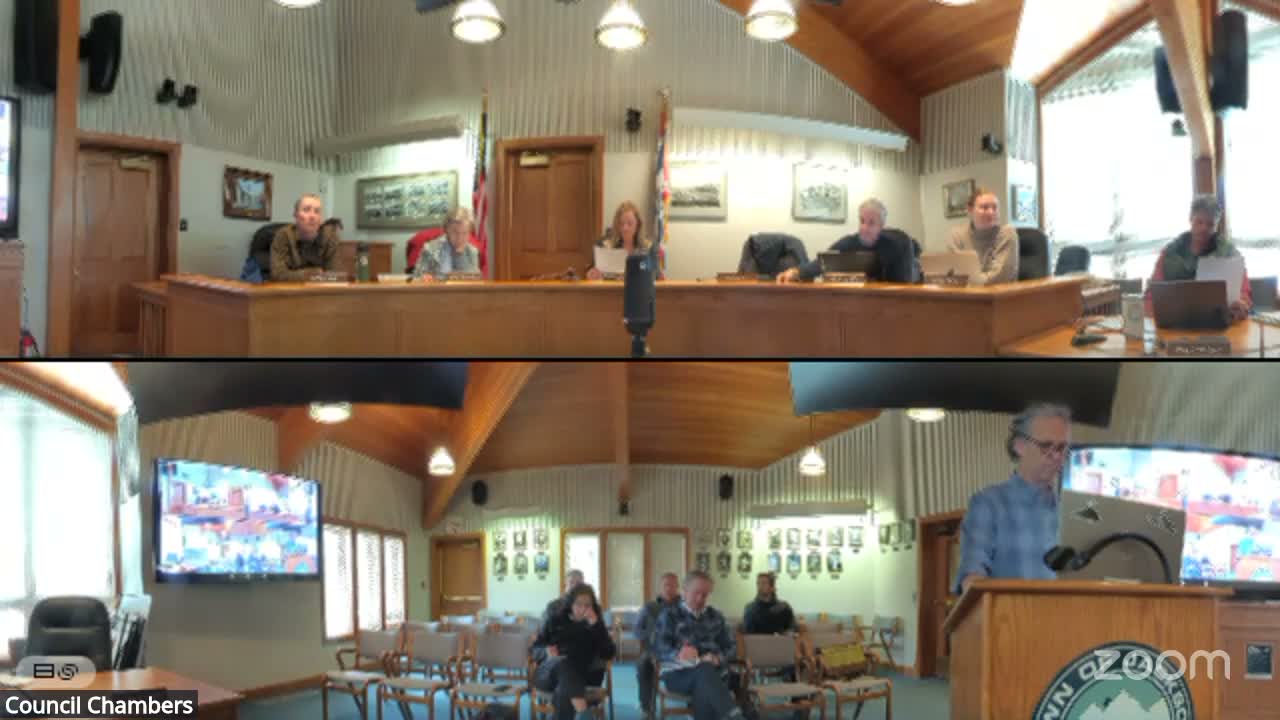
Summary
At a March Design Review Committee meeting planners and the applicant presented a revised conceptual plan for employee housing at the Virginian site on West Broadway. Committee members liked the rotated‑building courtyard but pressed the team for clearer parking, egress and pedestrian‑connectivity solutions before final design.
At its March meeting the Design Review Committee reviewed a conceptual site plan for an employee‑housing project on the Virginian parcel at West Broadway. Paul Anthony, the town planning director, said the Development Review Committee had previously given the applicant seven conditions focused on better integrating architecture, parking and site circulation; the current presentation was intended to check progress before a final design submission.
The project presenter described rotating two western buildings 90 degrees to form a central courtyard and green space, and reworking unit layouts to improve livability. "It's the Virginian site," the presenter said while outlining a roughly 32‑unit plan with ground‑level studio/one‑bedroom units and two‑bedroom units above. The team told the committee it had shifted siding to a board‑and‑batten palette to better relate to existing buildings on the property.
Committee members generally praised the courtyard reorientation as a clear improvement in "place‑making," but raised recurring concerns about parking and circulation. One member asked whether the second‑level balcony and egress stairs would create unsafe circulation; the presenter confirmed a balcony runs between units and there is a required egress stair on the north side. On parking, the applicant explained the overall 8‑acre property is "over parked" but that the quadrant immediately adjacent to the new buildings would show fewer spaces; remote spaces north of an old pump house could serve residents. "If they were to park here, you know, they've gotta walk a good 300, 400, 500 feet to their resident," an owner representative said, arguing the plan balances livability and function for on‑site employees.
Several committee members urged the team to reduce the number of parking spaces immediately in front of the courtyard and explore moving some stalls or adding landscape buffers. They also flagged potential vehicle turning conflicts where parallel stalls sit directly behind perpendicular spaces, and asked the applicant to study how snow from pitched roofs would be managed around sidewalks and entries. Members repeatedly asked the applicant to show pedestrian connections to nearby town destinations, including a future bike path easement and the library.
Paul Anthony told the committee this review was conceptual and no formal motion or vote was required; the applicant was asked to return with a more detailed site plan, parking and egress studies and refined connectivity options. The committee did not take formal action and will consider a final design at a future meeting once the team submits revised plans.