Get AI Briefings, Transcripts & Alerts on Local & National Government Meetings — Forever.
Committee advances HB2050 to modernize radiologic technologist training and supervision
Summary
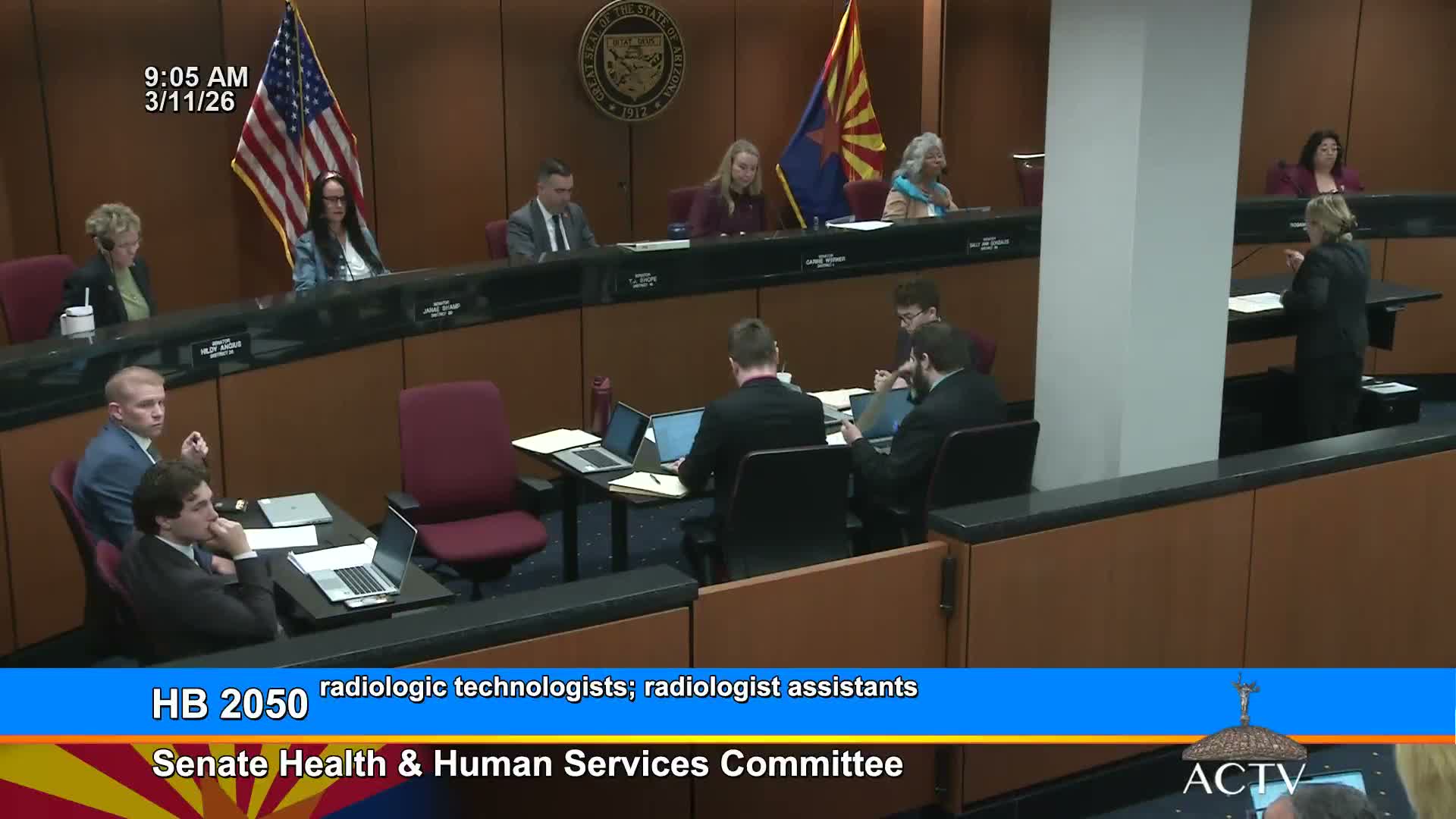
The Senate Health Committee gave House Bill 2050 a due‑pass recommendation after testimony from educators and clinicians who said reducing rigid program lengths and clinical hours and broadening approved accreditations would help address workforce shortages.
House Bill 2050, presented to the Senate Health Committee on March 10, would update Department of Health Services standards for radiologic technologists and radiologic assistants, modernize school approval criteria, and change supervision rules.
Presenter summarized key changes: DHS could approve radiologic technology schools accredited by national organizations instead of strictly by the committee on allied health accreditation; a minimum 24‑month full‑time study requirement would be removed; required clinical experience hours would fall from 1,800 to 1,650; renewals and fees would be generalized to remove fixed dollar amounts; and the bill would allow radiologist assistants to perform procedures under supervision that is less than direct control in some circumstances.
Tracy Rogers, director of radiology at Yavapai College, testified in support citing workforce shortages and the need for flexibility while maintaining quality standards. "There is a need for flexibility while maintaining high quality standards to provide healthcare facilities with competently trained radiology professionals," Rogers said. Jay Coburn, a nurse practitioner working in interventional radiology, described how restrictive licensing language risks limiting qualified clinicians' ability to perform fluoroscopy and other standard procedures.
The committee moved HB2050 with a due‑pass recommendation; recorded committee action indicated 7 ayes, 0 noes, 0 not voting.