
Public Safety Committee advances $300,000 for prison braille transcription program
Get AI-powered insights, summaries, and transcripts
Subscribe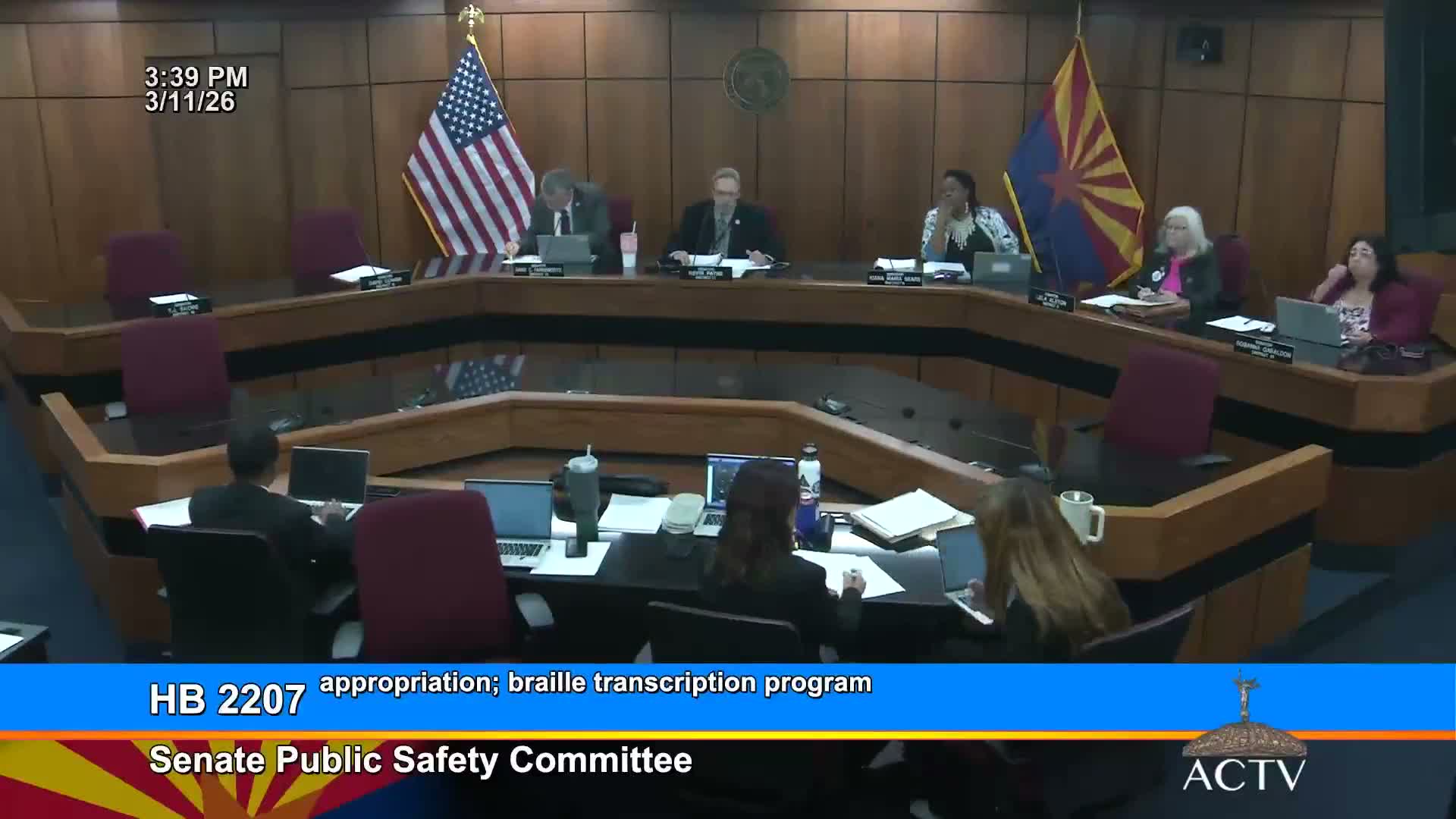
Summary
The Committee on Public Safety voted 7-0 to give House Bill 2207 a do-pass recommendation; the bill would appropriate $300,000 in FY2027 from the state general fund to the Arizona Department of Corrections, Rehabilitation, and Reentry to expand its braille transcription program and requires periodic reporting on students served.
The Committee on Public Safety voted 7-0 to advance House Bill 2207, which would appropriate $300,000 from the state general fund in fiscal year 2027 to the Arizona Department of Corrections, Rehabilitation, and Reentry for the department’s braille transcription program.
Sam, who presented the bill to the committee, said HB 2207 "appropriates $300,000 from the state general fund in fiscal year 2027 to the Arizona Department of Corrections, Rehabilitation, and Reentry for the Braille transcription program" and requires the department to submit reports on numbers of in-state and out-of-state students served by Oct. 15 in 2026 and 2027 (the transcript lists a third reporting date as "2828," which appears to be a transcription error and was not clarified at the hearing).
Edie Lafave of the Foundation for Blind Children testified in support. "This has actually turned into the biggest prison braille program in the nation and has resulted in Arizona having the largest braille library in the nation as well," Lafave said, describing a partnership with the department that trains incarcerated individuals to transcribe materials into braille. She told the committee that most materials produced by the program go to K–12 students with visual impairments and that the Foundation provides those materials at far lower cost than commercial alternatives; the testimony cited commercial textbook transcription costs of $15,000–$25,000 versus Foundation-supplied rates often under $5,000.
Lafave also addressed program growth and financing. She said the program now accounts for about 75% of all braille transcribed in the state and that revenue from sales of transcribed materials "does not go back to the braille system account," a point she raised to clarify how program finances are handled. When a committee member asked whether the program’s sales provide departmental funding, Sam said he could not confirm that from the house record and offered to follow up with staff.
After brief discussion and no amendments, the committee moved HB 2207 with a do-pass recommendation. The chair called the roll and recorded seven ayes and no nays; the bill advanced from the committee by a recorded 7-0 vote. The committee adjourned with no further business.
Next steps: HB 2207 will proceed with the committee’s do-pass recommendation to the next stage in the legislative process.