
Assembly committee reviews AB 457 implementation, witnesses flag funding and infrastructure gaps for farmworker housing
Get AI-powered insights, summaries, and transcripts
Subscribe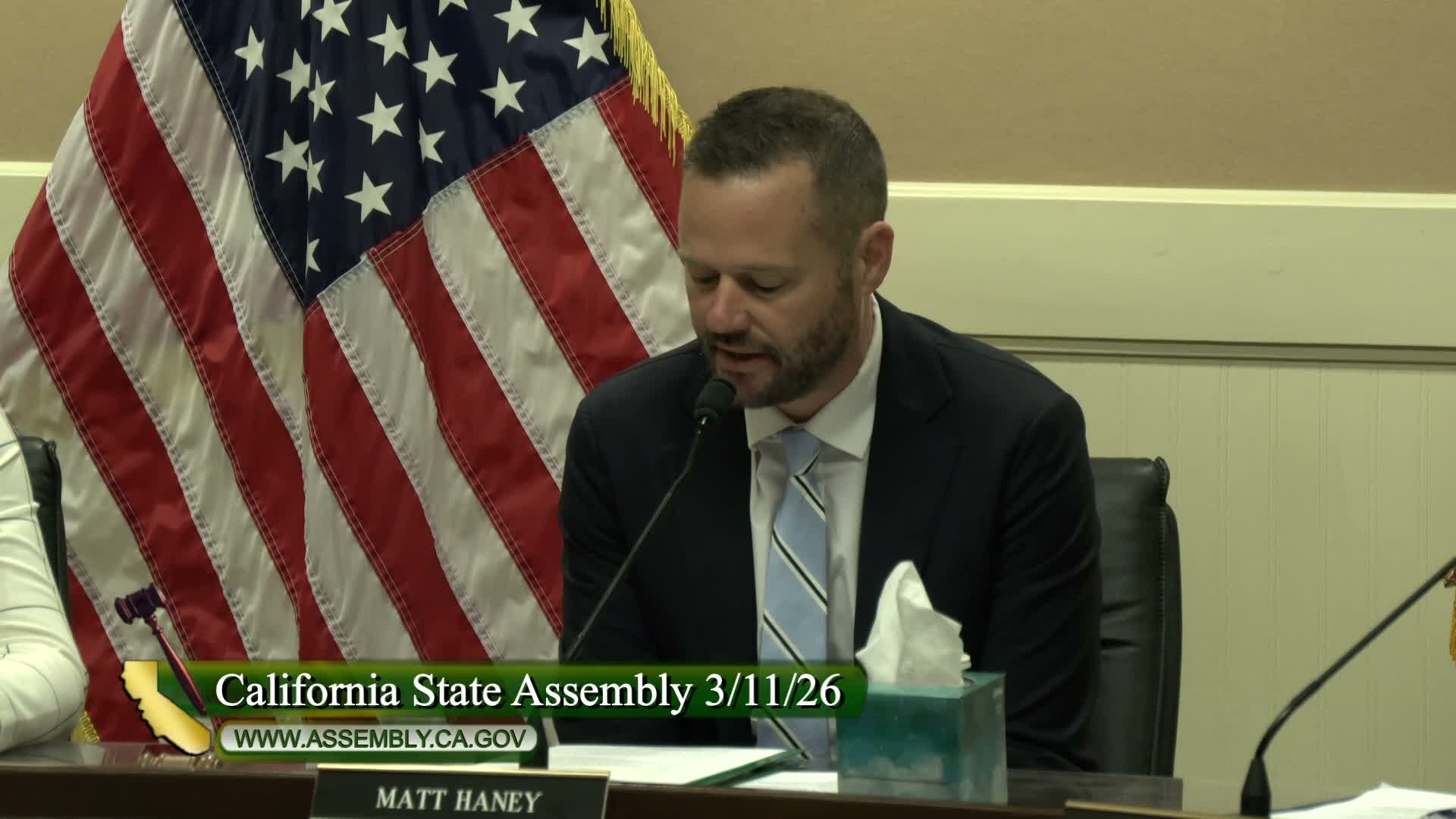
Summary
At an Assembly Housing and Community Development outcomes review, lawmakers and witnesses praised AB 457's ministerial streamlining but said lack of coordinated infrastructure funding, limited Serna program deployment in rural areas, and operational subsidies are blocking production of farmworker and rural housing.
Chair Haney convened an outcomes review hearing of the Assembly Housing and Community Development Committee focused on AB 457 and the state’s efforts to expand farmworker and rural housing. Witnesses from counties, nonprofits and the United Farm Workers described a set of practical barriers — from sewer and water capacity to program scoring that favors urban infill — that they said are limiting the bill’s immediate impact.
Assemblymember Soria, the author of AB 457, told the committee the law builds on earlier bills and is intended to create a more predictable ministerial approval pathway for sites near agricultural land. "Passing a bill is not the end of our job," she said, urging an implementation review to determine whether the new rules are producing housing for farmworkers and rural communities.
The hearing brought three panels of experts. Matt Huerta, an affordable housing consultant, said overcrowding and rising rents show the need for targeted production and described development challenges in rural areas: inadequate sanitation and water systems, off‑site improvement requirements, contaminated soils and ag‑buffer land costs. He noted the Monterey Bay region’s success with employer‑sponsored housing but said state investment and rental subsidies are the largest missing pieces.
Jennifer Palmer, director of Housing and Community Services for Napa County, outlined a local model the county calls "farmworker centers." Napa operates three 60‑bed centers (180 beds total) that provide nightly lodging and three meals for guests at $18 per night, and that run at about 96% occupancy. "These centers are navigation centers," Palmer said, describing on‑site services including health care, ESL classes and housing navigators that help residents build rental history and move into permanent units. Napa funds operations through lodger fees, a per‑acre grower assessment (CSA 4, currently about $14 per acre generating roughly $650,000 a year) and a $250,000 annual state contribution; Palmer urged the state to provide long‑term operational funding and to incentivize local dedicated funding through NOFA point bonuses.
Bonita Villalobos Rivera, third vice president and Central Coast regional director of the United Farm Workers, urged that local, long‑term residents receive priority for set‑aside units and warned that housing tied to the H‑2A visa program can leave workers vulnerable because employer control over housing and transportation can discourage complaints about unsafe conditions.
Nonprofit developers described how program design and competitive scoring can disadvantage rural projects. Tom Kalashaw of Self Help Enterprises said many rural sites are held up by infrastructure deficits and by funding programs that reward urban infill or deeper income targeting. He recommended more flexible scoring in the Super NOFA so Serna projects and blended farmworker developments can compete, and urged direct pairing of Serna awards with infrastructure resources where needed.
Lindy Suggs of the Department of Housing and Community Development (HCD) said the multifamily Super NOFA has awarded more than $1.6 billion across its first three rounds, with about 20% of funds going to rural projects, and that HCD has recently increased Serna investments — supporting dozens of farmworker projects. Suggs said the department is engaged in outreach, program alignment and the housing agency reorganization work designed to improve coordination.
City and county officials emphasized timing mismatches: rural projects often must secure separate approvals or infrastructure grants from State Water Resources Control Board programs (for example SAFER/Cap and Invest funds) before they are "shovel ready," yet housing funding competitions favor shovel‑ready projects. Christian Gonzales, city manager of Mendota, said his small city waived development impact fees for three years but still attracted no new residential projects because construction costs, environmental review and weak local markets make rural projects financially infeasible.
Committee members pressed HCD and witnesses for options to make Serna and related funding cycles more predictable and to create incentives for local funding partnerships. Multiple panelists suggested adjustments including targeted NOFA scoring for communities that provide local dedicated funding, program set‑asides for rural projects, and state capacity grants or direct allocations to small jurisdictions to reduce application and timing barriers.
The hearing closed with members commending local innovations and urging follow‑up work on aligning capital and operational funding to convert temporary lodging and pilot projects into permanent, family‑sized housing. Chair Haney adjourned the committee after remarking that AB 457 is one tool in a broader set of policies the Legislature will continue to refine.