
Researchers tell Senate enforcement raids coincided with private‑sector job declines in California
Get AI-powered insights, summaries, and transcripts
Subscribe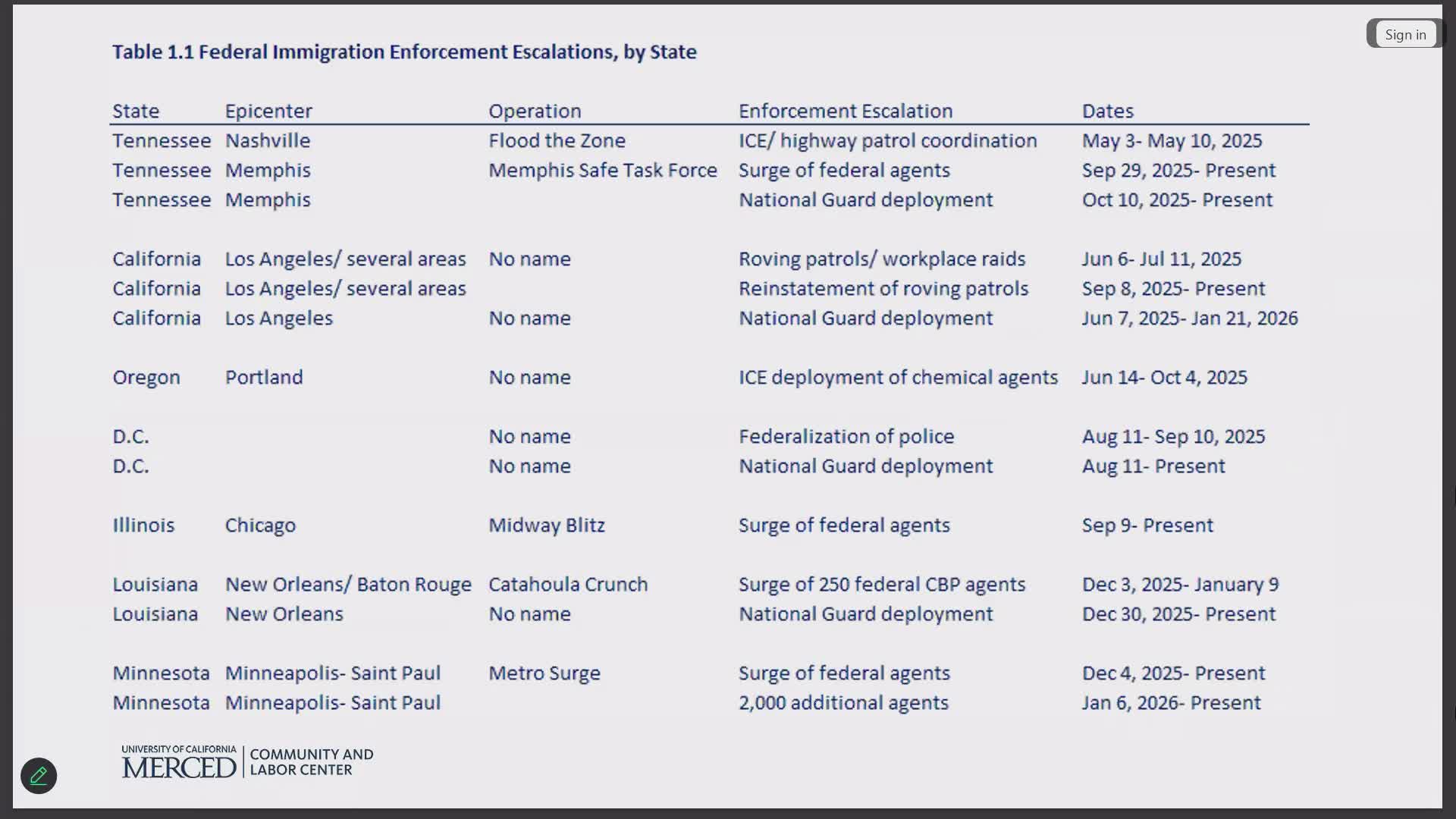
Summary
Economists and regional analysts told the Senate Labor and Public Employment Committee that escalations in federal immigration enforcement in 2025 coincided with measurable private‑sector job losses in California, and urged state planning including wage‑replacement or stimulus options to blunt local impacts.
Enrique Lopez Lira, director of the UC Berkeley Low Wage Work Program, told the Senate Labor and Public Employment Committee that California’s labor market has shown virtually no net employment growth since January 2023 and that low‑wage workers — about 35% of the state workforce — face acute pressure from rising living costs and policy shifts.
“Large federal cuts to medical funding could lead to significant job losses not only in California’s health‑care sector but other industries as well,” Lopez Lira said, citing model estimates that link cuts in programs including Medi‑Cal and SNAP (CalFresh) to declines in employment and tax revenue.
Edward Orozco Flores of the UC Merced Community and Labor Center presented the committee with historical monthly CPS (Current Population Survey) data showing private‑sector employment declines clustered in periods of escalated immigration enforcement. Flores said California’s private‑sector jobs fell by about 2.6% between May 2025 and January 2026 (from roughly 15.2 million to 14.8 million) and that monthly declines in June and July 2025 coincided with roving patrols and workplace raids.
“Private‑sector employment in enforcement states declined 1.8% while the rest of the U.S. gained about 1.1%,” Flores said, summarizing the study’s comparative approach. He described the June–July 2025 enforcement actions, the temporary restraining order (TRO) and the subsequent Supreme Court stay as moments when employment volatility increased.
Shannon Sedgwick of the Los Angeles County Economic Development Corporation said county‑level modeling and business surveys showed sharp and geographically concentrated effects: Los Angeles County’s immigrant workforce (about 3.5 million people) and an estimated 950,000 undocumented workers generate substantial economic activity. LAEDC found that businesses in high‑vulnerability ZIP codes reported operational disruption (82% negative impact in the survey) and that a one‑week curfew imposed during protests produced modeled losses of about $840 million in output and 3,900 jobs annually in the affected area.
Committee members asked for tax‑revenue estimates and comparisons with other enforcement states; Flores said specific tax‑loss projections were not available but argued that stimulus or worker‑facing wage‑replacement programs were appropriate policy tools in a downturn linked to enforcement shocks.
Why it matters: Panelists framed enforcement as not only a legal or humanitarian issue but also a labor‑market and local‑fiscal concern. Testimony linked transient raids and broader enforcement patterns to declines in labor supply, reduced consumer spending in affected neighborhoods and direct impacts on businesses that rely heavily on immigrant workers.
The committee did not take formal action at the hearing; members signaled interest in state responses that could include targeted relief funds, workforce supports and closer monitoring of early indicators (initial UI claims and local WARN notices).