
House passes income tax on millionaires after marathon debate; key amendments rejected
Get AI-powered insights, summaries, and transcripts
Sign Up Free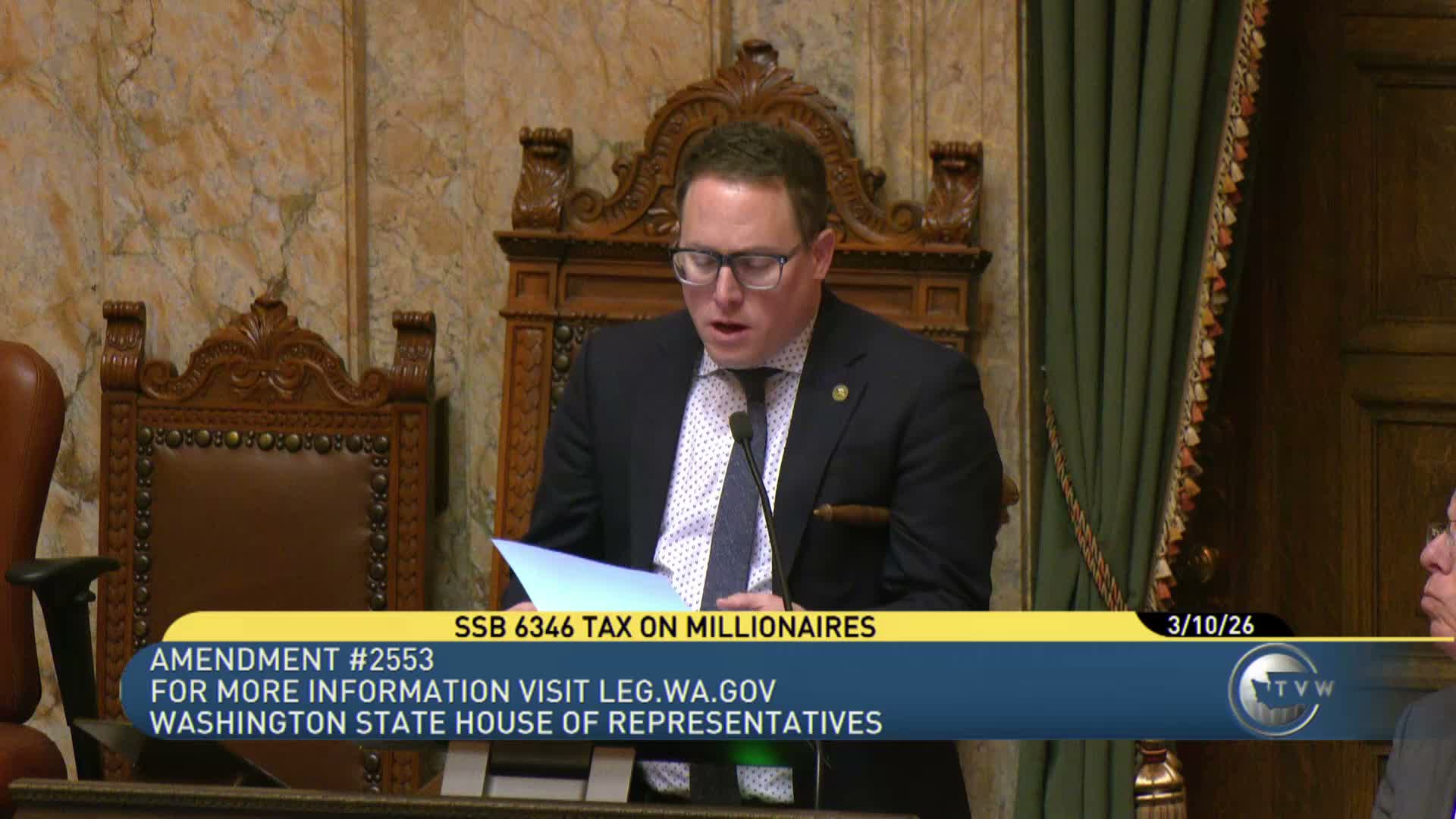
Summary
After more than 24 hours of debate, the Washington House passed an amended version of Senate Bill 6346 — a new income tax targeting incomes above the statutory threshold — by a 51‑46 vote. Lawmakers sparred over constitutional questions, administrative costs and taxpayer migration; most high‑profile amendments failed, while targeted reporting requirements were adopted.
The Washington State House passed an amended engrossed substitute Senate Bill 6346 late in the day, approving a new, graduated income tax on high earners and a package of tax changes and relief measures by a final vote of 51 yeas to 46 nays.
Proponents framed the bill as structural tax reform that will shift funding away from regressive levies and provide targeted relief and new investments for schools, child care and health care. "This is a way to change that," Representative Berg (speaker 23) said in final remarks, arguing the code has not kept up with the state's growth and that the measure would bring "structural reform." Representative Mena (speaker 43) said the measure would expand the Working Families Tax Credit and exempt many grocery and hygiene items from sales tax.
Opponents warned that the bill is constitutionally vulnerable and will prompt capital flight and harm employers and rural economies. Representative Orcutt (speaker 14) cited Washington precedent and said the state should not rush a measure that may be found unconstitutional; Representative Penner (speaker 33) and others said the bill’s protections (including the $1,000,000 standard deduction) could be changed by future legislatures and therefore do not guarantee the tax will remain limited to the wealthiest.
Major floor amendments were offered and most were rejected. The House adopted an amendment requiring the Department of Revenue to study and report administrative costs and oversight (Amendment 25‑63), which passed unanimously on roll call (93‑0, 5 excused). But other significant amendments failed, including proposals to: send the scheme to voters or require a constitutional amendment (Amendment 25‑94 failed 46‑49); cap hiring for the Department of Revenue to 100 FTEs (Amendment 25‑77 failed 38‑57); exempt public pension distributions (Amendment 25‑66 failed 44‑52); and repeal certain B&O surcharges enacted in 2025 (Amendment 25‑86 failed 45‑50). Supporters and opponents repeatedly cited fiscal‑note figures and staffing estimates during debate; witnesses on the floor referenced an administration cost estimate in the hundreds of millions and a departmental hiring plan in the low hundreds of FTEs.
Constitutional concerns figured prominently. Several members quoted the state court precedent (Cullerton v. Chase) and Article VII, Section 1 of the Washington Constitution during floor debate, arguing that the constitution’s uniformity requirement constrains the legislature’s power to levy an income tax that singles out particular classes. Supporters countered that 41 states have income taxes and that the proposal is narrowly drawn to apply only above the statutory threshold.
The final roll call began late in the day; the clerk recorded 51 yeas, 46 nays and one excused. With a constitutional majority achieved, the bill "as amended by the House" was declared passed and will move on to the next procedural steps. Floor remarks after passage emphasized both the perceived need for new revenue to fund state services and the depth of opposition from many members.
Votes at a glance
- Final passage — gross substitute Senate Bill 6346 as amended: approved on final passage, 51 yeas, 46 nays (final roll call). - Amendment 25‑63 (Department of Revenue reporting on administrative costs): adopted, 93 yeas, 0 nays, 5 excused. - Amendment 25‑51 (delay tied to return of the Seattle SuperSonics): not adopted, 37 yeas, 56 nays. - Amendment 25‑67 (require DOR to track taxpayer migration of $500k+): not adopted, 37 yeas, 57 nays. - Amendment 25‑77 (cap DOR hires at 100 FTEs): not adopted, 38 yeas, 57 nays. - Amendment 25‑94 (require constitutional amendment / voter approval): not adopted, 46 yeas, 49 nays, 3 excused. - Amendment 25‑66 (exclude public pension distributions): not adopted, 44 yeas, 52 nays. - Amendment 25‑86 (repeal certain B&O surcharges/advanced computing surcharge): not adopted, 45 yeas, 50 nays. - Amendment 25‑54 (remove severability): not adopted, 40 yeas, 55 nays. - Amendment 25‑84 (remove necessity/emergency clause): not adopted, 41 yeas, 55 nays.
What happens next
Supporters said the bill will fund expanded tax credits and public programs that the state has lacked the capacity to fully support; opponents said legal challenges are likely and that the legislature should have placed constitutional changes before voters. Several members urged additional procedural and legal review as the bill proceeds. The House adjourned for the day after the final vote.
Sources and provenance: reporting in this article is based solely on the House floor transcript of March 10, 2026 (floor debate, amendments and roll calls).