
Debate over Mount Simon–Hinckley aquifer use leaves HF 4019 laid over for further study
Get AI-powered insights, summaries, and transcripts
Subscribe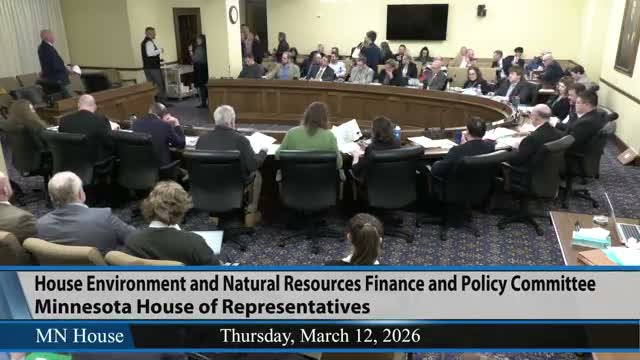
Summary
Representative Schultz's bill on limited uses of the Mount Simon–Hinckley Aquifer (notably agricultural irrigation outside the 7‑county metro) was laid over after DNR described a DE that would clarify allowable 'priority 1' uses and conservation requirements; environmental groups and former DNR scientists warned the amendment could reopen protections against high‑volume industrial use.
Representative Schultz said House File 40‑19 aims to provide limited relief where communities lack other sources of water, focusing on agriculture and localized needs outside the 7‑county metro. He asked members to take a problem‑solving approach and noted he was open to collaborative solutions.
DNR director Melissa Kuskie described a DE1 she and the agency drafted to replace ambiguous language (for example, replacing the undefined term "potable" with statutory "priority 1" uses) and to require specified water‑conservation plans and statutory cross‑references in any permit. Kuskie told the committee the department supports clarified language that would allow limited uses outside the metro while preserving statutory tools to restrict uses where necessary.
Witnesses disagreed sharply. Stu Lohrey of the Minnesota Farmers Union and some local farmers supported a narrow exemption for agricultural irrigation limited to those who have no reasonable alternatives. By contrast, Andrew Hillman of the Minnesota Center for Environmental Advocacy warned the DE would reopen the aquifer to industrial and large‑volume uses — citing a data‑center proposal that sought to consume "up to 30,000,000 gallons of water per day" — and said the 2021 law that expanded protections was appropriate. Retired DNR hydrogeologist Jim Berg testified the Mount Simon is a very slow‑recharge aquifer that should be limited principally to drinking water across most of its extent.
Representative Gottfried and others requested more hydrogeologic information and case‑by‑case analysis to understand how large withdrawals would affect different parts of the aquifer. Representative Schultz withdrew the DE1 at the committee's invitation and laid HF 40‑19 over to continue conversations with DNR and stakeholders; he said he intends to move the bill out of committee within two weeks if an agreement can be found.
The hearing recorded competing priorities: the need for local agricultural viability in some places and the imperative to protect a deep, slow‑recharge aquifer that supplies drinking water to many communities.