
Committee refers infectious‑waste enforcement bill to Ways and Means after worker‑safety debate
Get AI-powered insights, summaries, and transcripts
Subscribe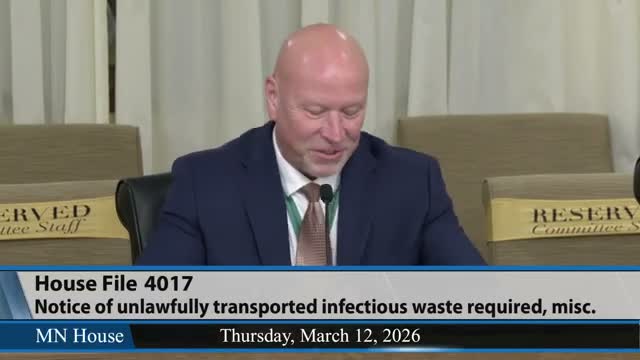
Summary
House File 4017, authored by Rep. Johnson, would increase enforcement and penalties for infectious waste mixed into municipal solid waste; the committee moved the bill to Ways and Means after testimony from county officials and waste‑facility workers detailing traumatic exposures and hospitals and regulators asking for clearer penalty parameters and resources.
Representative Johnson presented House File 40‑17, which would add enforcement mechanisms and penalties to prevent infectious and pathological waste from entering municipal solid‑waste streams. Washington County Commissioner Carla Bingham said workers at the Ramsey‑Washington Recycling & Energy Center have repeatedly encountered "blood and body parts" and described the emotional and operational impact on staff. R&E employee Brad Prozak said he has seen "bones, flesh, hair, and scalp matter" and described the difficulty of removing such items from conveyors.
Michelle Benson, speaking for the Minnesota Hospital Association on behalf of 139 hospitals and health systems, said hospitals operate in heavily regulated settings and that mistakes can occur, but she warned the bill’s penalty language is unclear and could escalate into "multiplying penalties by hundreds of thousands and even into millions of dollars," potentially jeopardizing small hospitals. Kirk Koudelka, assistant commissioner at the Minnesota Pollution Control Agency, said the bill is a good start but urged a holistic approach — education, outreach, updated compliance tools, and resources to carry out inspections — and noted that adding mandatory inspections would require additional agency staffing.
Sam Hall, the R&E facility director, described multi‑year efforts with MPCA, MDH and others to address the problem and urged stronger measures because previous stakeholder conversations had not solved the recurring deliveries. Committee members raised concerns about the time horizon for violations and the need for a tiered penalty system or reset mechanism. Representative Gottfried and others said they planned to support moving the bill forward while expecting amendments in later steps (Ways and Means) to clarify penalty matrices and ensure balanced enforcement.
After discussion the chair renewed the motion and the committee recommended HF 40‑17, as amended, to be referred to the Ways and Means Committee by voice vote.
The record shows competing concerns: worker‑safety witnesses asked for accountability and resources to cover cleanup costs, hospitals warned the penalty structure as written could be overly punitive, and state regulators urged a comprehensive, resourced approach to enforcement.