
Senate commerce panel backs restoring 'any willing provider' contracting for mental health
Get AI-powered insights, summaries, and transcripts
Subscribe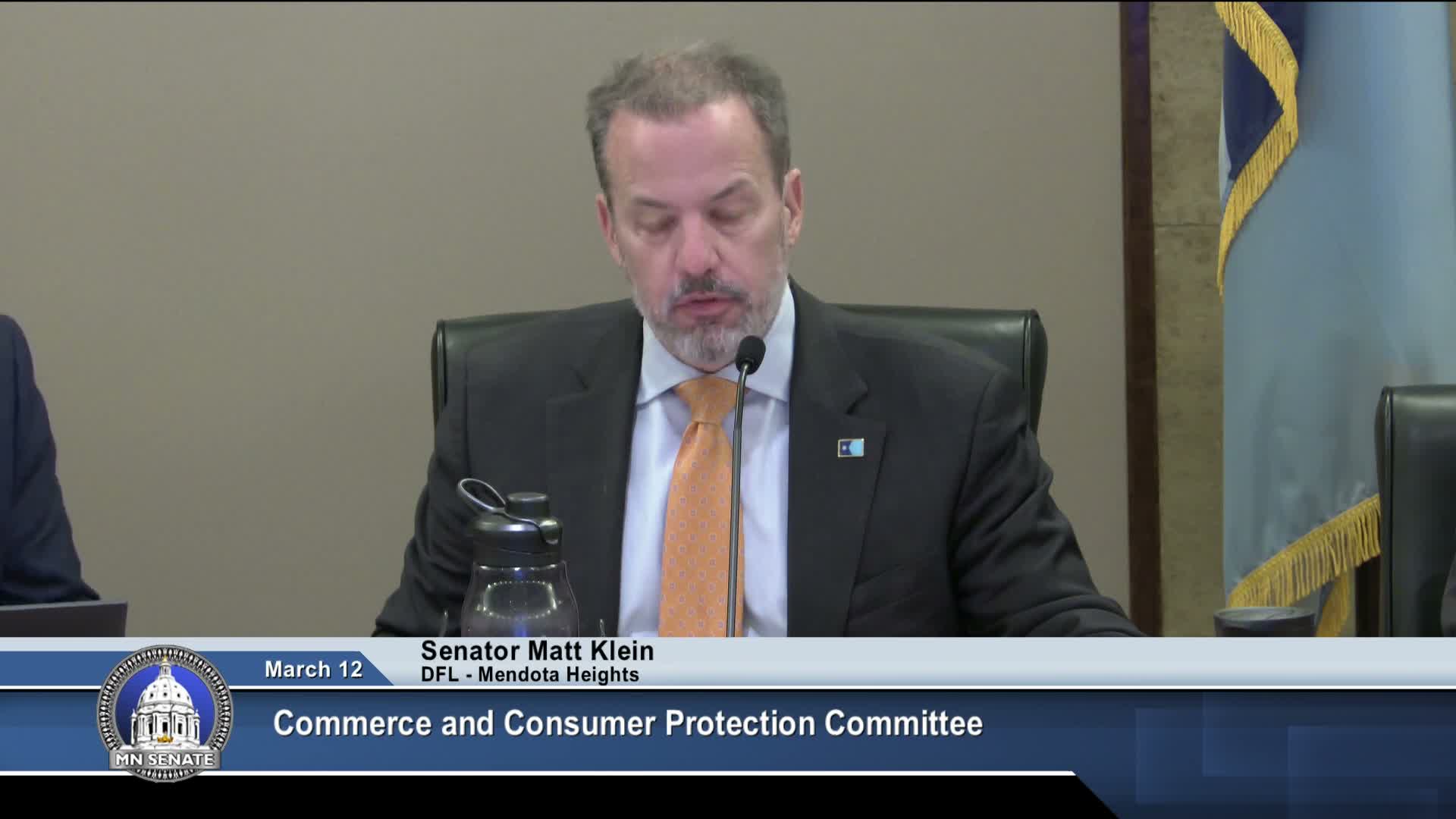
Summary
The Senate Commerce and Consumer Protection Committee recommended Senate File 3705 as amended on March 12, 2026, to restore a temporary 'any willing provider' contracting rule for mental-health clinicians, after testimony from providers and advocacy groups about access problems and questions from members about program integrity.
Senate File 3705, which would remove the sunset on a temporary "any willing provider" contracting rule for mental-health clinicians, passed the Senate Commerce and Consumer Protection Committee as amended and was referred to the Senate Health and Human Services Committee on March 12, 2026.
Senator Mann, the bill author, told the committee Minnesota is facing a "very well-documented" mental-health provider shortage that has left many counties without sufficient in-network clinicians. He said the bill would reinstate the policy that allowed providers who met credentialing standards and accepted standard contract terms to join insurer networks.
Several provider witnesses told the committee they have seen denials from major insurers since the pilot expired. "HealthPartners and Blue Cross Blue Shield of Minnesota have started denying contract requests from qualified providers," said Maggie Williams, cofounder of Flourish Business Solutions and Flourish Wellness Collaborative. She added that "over 70% of Minnesota counties are designated as mental-health professional shortage areas" and that denials limit patient options and disrupt continuity of care.
Other testifiers described similar experiences. "I was denied simply because they had enough providers," said Andrew Carr, a group-practice owner and recruiter, recounting past contract denials. Jason Roman, a clinic owner and licensed counselor, said denials because of claimed "network saturation" force patients to travel or pay out of pocket and make it harder for small practices to plan and hire.
Elliot Butay of NAMI Minnesota said the group supports making the pilot permanent and reported outreach with health plans to discuss program-integrity language. "We stand ready to work together to pass this bill this year," he told the committee, while stressing the bill's intent to improve access for rural communities, children and Black and Brown Minnesotans.
Committee members welcomed the testimony but pressed the author on safeguards. Senator Rasmussen, who works on human-services issues, warned that some high‑risk provider categories have ongoing fraud concerns and that the Department of Human Services has used moratoria and revalidation to address program integrity. "My concern is ... in some of these high‑risk areas this could make it harder to manage fraud," he said. Senator Wicklund urged the author to craft language that improves access without compromising oversight.
Senator Mann said he had not been contacted by the health plans about the current bill and said he was open to language addressing program integrity. "Keeping people from getting care and punishing people who need mental health care is not the way we should deal with fraud," he added.
The committee adopted an author's amendment earlier in the hearing and, by voice vote, recommended SF 3705 as amended and referred it to the Health and Human Services Committee for further consideration. The committee record did not include a roll‑call tally in the transcript.
Next steps: SF 3705 will be considered next by the Senate Health and Human Services Committee; sponsors and testifiers said they expect negotiations with health plans about program‑integrity language to continue.