
Sen. Pappas advances bill to tighten enforcement, audits and penalties for infectious-waste disposal
Get AI-powered insights, summaries, and transcripts
Subscribe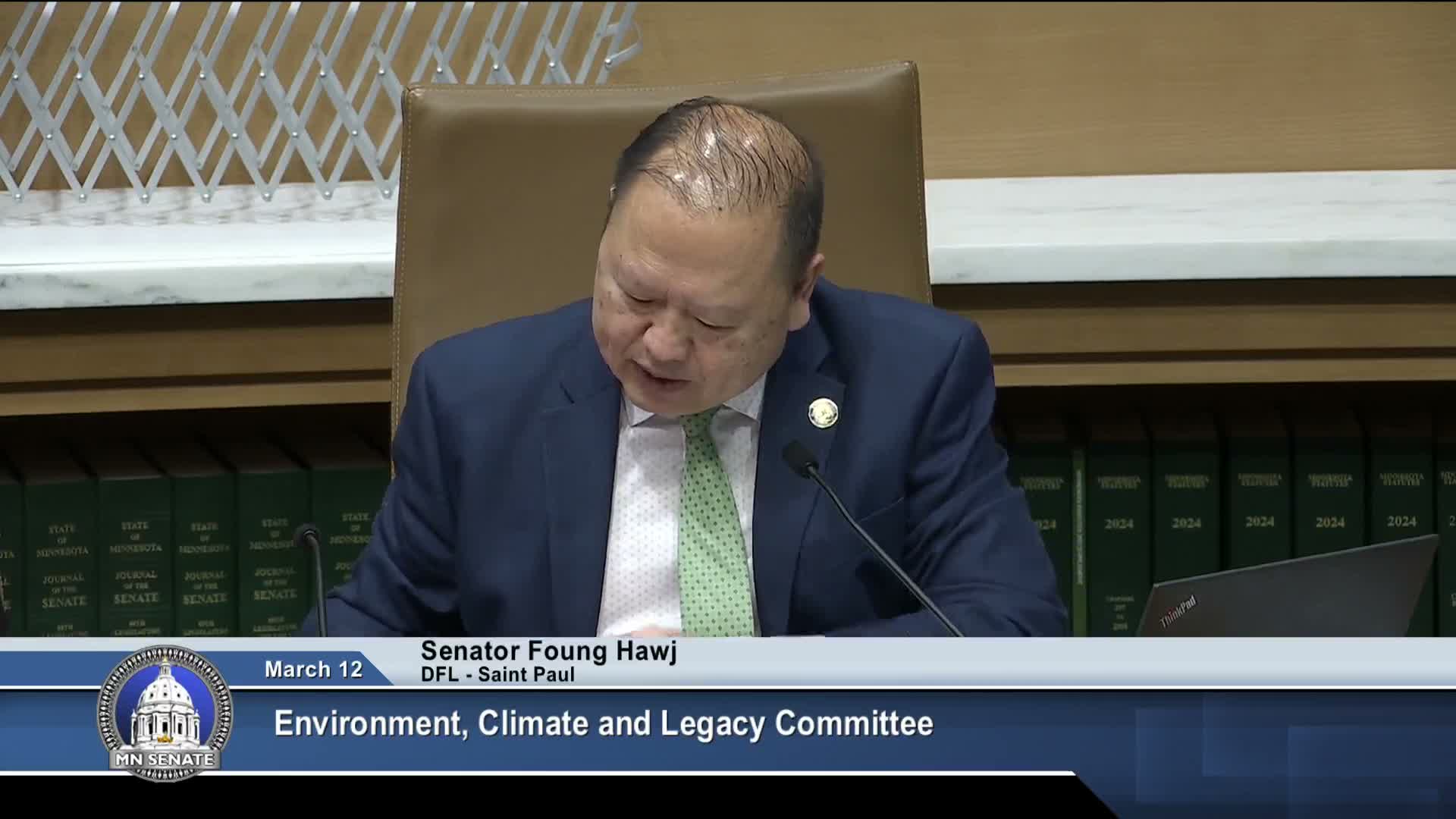
Summary
Sen. Pappas persuaded the Environment Committee to recommend passage of legislation increasing unannounced audits, internal audit requirements and tiered fines for generators who mix infectious waste with general trash. Supporters cited repeated worker exposure at the Ramsey Washington Recycling & Energy Center; hospital representatives urged scaling penalties to avoid bankrupting rural facilities.
Sen. Pappas urged the Senate Environment, Climate and Legacy Committee on March 12 to back a bill she described as ‘‘a pretty yucky bill’’ aimed at preventing hospitals and other generators from putting infectious and pathological waste into general municipal trash. The committee recommended passage of Senate File 41-87, as amended, and referred it to the Health and Human Services Committee.
The measure would require unannounced inspections of infectious-waste generators, mandate internal audits by generators, increase tiered fines for repeat offenders and provide funding for training and guidance on proper disposal, Sen. Pappas said. "The goal is for the fines to be high enough to compel infectious waste generators to do what the law already requires of them," she said.
Supporters said local facilities that handle municipal solid waste are seeing body parts, bloody rags and other hazardous material mixed into regular loads. Washington County Commissioner Carla Bingham, whose county sits on the joint Ramsey Washington Recycling and Energy (R&E) board, told the committee that workers face both infection risk and trauma when they encounter such material. "We need this waste to stop coming in. We need compliance. We need enforcement," Bingham said.
A longtime R&E employee, Brad Pracek, gave graphic examples from his 25 years on the job: "I've personally seen bones, flesh, hair and scalp matter and soft tissue that I can't identify. I've seen large quantities of blood items such as IV tubes, vials, filters and rags." Pracek said some loads required the facility to cordon off the tipping floor and bring in specialist crews, disrupting operations and adding cost.
Hospital representatives told the committee they share the goal of protecting workers and public health but warned the bill’s penalty structure is vague and could impose outsized burdens. Michelle Benson, representing the Minnesota Hospital Association, asked whether violations would be counted per load, per incident or aggregated over time and warned that, "for a small rural hospital, a fine of that size could jeopardize their ability to continue serving their community." She urged the committee to align consequences with existing regulatory frameworks and work collaboratively on training and compliance.
Kirk Koudelka, assistant commissioner at the Minnesota Pollution Control Agency, said the agency has active enforcement actions in some areas and supports a holistic approach combining education, targeted inspections and possible statutory updates. He noted additional inspections will require additional resources from the MPCA.
Committee members repeatedly pressed on detail and design: how violations would be defined and counted, how to avoid penalizing inadvertent single-item occurrences (diapers or menstrual products), and whether fines shared with receiving waste facilities could create perverse incentives. Several members suggested prioritizing regular audits and training with smaller escalating fines rather than immediately imposing very large penalties.
After discussion, the committee adopted the A1 delete-all amendment and, by voice vote, recommended SF 41-87 as amended to pass and be referred to the Health and Human Services Committee for further review, including fiscal details. The motion to recommend passage was moved by Sarah Kunis and the chair announced the motion prevailed.
The committee recording and witnesses show bipartisan concern for both worker safety at material-processing facilities and for the financial health of hospitals; members said they expect further drafting to clarify violation metrics, penalty thresholds and funding language before a final vote.