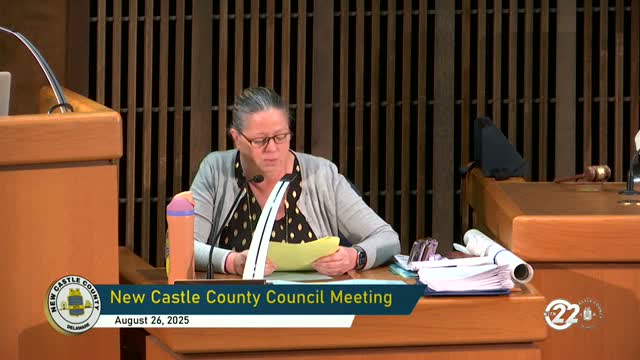
New Castle County council rejects formal auditor review of property reassessment after hours of public testimony
Loading...
Summary
After more than two hours of public comment and extended council debate about Tyler Technologies’ reassessment work, the New Castle County Council voted 6–7 to defeat Resolution R25-150, which would have asked the county auditor to review valuation methodology, data quality and the appeals process.
The New Castle County Council voted 6–7 on Aug. 26 to defeat Resolution R25-150, a measure that would have asked the county auditor to review the methodology, data quality controls and appeal procedures used in the county’s recent property reassessment.
Supporters of the resolution said it would provide an independent, documented review and reassure residents who reported large and, they said, inconsistent assessment increases. ‘‘We need to get to the bottom of why and how that happened,’’ said Jamila Davie, a Wilmington resident who urged the council to approve the resolution so the auditor could ‘‘summarize those findings and make recommendations’’ (public comment). Dale Swain, who testified earlier in committee, told the council the proposal would help correct ‘‘fallacies’’ and counter social-media misinformation.
Opponents, including several council members, argued the county auditor was already examining reassessment work and warned that passing the resolution would politicize the auditor’s office. ‘‘He reviews contracts and other things for us all the time without passing resolutions,’’ said a council member opposing the measure, adding that a targeted parcel-level review could violate uniformity requirements and invite litigation.
The meeting’s public comment period produced dozens of speakers. Residents described apparent data errors, unexplained multipliers and long waits for appeals. Several people said they saw neighbors receive wildly different assessment changes on the same street. ‘‘My taxes went up $800; other constituents’ taxes went up thousands,’’ a resident said during public comment. Multiple speakers asked the county to commission an independent audit or for the auditor’s office to document and publish a thorough review of the reassessment process.
Tyler Technologies, the outside firm that performed the reassessment, was repeatedly named by callers who said the company’s data or methods led to inconsistent valuations and that communications and appeal-handling had been inadequate. Speakers also cited lawsuits and other jurisdictions’ problems with the same vendor when arguing for further scrutiny.
Council discussion before the vote focused on whether a formal resolution would meaningfully change what the auditor was already doing. Sponsors said voting for R25-150 would send a clear message of council unity and put the review on the public record; opponents said the resolution risked creating the impression of an array of parcel-by-parcel fixes that the county could not legally perform.
The roll call on R25-150, as read by the clerk, recorded six yes votes and seven no votes; the resolution therefore failed. Councilmembers who voted in favor said they heard urgent concerns from constituents who lack time or resources to pursue individual appeals; those who voted against the measure emphasized legal and process limits and reiterated that an internal review was underway.
What happens next: the council left standing the auditor’s internal review and the appeals process now underway. Several public speakers urged the council to consider a separate policy to pause interest or penalties while formal appeals (thousands of which are docketed, speakers said) are adjudicated.
The meeting record shows the vote and extensive public-comment transcript; members of the public and representatives of the county’s auditor’s office may release further documents or findings as that review proceeds.