Get Full Government Meeting Transcripts, Videos, & Alerts Forever!
Get email alerts on the Climate Future topic
No spam. Unsubscribe anytime.
Portland highlights $4 million in grants and resilience work five years into Climate Future
Summary
Director Troy Moon reported the Climate Future joint plan with South Portland is 70% underway, has helped the city secure about $4 million in grants, advanced off‑site solar projects and implemented resilience policies including a coastal flood overlay with elevated critical infrastructure standards.
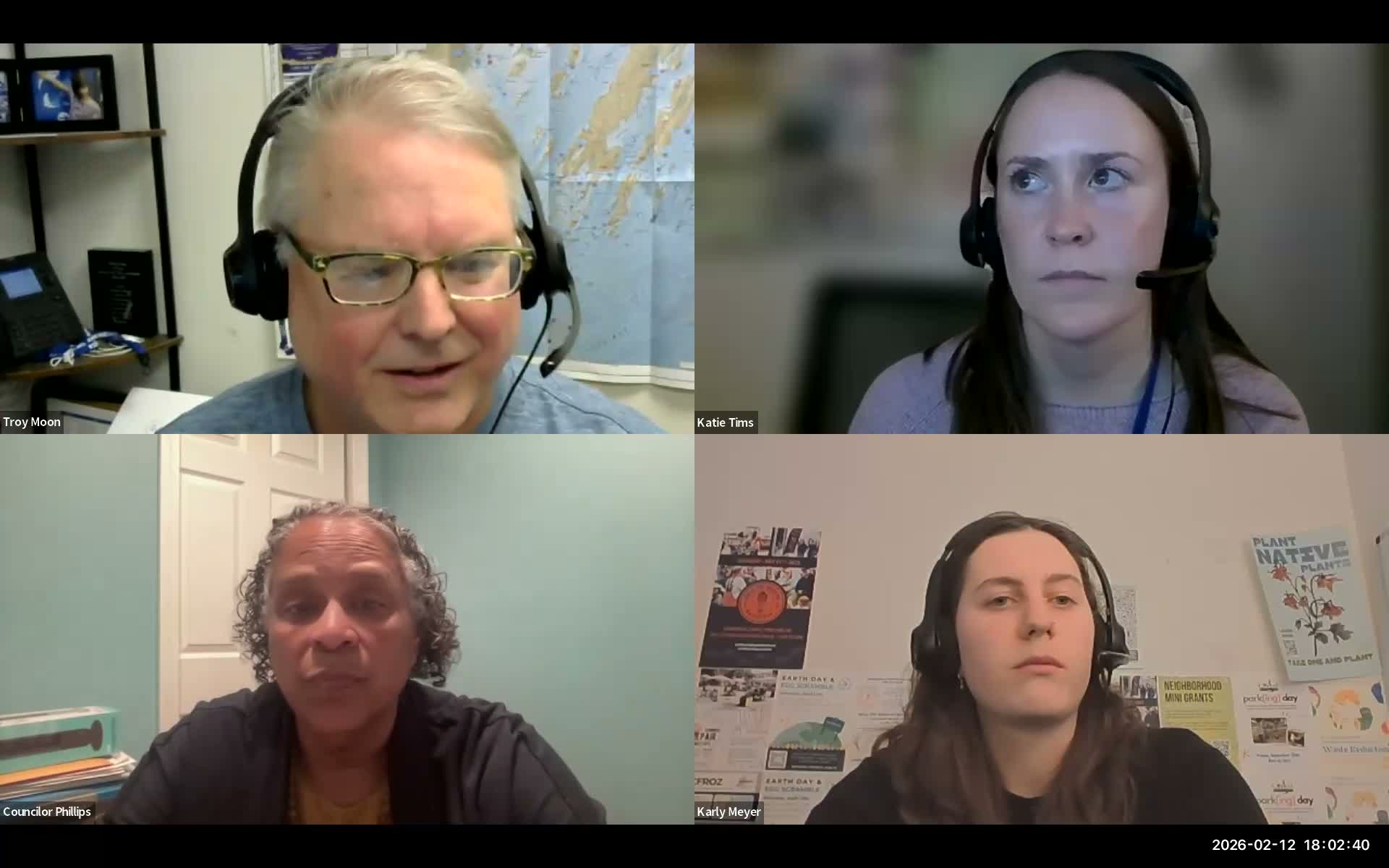
Troy Moon, director of sustainability, gave the committee a five‑year review of Climate Future (adopted 2020, a joint plan with South Portland). Moon said the plan contains 68 strategies across energy, buildings, waste, transportation/land use and resilience; roughly 70% of those strategies are underway in some form.
Moon reported the city has leveraged more than $4,000,000 in grant funding tied to climate initiatives, including about $2,000,000 for a water‑infrastructure project that will make Commercial Street more resilient to stormwater impacts. He described participation in about 21 off‑site renewable energy projects (solar and small hydro) that together produced roughly 43,000,000 kilowatt‑hours in recent years and yielded about $3,000,000 in avoided costs.
The update noted concrete policy steps: the council recently adopted a coastal flood resilience overlay that requires new critical infrastructure to have a design floor elevation of 14 feet, an expanded energy stretch code for new construction and an energy benchmarking program for large commercial buildings. Moon said the city now supports 44 EV charging stations (eight fast chargers) and is working with CMP and regional partners to expand benchmarking and grid resilience discussions.
Moon said the greenhouse‑gas inventory shows a 14% reduction in building‑sector emissions since the 2017 baseline, though transportation emissions have risen; overall community emissions are down roughly 5% from the earlier inventory. He emphasized that adaptation and resilience work will be central in the next phase of implementation and that staff are updating vulnerability assessments with new sea‑level rise models and social‑vulnerability data.
Councilors thanked staff for the progress and asked for continued engagement with state and utility partners on grid reliability. Moon said the city is an intervener in the utility expansion process and will remain engaged.
Next steps: staff will complete updated vulnerability modeling, develop a community resilience plan with location‑specific strategies, continue energy benchmarking expansion and pursue funding for resilience and infrastructure work.