Get Full Government Meeting Transcripts, Videos, & Alerts Forever!
Get email alerts on the Design Manual Adoption topic
No spam. Unsubscribe anytime.
Portland board adopts revised Historic Resources Design Manual and plans immediate online publication
Summary
The Portland Historic Preservation Board voted to adopt an amended Historic Resources Design Manual on March 5, 2026, after staff summarized a multi-year drafting process and 80 public comments. Staff said the adopted version can be posted online immediately and the manual will be maintained as a living document.
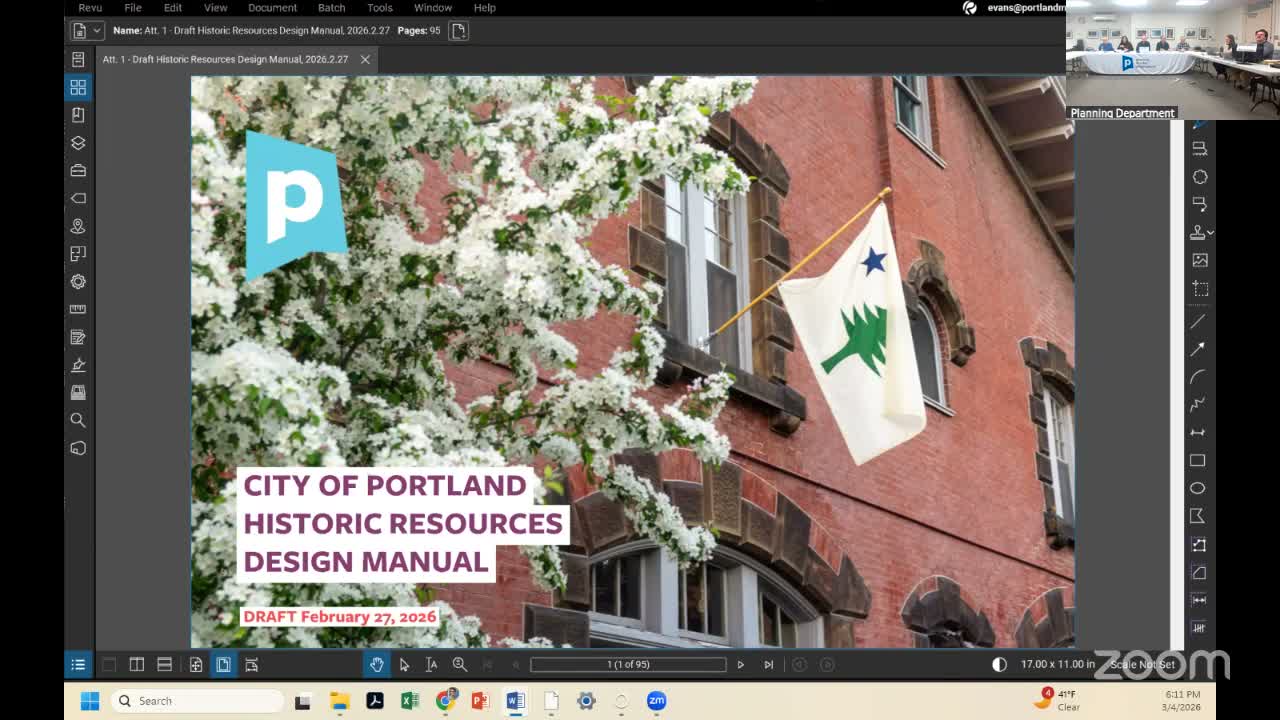
The Portland Historic Preservation Board voted to adopt an amended City of Portland Historic Resources Design Manual at its March 5, 2026 meeting, clearing the way to publish the revised 95-page manual online.
Staff told the board the document grew from a workshop in November 2024 through a series of 2025 workshops and a public review draft released in January 2026. The board packet included about 80 public comments; staff said most were constructive and had been addressed through edits and reorganization. Substantive changes highlighted by staff included reordering chapter 3 to place project types first, consolidating critical policy and regulatory references in chapter 1, streamlining graphics and pulling case studies to the end of each chapter to allow future updates.
Board members discussed usability features staff plans to add after adoption, including embedded hyperlinks in a downloadable PDF, options for printed copies for public purchase or board use, and an approach to keep the manual under periodic review so new case studies or clarifications can be added. Staff said if the board adopted the manual that night, the version could go live immediately and staff would continue technical work such as hyperlinking and making the document easier to navigate online.
A board member moved to adopt the amended manual pursuant to the relevant City of Portland land‑use code provision; another member seconded. The clerk called the roll and the board recorded affirmative votes from the members present. The motion carried and staff said they would make the adopted version available online and explore printed and web-based usability improvements.
Board members noted the manual’s benefits for homeowners and applicants—project-type one‑pagers and a fundamentals chapter that defines terms like “contributing” and “character-defining features” were highlighted as especially useful. Staff and members also discussed creating a process for periodic review to add case studies and correct typographical errors in future amendments.