Get Full Government Meeting Transcripts, Videos, & Alerts Forever!
Get email alerts on the Micromobility Rider Score topic
No spam. Unsubscribe anytime.
SPIN tells Nashville commission its rider-score visibility and parking tech reduced risky parking; pilots to expand
Summary
SPIN presented pilot results showing a rise in rider behavior scores after scores became visible in-app, described upcoming AI photo-review and Bluetooth-beacon pilots to curb improper parking, and pledged follow-up data to the Transportation Licensing Commission in Q2.
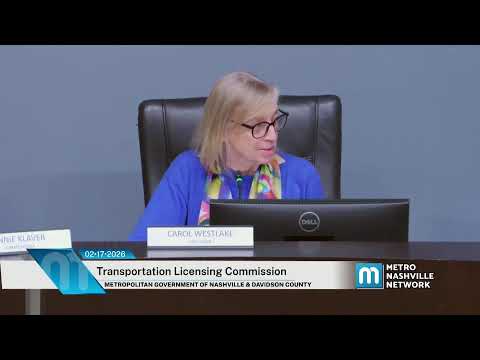
Jimmy Gilman, who leads government partnerships for SPIN, told the Transportation Licensing Commission that the company’s pilot of a rider-score system produced the largest behavior improvement when scores were made visible to users.
“we did see the bump when the scores became visible,” Gilman said, describing an initial visibility rollout in July–August and later targeted warnings. He told commissioners the dataset covered about 250,000 trips and 90,000 unique users during the July–December window and that roughly three-quarters of those trips in that period were identified as visitor trips; for 2025 the presenter said about 36% of users were locals or repeat users.
The company outlined how it classifies users for the analysis: regular users over a six-month window are treated as local/commuter users, occasional users have fewer trips in the period, and visitors have trips concentrated within a one-week span. Gilman acknowledged limitations of that method versus ZIP-code or account-based approaches and offered to provide additional breakdowns, including by device type, after the meeting.
SPIN described two parking-focused technologies it plans to pilot. First, an AI photo-review will verify parking photos in real time and can bar a rider from ending a trip if the system detects blocking a sidewalk or ADA access; Gilman said a small, randomized subset of users would see the feature within weeks to test false positives and user friction. Second, SPIN previewed Bluetooth beacons that can be sited at corrals to ensure trips can only be ended within the beacon’s signal, which the company said can be more accurate than GPS triangulation.
Gilman also described fleet changes: the standing scooter fleet is transitioning to the Spin 5 e-scooter, SPIN has added about 50 commuter e-bikes, and introduced a seated scooter model designed for riders with balance considerations.
Commissioners pressed for technical limits and enforcement. One commissioner asked whether the company can prevent wrong-way riding or running red lights; Gilman said geofencing and forced slowdowns can address no-ride zones and parking but that reliably disallowing wrong-way riding or running signals remains technically challenging and is not fully implemented.
“I cringe every time there’s a scooter parked in an ADA spot,” a commissioner said, urging faster deployment of tools to reduce blocking of accessible routes. Gilman responded that reducing those instances is a prime goal and characterized the new technologies as central to that effort.
Staff said procurement is moving forward on an RFP and that the RFP could be used to incentivize operators that deploy safety or behavior technologies; staff also noted coordination with WeGo MTA on the procurement process. Gilman offered to return to the commission in Q2 with updated data after SPIN has expanded visibility and tested the new interventions.
Next steps: SPIN will pilot the AI photo-review with a subset of users imminently, test Bluetooth beacons in a small pilot, and provide follow-up analysis to the commission later in Q2.