
Prosper council hears two-year review, staff recommends keeping 48/96 firefighter schedule
Get AI-powered insights, summaries, and transcripts
Subscribe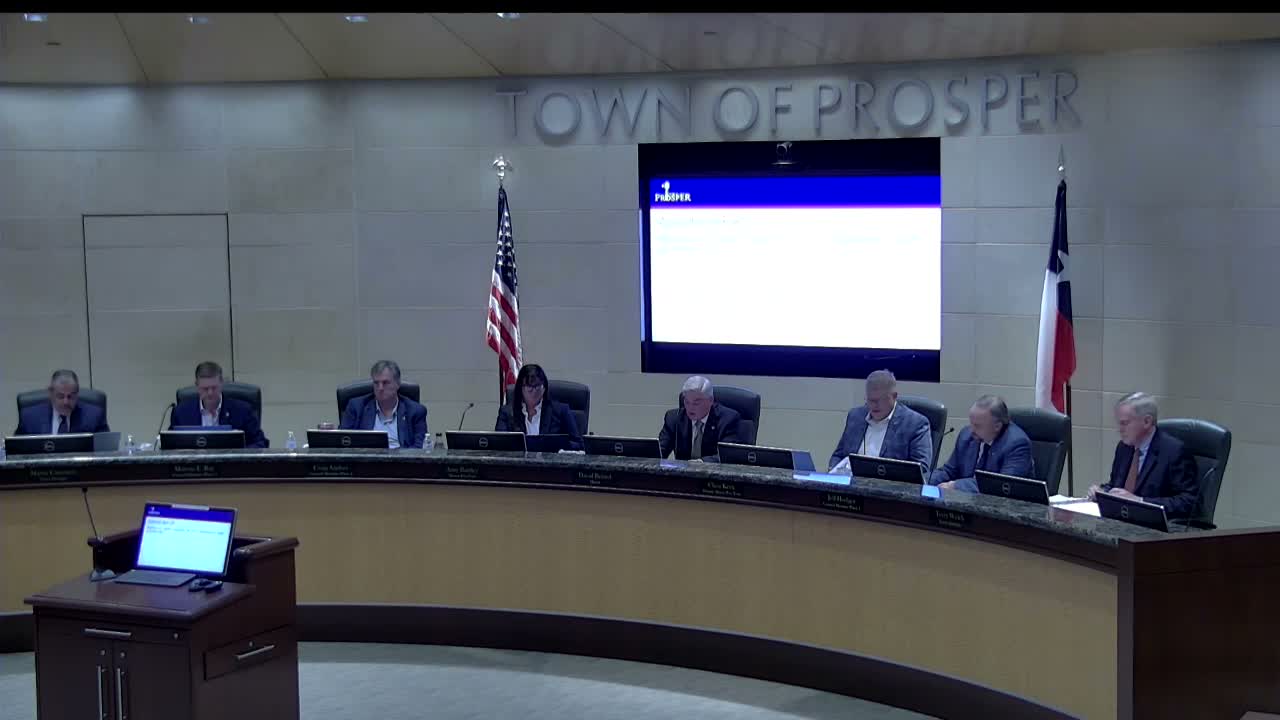
Summary
Fire Chief Blassingame told the Town Council that internal surveys and safety reviews support the department's 48/96 schedule; staff recommended adopting the schedule in full but the council took no separate formal vote to change policy during the meeting.
Fire Chief Blassingame presented a two-year review of Prosper Fire Department's 48/96 schedule (48 hours on, 96 off), telling the Town Council that the schedule's implementation on Jan. 6, 2024, has produced uniformly positive internal feedback and no clear safety problems tied to the shift pattern.
"We surveyed the firefighters' and a 100% asked to keep the schedule," Chief Blassingame said, adding that "a 100% reported feeling more rested, and 95% noticed improved teamwork and morale." He summarized safety metrics from the review: two reportable vehicle accidents over the past year (both described as minor), two minor medication errors in 2025 with no patient harm, and six work-related injuries, including one significant knee injury sustained on-scene at a May fire. Blassingame said internal reviews found no evidence the 48/96 schedule contributed to those incidents.
The chief also detailed operational impacts: an engineer-grade estimate of overtime and backfill hours tied to a long-term injury (about 2,845 hours in 2025), and the department's minimum daily staffing requirement of 23 personnel (rising to 26 when Station 4 opens). Blassingame said training hours were strong and noted that several area departments have adopted the 48/96 pattern.
"Our staff recommends no changes to the 48/96 schedule," he told the council, and when asked whether the council should continue revisiting the program or adopt it in full he replied that he believed the council should adopt it in full.
Council members asked clarifying questions about incidents, staffing and overtime but did not take a separate formal vote on altering the schedule during the meeting. The presentation will remain part of the council's public record for future deliberation as needed.
The chief's full presentation covered survey methodology, incident summaries and comparative metrics with neighboring departments; he offered to return for further questions.