Get Full Government Meeting Transcripts, Videos, & Alerts Forever!
Get email alerts on the Land Use Buffer topic
No spam. Unsubscribe anytime.
Portland committee sends competing theater-buffer options to planning board after heated debate
Summary
The Housing & Economic Development Committee voted 3–1 to ask the planning board to review both a 250-foot and the originally proposed 750-foot buffer between large performance venues after hours of testimony from city staff, neighborhood groups, developers and Live Nation supporters.
The City of Portland’s Housing & Economic Development Committee voted to send two competing proposals for a separation buffer between large performance venues to the planning board for review, after staff presentations and more than an hour of public comment.
Chair Pius Ali opened the discussion by framing the issue as a land-use question that must balance safety, circulation and downtown economic vitality. Planning Director Kevin Craft told the committee the earlier staff proposal would have established a 750-foot buffer for venues with capacity of 1,000 or more and cautioned that a fixed, large buffer could significantly limit siting options in the downtown arts district and run counter to the city’s comprehensive-plan emphasis on concentrating uses in transit-rich downtown areas.
Supporters of the larger buffer argued the measure would reduce crowding, parking stress and emergency-response risk. "Separating the venues will spread out this burden over a much larger area," said Martin Lodish, a longtime Peninsula resident who told the committee he supported the 750-foot proposal for safety and parking reasons.
Opponents — including the project’s developer and business groups — said expanding the buffer would be effectively targeted and retroactive. Todd Goldenfarb, developer of the proposed Portland Music Hall, said the project was filed more than a year ago and would comply with the city’s post‑recode rules. "This is a targeted retroactive zoning change," Goldenfarb said, calling retroactivity a dangerous precedent. Thomas O'Boyle, director of advocacy for the Portland Regional Chamber, warned that a 750-foot buffer “effectively functions as a barrier” on the peninsula and cited an Oxford Economics estimate presented to the committee that the proposed Live Nation venue could generate roughly $44,000,000 in annual regional economic impact and support nearly 500 jobs.
Other public commenters focused on operational safety and staging. Eric Hager, production manager for Portland Ovation, described a recent event when buses and trucks filled Myrtle Street and said there was not enough room for emergency response in the event of multiple simultaneous shows. Live Nation’s regional president, Ryan Vangel, said his company has operated much larger events safely in other cities and that the proposed 3,300-seat hall would be manageable with staggered arrival/exit times and coordinated logistics.
Several councilors said a narrowly tailored solution might address pedestrian and bus-staging concerns. Councilor Sarah McNovich proposed a 250-foot buffer that she said could reorient entrances to reduce pedestrian congestion without foreclosing downtown venues; others said site-plan and Traffic Movement Permit reviews already provide tools — such as loading-time restrictions and curb management — to address many operational concerns on a case-by-case basis.
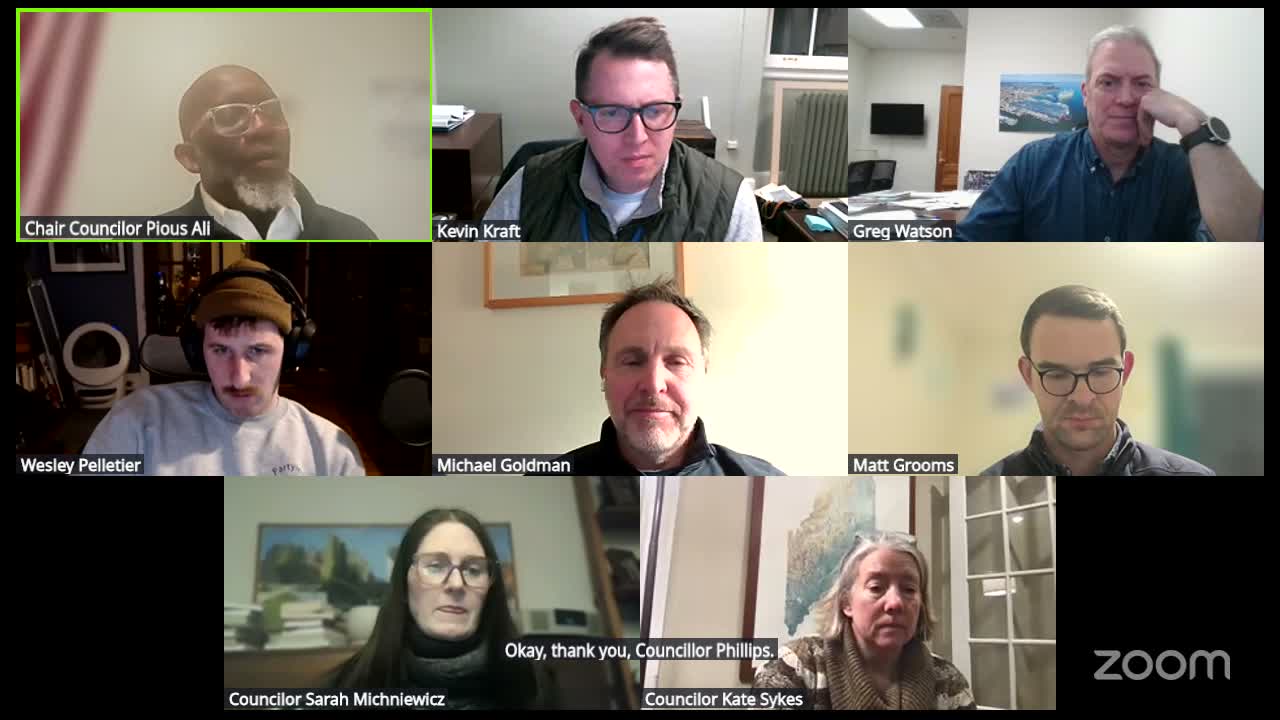
Corporation Counsel Michael Goldman advised the committee that it need not signal final approval of an ordinance to send questions to the planning board; members could ask the planning board simply to consider both the original 750-foot amendment and a 250-foot alternative and return recommendations to the council. The committee adopted that approach: the motion directing staff to ask the planning board to review both options passed in a roll-call vote with three yeses and one no.
What happens next: Planning staff said they will prepare materials and a planning-board workshop plus hearing(s) to allow full review; the planning board can recommend either option, an amendment, or no change before any council vote.
The committee’s action was limited to requesting planning-board review; no change to the land-use code was adopted at the meeting.