Get Full Government Meeting Transcripts, Videos, & Alerts Forever!
Get email alerts on the Public Safety topic
No spam. Unsubscribe anytime.
Taylor adopts ordinance restricting sitting, aggressive panhandling downtown after heated public comments
Summary
Taylor City Council unanimously adopted Ordinance 2025-33 regulating certain conduct downtown — including sitting, lying and aggressive panhandling — after weeks of outreach; supporters said businesses requested enforcement tools, while opponents argued the language criminalizes vulnerable people and urged alternatives.
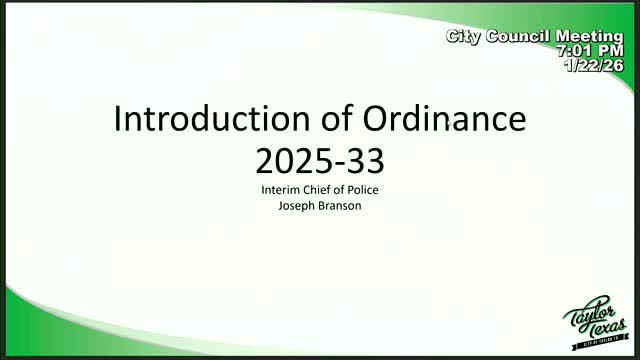
Taylor City Council voted unanimously on Jan. 22 to adopt Ordinance 2025-33, a city ordinance that defines and penalizes specified conduct downtown — including sitting, lying or sleeping in certain public areas and aggressive panhandling — and emphasizes complaint-based enforcement.
The measure was presented by Police Chief Branson, who told the council the ordinance is meant to give officers a narrowly drawn tool to keep sidewalks and pedestrian ways clear while preserving de‑escalation practices and referrals to social services. "It gives our officers a tool," Branson said, adding that officers are trained to recognize mental‑health and substance‑use challenges and to handle those encounters differently.
The ordinance text, as presented, spells out prohibited conduct and establishes penalties similar in function to a traffic citation; staff said enforcement would be complaint‑driven and that the ordinance would not criminalize a person's status. Several council members noted they had sought legal review; the chief said the proposal had been vetted by counsel and compared to similar ordinances adopted elsewhere.
Multiple residents and service providers urged the council to narrow or remove provisions that could criminalize ordinary public presence. Beth Rex, a Taylor resident, asked the council to remove the language criminalizing "sitting, laying, and sleeping in public," saying those acts are not crimes and that penalizing them stigmatizes people experiencing housing instability. "Those activities are criminalized — it sends a message that some members of our community are valued less than others," Rex said.
Felicia Graves, founder of Little Fireflies pediatric therapy, praised recent autism‑awareness training she provided to Taylor PD and urged caution about using enforcement as a substitute for housing and health services. "This training does not make policing the solution to homelessness or disability," Graves said, and she encouraged continued investment in mental‑health supports.
Other public commenters and some council members said business owners downtown had expressed strong support for the ordinance to address obstruction and safety concerns. In a motion to adopt, Councilwoman Long said the ordinance regulates conduct, not status, and referenced recent legal guidance. The motion passed on a voice vote recorded as unanimous.
The ordinance as adopted will be enforced in accordance with the conditions and training described by staff; council members and the chief said they intend to monitor impacts and coordinate with service providers going forward.