Get Full Government Meeting Transcripts, Videos, & Alerts Forever!
Get email alerts on the Housing Policy topic
No spam. Unsubscribe anytime.
Council endorses HGAC Clute Housing Vision study to inform zoning and comp-plan updates
Summary
The Clute City Council unanimously endorsed an HGAC housing vision study (resolution O1-2026) that presents conceptual options for Shanks Lake to address affordability, recommends policy and zoning changes, and calls for the study’s integration into the city's comprehensive planning process.
The Clute City Council on Jan. 8 unanimously approved a resolution endorsing a conceptual housing vision plan prepared by the Houston-Galveston Area Council (HGAC), a study the consultant described as a public-guided blueprint to inform future zoning and comprehensive-plan updates.
The endorsement (resolution O1-2026) directs city staff to integrate the HGAC recommendations into the city’s comprehensive planning work and supports the study’s submission for recognition by the Texas chapter of the American Planning Association.
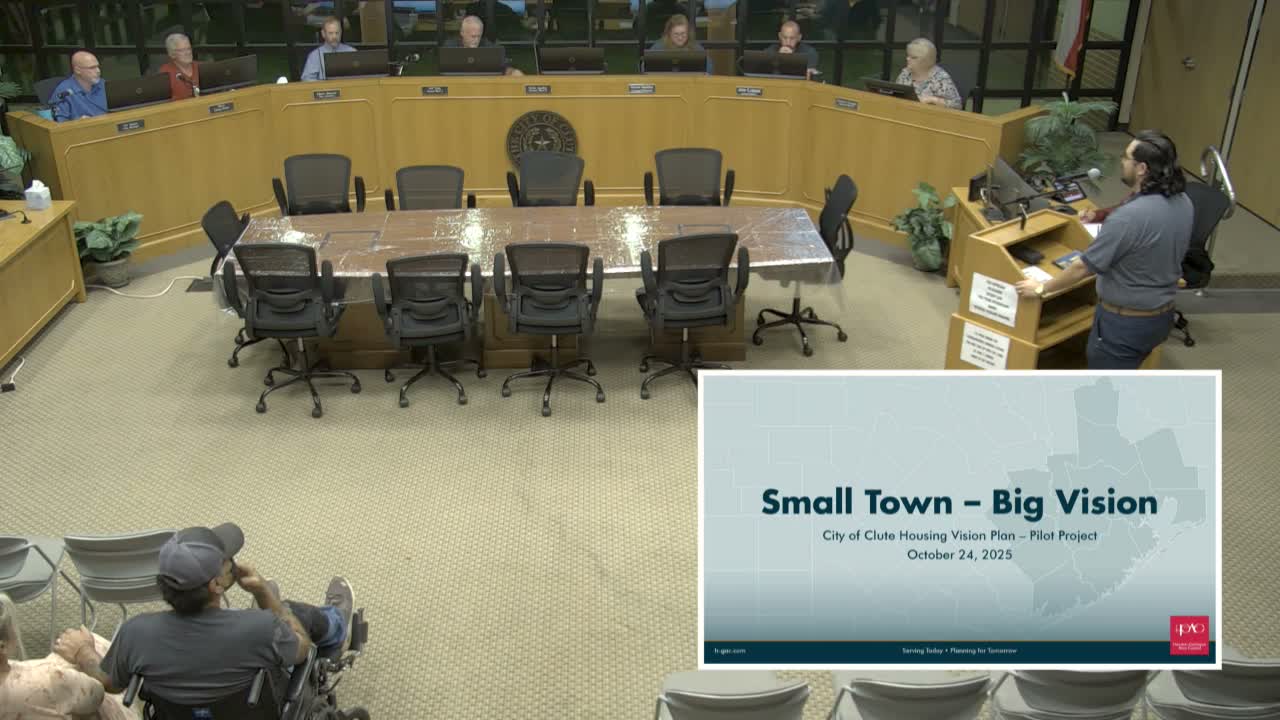
Jose Cantu, a senior planner at the Houston-Galveston Area Council, told the council the plan grew from the city’s 2023 livable-center study and extensive public outreach, including an open house and a booth at a community festival that drew “almost 300 folks.” Cantu said outreach produced roughly 500 responses overall and showed strong community preference for a cottage-court housing option over a side-by-side duplex model.
Cantu presented housing affordability measures the study used: median household income in the area is about $66,000, he said, and the report cites a change in median home price ‘‘from about $125,000 to $251,000’’ over five years. Using an affordability index (roughly 30% of net monthly income on housing costs), Cantu said a competitively affordable purchase-price target would be about $180,000; the report estimates per-unit construction costs in comparable projects at roughly $112,000–$200,000. He stressed the study is conceptual and intended to show what developers and residents prefer rather than to authorize immediate construction.
Council discussion emphasized that the plan does not obligate city funds or require the city to build housing. A council member noted the project is intended to be private investment guided by policy changes. “This is a concept,” Cantu said. “It is not city money.”
The resolution asks that recommended flexibility and policy language be incorporated into the city’s upcoming comprehensive planning materials and future amendments to the development code and zoning ordinance, steps the council must take before the concepts could be built. The council also directed staff to continue outreach and to return with any necessary implementing ordinance changes.
Why it matters: The study seeks to expand housing choices and affordability in Clute by suggesting smaller-lot infill patterns and design options that residents favored. If the city adopts the recommended code changes, the measures could make it easier for smaller, lower-cost homes to be developed on infill parcels, but any proposal would still require formal ordinance changes and permitting processes.
The council passed the resolution O1-2026 by voice vote; the study will be included in the comprehensive-plan process for future zoning and development-code amendments.