Get Full Government Meeting Transcripts, Videos, & Alerts Forever!
Get email alerts on the Public Safety topic
No spam. Unsubscribe anytime.
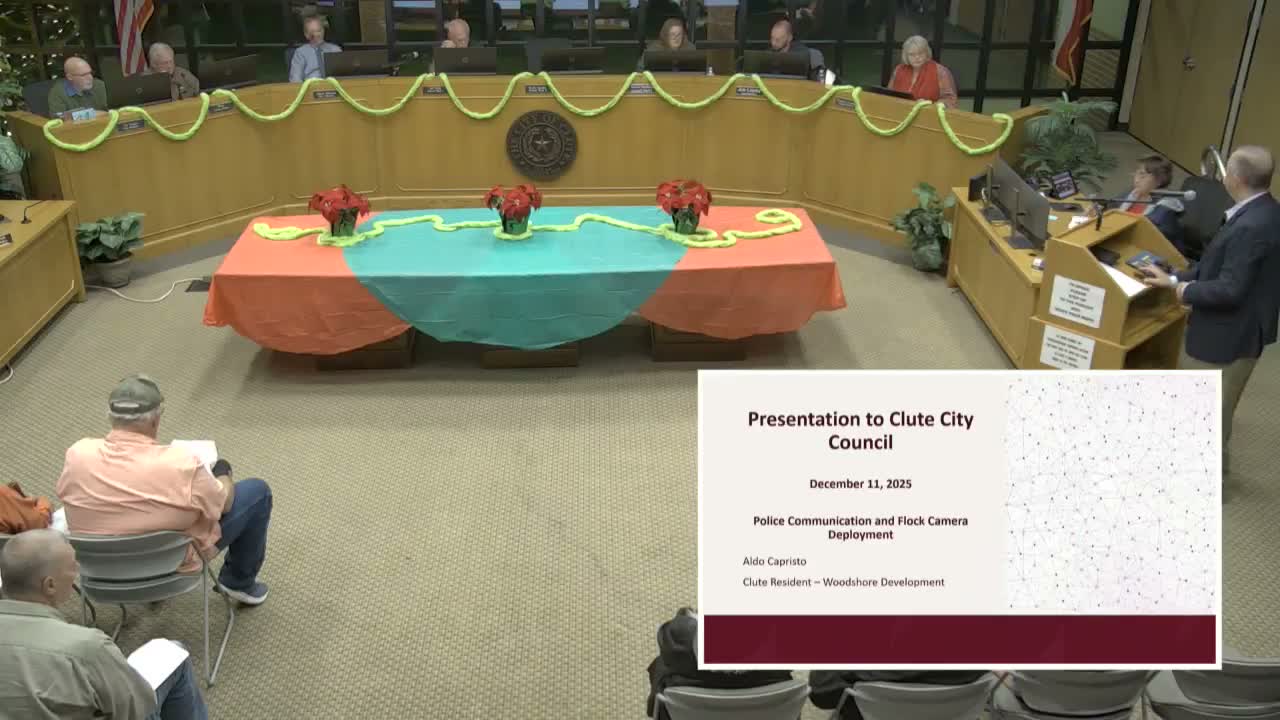
Woodshore residents press for clearer police communication; council hears plan for grant-funded license-plate readers
Summary
Aldo Capristo and other Woodshore residents urged the police to provide clearer public information after gunfire in the neighborhood; police and staff described a recent grant procurement of LPR cameras aimed at auto and catalytic-converter theft, explained placement strategy and said the cameras are investigative tools rather than proactive neighborhood monitors.
Woodshore residents told the Clute City Council they want faster, clearer information from the police after an incident that involved gunfire near homes, and asked that the department use existing channels to reduce rumor and community anxiety.
"There was an extended police presence in the community and there was not any communication from the police department about what happened," Aldo Capristo said, urging the city to use social media or targeted text alerts when it is appropriate to do so. Capristo said speculation on Facebook had suggested a "drive-by" shooting and that official information could have limited misinformation.
Police Chief (self-identified at the meeting) acknowledged the concern and described the investigative findings in the Woodshore case: review of about 15 videos suggested no vehicles or pedestrians passed the house during the relevant period and that evidence points to shots fired into the air from another neighborhood. The chief said the department is weighing thresholds for issuing press releases and invited residents to contact him directly with questions.
On cameras, the city received grant-funded license-plate-reader (LPR) systems intended to help investigate auto theft and catalytic-converter theft, officials said. The system includes several stationary cameras and a trailer unit that can be moved to hotspot locations. Staff said initial placements target entrances into town and that deploying a unit on the state right-of-way at 288B requires TxDOT permission. The police chief said the cameras are primarily reactive investigative tools: "They're an investigative tool, for, unfortunately, crimes that have already been committed," he said.
Capristo asked that future deployment decisions be made in public and consider prevention as well as investigation. The chief said placement decisions reflected the grant's purpose and that the trailer has been used at a local hotel to reduce a drug-trade problem.
What happens next: The police chief invited residents to call or email with concerns and said the department will continue to evaluate when to issue public notifications in the interest of balancing investigative needs and reducing misinformation.