Get Full Government Meeting Transcripts, Videos, & Alerts Forever!
Get email alerts on the Comprehensive Plan topic
No spam. Unsubscribe anytime.
Clute holds public hearing on GLO-funded comprehensive plan, residents press for sidewalks, pool fixes and zoning changes
Summary
Consultant Donald Brinkman presented draft goals and objectives for a GLO-funded comprehensive plan emphasizing safety, simplified land-use and resilience; residents urged funding for sidewalks and sewer, questioned pool repair vs. conceptual kayak inlet, and developers and staff discussed how the plan enables future zoning changes and grant eligibility.
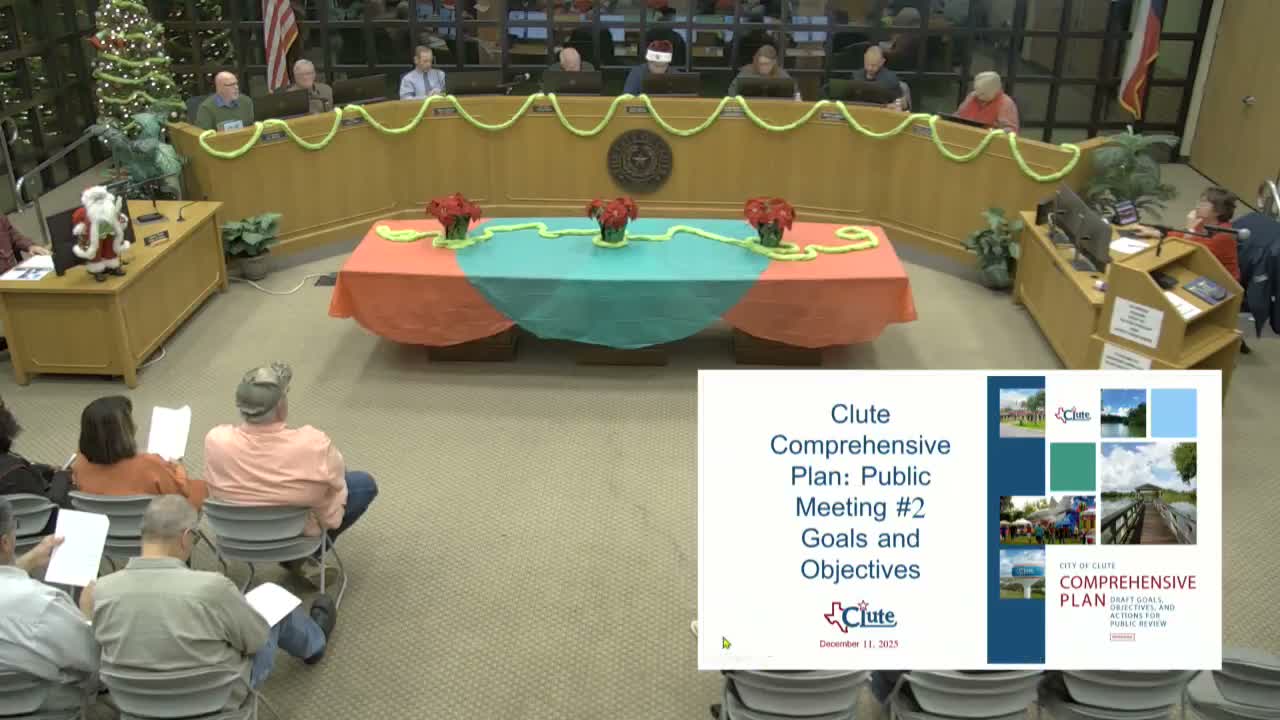
Clute officials and residents spent much of the Dec. 11 meeting discussing a draft comprehensive plan funded by the Texas General Land Office (GLO). Consultant Donald Brinkman of CSR/Westwood told the council the project is 100% GLO-funded and aims to set a 15–20 year vision with goals, objectives and an implementation strategy informed by stakeholder meetings, baseline studies and a public survey.
"Core purpose is to create a resilient community," Brinkman said, outlining draft goals that include improving safety and cleanliness, modernizing land-use and development processes, creating family-oriented places, and strengthening resilience for extreme weather. He cautioned that the plan images are conceptual and that environmental permitting and budget constraints will affect final designs.
Residents used the public-hearing forum to press for concrete infrastructure work. Several speakers urged improved lighting along State Route 288B and said TxDOT controls corridor lighting; staff said the city has requested TxDOT review for additional lighting due to a history of fatalities on the corridor. Other residents called for sidewalks, drainage repairs and faster utility responses in neighborhoods they described as neglected; staff said the CIP contains funding to begin sidewalk and sewer improvements in prioritized zones, and that code enforcement capacity was recently increased with a second officer.
On recreation, residents asked why the municipal pool is not being restored. Staff said bringing the pool up to current state code would cost about $4,000,000 — roughly 30% of the city's annual budget — and that smaller, less-expensive options such as a $400,000 kayak inlet were conceptual alternatives. "These are conceptual ideas that came out of public feedback," staff said, adding the council has asked staff to explore pool-funding options.
The plan also includes actions to modernize zoning and land-use rules to permit smaller infill lots and more flexible development types. Staff said a required comprehensive plan is a legal prerequisite to changing the city's antiquated zoning and development ordinances, and that HGAC's housing work suggests market price points for affordable products in older parts of town.
Developer Doug Kamaka, who said he developed Woodshore, urged community engagement and market-driven planning, citing Erie, Pennsylvania, as an example where a plan helped revitalize the downtown. "It starts off with a plan," Kamaka said, urging long-term commitment to realize catalytic projects.
What happens next: The draft goals and objectives remain open for public feedback (the survey remains active). Staff and the consultant will synthesize comments into a draft comprehensive plan and proceed to map and zoning updates; the council emphasized the process is iterative and that public input will be considered before any ordinance changes are proposed.