Get Full Government Meeting Transcripts, Videos, & Alerts Forever!
Get email alerts on the Rezoning topic
No spam. Unsubscribe anytime.
Cedar Park planning commissioners unanimously recommend industrial zoning for 1199 Fire Lane with conditions
Summary
The Planning & Zoning Commission recommended changing the future land use and rezoning 25.9 acres at 1199 Fire Lane to light industrial conditional overlay to allow about 265,000 sq ft of shallow-bay industrial buildings. Staff and the developer proposed limits on building size and outdoor uses; commissioners pressed for traffic, noise and stormwater safeguards.
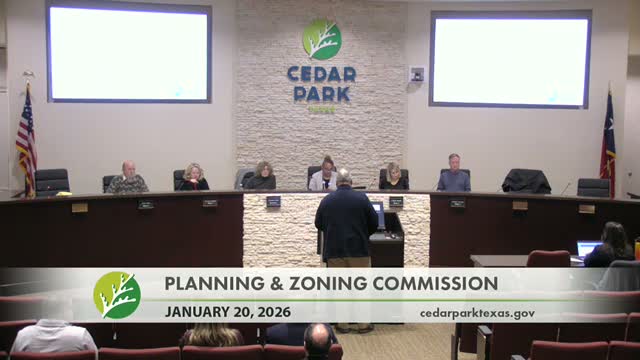
The Cedar Park Planning and Zoning Commission on Jan. 20 recommended that City Council approve a future land-use amendment and a rezoning to allow light industrial development at 1199 Fire Lane, a 25.9-acre site near Brushy Creek Loop and the 183A toll corridor.
Dustin Henry, development services, told the commission the applicant seeks to change the future land-use designation from regional office/retail commercial to industrial manufacturing and to rezone the parcel from general business conditional overlay to light industrial conditional overlay. "The applicant is proposing to develop approximately 265,000 square feet of an industrial development," Henry said, and staff recommended approval with a conditional overlay that limits certain uses, caps building size and controls loading-dock orientation to increase compatibility with neighboring uses.
Ethan Harwell, a planner with Kinley-Horn representing Headwater Development, said the concept plan shows multiple shallow-bay industrial buildings ranging roughly from 50,000 to 83,000 square feet that would target advanced-manufacturing, defense, aerospace and clean-energy users. "We do not expect to have kind of those 'dirty nuisance' uses," Harwell said, adding that the design places loading docks interior to the site and proposes restrictions on outdoor storage to reduce noise and visual impacts.
Commissioners pressed staff and the applicant on several specific points. One commissioner asked how noise would be regulated beyond the citywide ordinance; staff pointed to Chapter 8 and said the police department enforces noise standards. The commission asked for a clear distinction between light and general manufacturing; staff read the definitions on the record, saying light manufacturing involves fabrication or assembly from previously prepared materials while general manufacturing involves processing from raw or extracted materials.
Traffic and circulation around the proposed Little Elm Trail extension and its connection to a new service road to 183A drew repeated concern. The applicant described two preferred truck routes that rely on a service road and frontage-road connections and said the developer expects only a small share of total trips to be trucks. The presentation noted a planned 70-foot right-of-way for the Little Elm extension with three travel lanes and a 12-foot shared-use path; the project team also said they are coordinating on funding and design with the city's economic development group and that some roadway costs would be development-driven.
The applicant acknowledged the site sits above the Edwards Aquifer recharge zone and that the civil engineer will design water-quality measures required to prevent untreated runoff into Brushy Creek. Commissioners asked for topo maps and additional detail on vehicle maneuvering and potential trailer or outdoor storage, and the applicant said targeted tenants typically would not need substantial outdoor storage and that city standards cap outdoor storage and require screening.
After discussion, a commissioner moved to recommend approval of the future land-use amendment; the motion passed unanimously on roll call. The commission then voted unanimously to recommend the related rezoning to the light industrial conditional overlay, with the conditional-overlay provisions discussed in the packet (including a roughly 85,000-square-foot limit on building size, prohibited uses and limits on loading-dock orientation).
The staff presentation noted there are no single-family homes within 500 feet of the subject property and that prior residential proposals for the site did not advance in part because of the cost to construct the Little Elm roadway improvements. The Planning and Zoning Commission forwarded its recommendation to City Council; Dustin Henry said the two items will appear for a first reading and public hearing at Council on Feb. 12.
The commission also received administrative updates about upcoming council workshops and assigned commissioners to attend council meetings on Jan. 22 and Feb. 12. The meeting adjourned with no public comments submitted for the hearing.