
Residents urge House panel to back bill requiring DOT to respect local airport buffers; DOT cites safety and FAA limits
Get AI-powered insights, summaries, and transcripts
Subscribe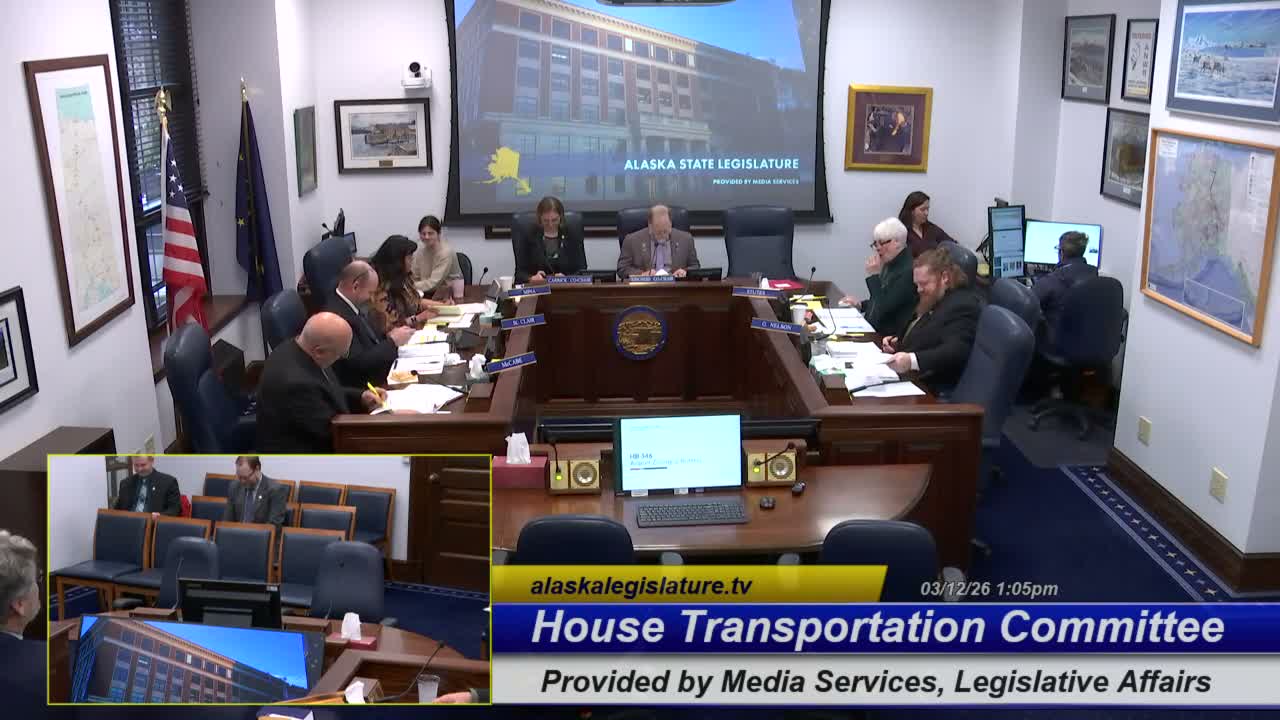
Summary
Residents near the Girdwood Airport urged the Alaska House Transportation Committee to pass House Bill 346 so the Department of Transportation and Public Facilities must follow municipal buffer rules; DOT officials said safety and FAA grant-assurance obligations limit how the state can be constrained.
Representative Kai Holland introduced House Bill 346 to the House Transportation Committee on March 12, saying the bill would require the Department of Transportation and Public Facilities to “comply with local planning and zoning jurisdictions to maintain buffers between the airport and adjacent land use.” The sponsor said the change is intended to preserve vegetative or constructed buffers where local ordinances already require them, not to force new buffers where none exist.
Aidan Nickel, staff to Representative Holland, told the committee the bill responds to a statutory ambiguity between the Airport Zoning Act and Title 35 planning provisions. He said a 1996 Attorney General memo had been interpreted to make DOT the controlling authority for airport property, but the bill would require DOT&PF to follow local ordinances that mandate buffers between airport operations and nonindustrial (residential) land unless removal is needed to address a safety hazard, in which case the bill would require notice, opportunity to comment and mitigation where possible.
Two residents from Girdwood gave invited testimony. Camilla Seifert said she has lived on Lake Tahoe Road since 1981 and described a recent state action that created a new lease lot and placed a 30-foot, 4,800-square-foot metal hangar a few paces from her back door, converting what had been a vegetated, de facto buffer into industrial property. “The new perimeter fence is a few paces from my back door,” Seifert said, and she urged the committee to consider HB 346 to require DOT&PF and Aviation Leasing to comply with local ordinances that require vegetated or constructed buffers between airport and adjacent nonindustrial property.
Neighbor and Alaskans for Responsible Airport Development board member Steve Halverson said the new lease lot was created outside the airport’s former security fence and, he said, outside the existing airport layout plan without a public process. Halverson said the change allowed a commercial helicopter operator to locate at the south end of the airport nearer to houses than the master plan anticipated. “This new development is indeed outside the former security fence,” Halverson said, and he described ARAD’s formation to give nearby residents a voice in airport development.
Committee members asked whether the bill would be retroactive or require existing airports to add buffers. Holland said the intent is not to force retroactive construction of buffers or create large unfunded obligations; rather the bill targets future airport development that would remove or reduce buffers that otherwise would remain. Representative Stutes, noting his review of fiscal materials, said the bill’s potential costs gave him pause.
Britton Goldberg, chief of leasing for Central Region Aviation Leasing at DOT&PF, told members the department administers authorities established in the Airport Zoning Act and maintains master plans that are guidance documents, some decades old. Goldberg emphasized the department cannot allow anything to impact airport safety and that any buffer established by the legislation would be on state-managed property; he warned of possible conflicts with FAA grant assurances and DOT’s ability to act quickly to address direct and immediate safety hazards. “We can’t allow anything to impact the safety of the airport,” Goldberg said.
Members suggested alternatives ranging from improved DOT-community consultation to selling or transferring airports to municipalities; some members said hangars and other structures can act as practical noise buffers while others worried the bill could invite legal challenges with federal regulators. Staff and the sponsor said the bill deliberately took a narrow approach, focusing on buffers and public process rather than a broad rewrite of airport planning law, and that language about notice and timing could be clarified before further action.
The committee set the bill aside for now. Chair Representative Eisheide closed the hearing, noting the committee’s next meeting is scheduled for March 17 at 1 p.m.; the meeting adjourned at 2:07 p.m.