
Researchers pitch low‑cost profilers, AI and stream cameras to give managers near‑real‑time fish counts
Get AI-powered insights, summaries, and transcripts
Subscribe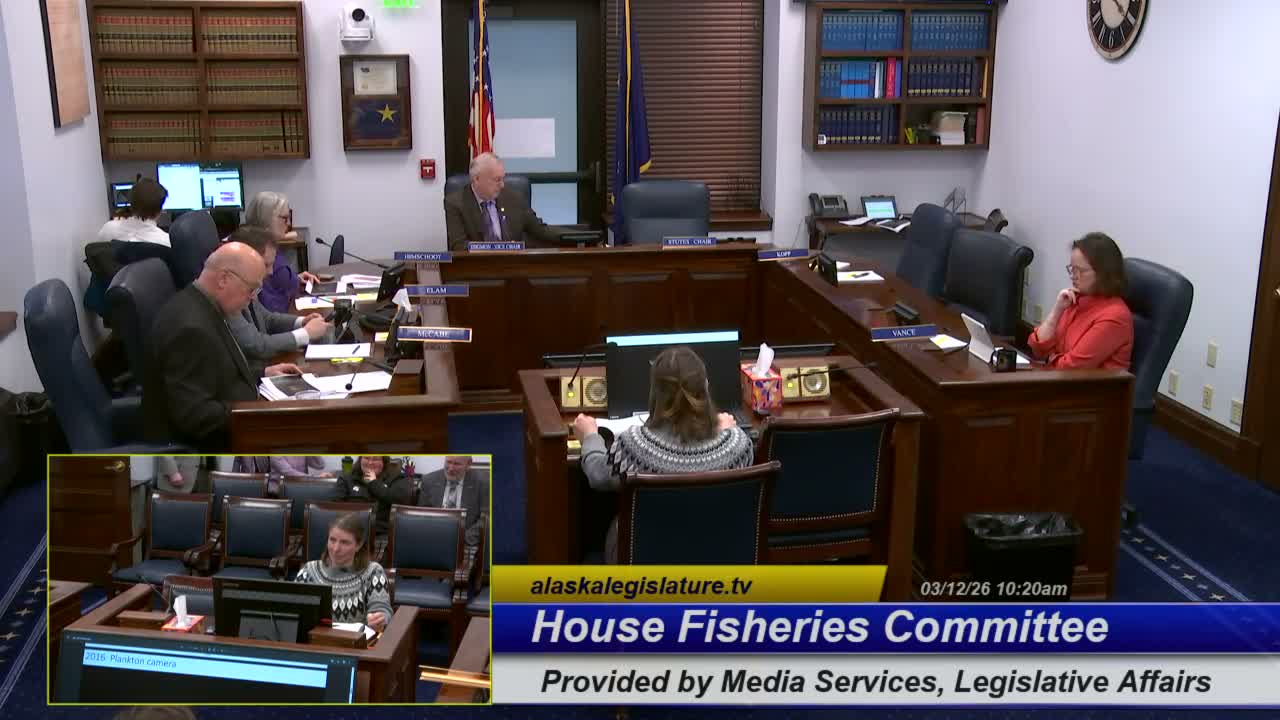
Summary
The Prince William Sound Science Center asked the fisheries committee to consider investing in low‑cost profilers, plankton cameras, AI‑based scale aging and stream cameras/sonar as cheaper, faster alternatives to traditional weirs and to improve in‑season fisheries decision making.
Dr. Rob Campbell told the Special Committee on Fisheries the Science Center is developing lower‑cost monitoring tools that could provide fisheries managers near‑real‑time environmental and fish‑count information.
Campbell said the center received a congressionally directed funding request with help from Senator Murkowski to develop a low‑cost profiler (referred to in the presentation as AMPRA 2) built from off‑the‑shelf parts so units could be manufactured for a few thousand dollars apiece rather than costing tens of thousands to operate per site. "A WEIR costs something like 50 to $75,000 a year to run," Campbell said. "Our systems are just off‑the‑shelf hardware... you can build one for a few thousand bucks." He noted the largest remaining costs are software development and data transmission.
The center has added a plankton camera to its profiler (2016) and used machine‑vision AI to classify millions of plankton images into 43 classes. Campbell described an AI trained to age salmon scales that performed comparably to human readers in tests; the team identified an archive of about 800,000 scales at the University of Washington they hope to scan to further improve models.
Campbell also described stream cameras with onboard processors and sonar experiments (including a Copper River project) as lower‑cost ways to estimate fish passage in clear and turbid systems, respectively. He said stream cameras are effective in clear water while sonar is better for highly turbid rivers such as portions of Bristol Bay and certain stretches of the Copper River.
Committee members urged the center and the department to compare systems and consider pilot investments. Representative Vance suggested the committee explore whether the Alaska Department of Fish and Game already has similar measures and recommended evaluating potential return on investment in the next budget cycle. "It would be very prudent of us to see if it's worth investing in this work," Vance said.
Campbell emphasized the need for faster data: currently, many sample‑processing workflows can take months to a year (for plankton counts), which puts managers behind; automated profilers, cameras and AI could produce actionable indicators within the season. The committee did not take formal action but discussed potential follow‑up on funding and partnerships to pilot technologies and integrate data into management workflows.
No formal motions or votes occurred during the session.