
House Finance Committee presses Division of Elections on SB 64 implementation, rural impacts and data sharing
Get AI-powered insights, summaries, and transcripts
Subscribe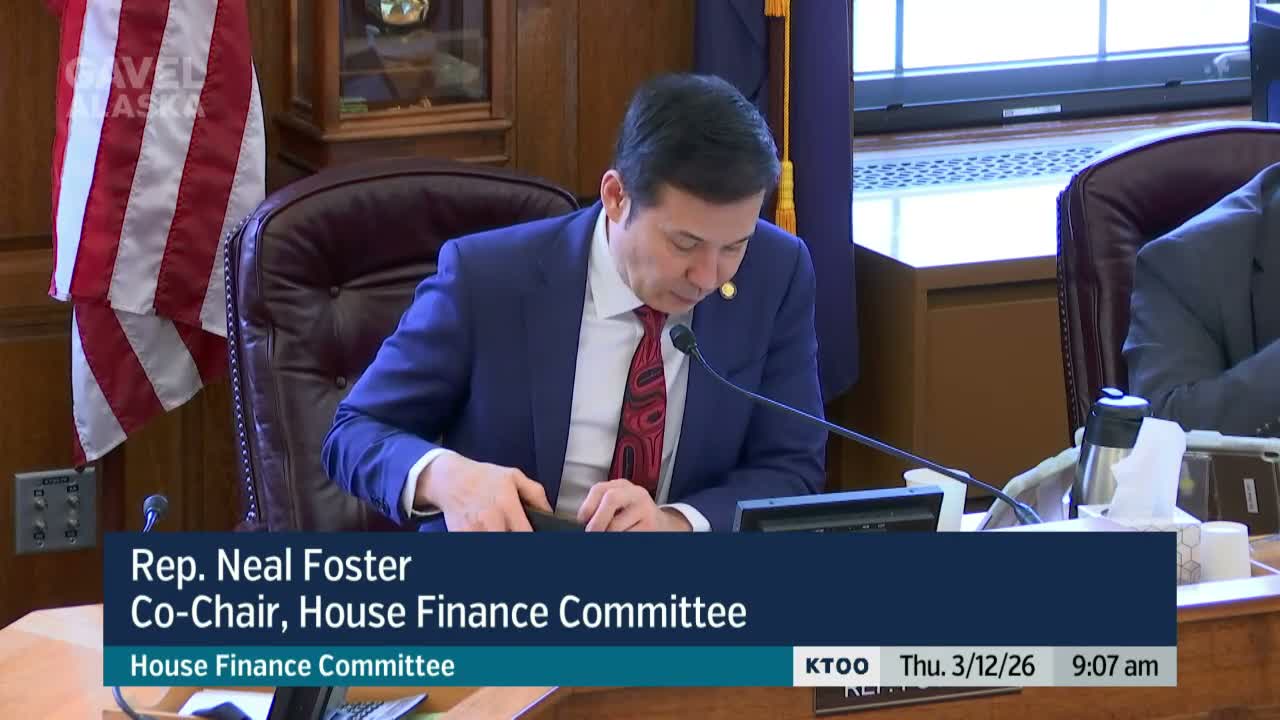
Summary
At a March 12 hearing on Senate Bill 64, the House Finance Committee focused on feasibility of an online ballot-tracking and ‘cure’ system, privacy and data-sharing (SAVE/ERIC/PFD) and practical obstacles for rural Alaskans. Division of Elections staff said an automated system could not be ready for the August 2026 primary and estimated under 1,000 curable absentee ballots statewide.
ANCHORAGE — The Alaska House Finance Committee spent more than an hour March 12 questioning whether Senate Bill 64’s new ballot-curing and tracking requirements can be implemented in time for the 2026 primary, and what the changes would mean for voters in rural communities.
Cochair Foster opened the hearing by inviting Sen. Bill Wilikowski, the bill sponsor, and Division of Elections staff to answer questions about timing, technology and data sharing. Sen. Wilikowski told the committee he had no opening comments and was available to take questions.
The committee’s first line of inquiry focused on how and when voters would be notified if an absentee ballot has a curable defect. "Within 24 hours of the ballot being reviewed, the director is required to notify if they have a phone number and email for the voter, to inform the voter, and then within 48 hours, to mail the deficiency notice," said David Dinsmore, staff to the senator, summarizing the bill’s notice timeline.
Carol Beecher, director of the Division of Elections, described how absentee ballots are handled in regional offices and by regional absentee review boards. "The ballots as they come in, the regional supervisor makes a determination essentially based on the volume of the ballots that come in," Beecher said, explaining that some regions (Anchorage) convene boards more frequently than very small communities.
Committee members pressed whether the bill should set a required cadence for regional reviews. Beecher said the division prefers flexibility: "If there were set times requiring the review, that would require us to pull in the boards to review when there may be just a few there to review, which would be a waste of their time."
A central implementation dispute was the bill’s effective dates and the feasibility of building an online, mobile-friendly ballot-tracking system before the August primary. Beecher warned the committee that the Division could not develop, procure, test and deploy a reliable system in the 49 days between a July 1 effective date and the primary. "It would be extremely difficult, if not impossible, for the division to implement something that was tested, that was reliable and that we made sure that the public knew that it worked properly because the time frame is so short," she said.
Beecher said the Division could attempt a manual cure process in 2026 — calling, texting and mailing voters — but cautioned that rural mail transit and limited phone coverage make the bill’s 10-day post-election cure window problematic in some areas. Committee members noted that for remote communities, mail can take many days to arrive and return. "If the division has five days in which to mail something… it could take five days to get there," Beecher said, adding that phone contact rates in remote precincts can be very low.
Committee members also asked whether the Division has an estimate of how many absentee ballots would require cure. Beecher said the Division’s estimate based on 2024 general-election data is "there were probably under 1,000" curable items statewide.
Privacy, verification and federal data queries were another focus. Section 8 of the bill would require use of the federal SAVE (Systematic Alien Verification for Entitlements) system for certain citizenship verification checks. Beecher said some states report SAVE manual-review times of up to 30 days: "My understanding is it's taking them about 30 days to manually review those records." She added the Division is not currently an SAVE MOU partner and does not view SAVE as a critical tool for detecting noncitizens but described it as "another tool" that could be consulted.
Representatives also questioned data sharing with ERIC (Electronic Registration Information Center) and the Permanent Fund Dividend (PFD) program. Beecher confirmed Alaska participates in ERIC and explained that ERIC receives hashed voter and DMV data from states and returns matches; she also said the bill’s PFD changes would alter what the Division receives from the PFD application and that sponsors should clarify those provisions to avoid unintended implementation consequences.
Several lawmakers urged statutory changes to address rural equity — asking whether notice windows or cure methods could be modified so remote voters would have a realistic opportunity to respond. Beecher said equal treatment across Alaska would be difficult without moving curable ballots earlier in the process or delaying election-day deadlines.
After extended questioning, Cochair Foster set SB 64 aside for continued consideration at 9 a.m. the next day. The committee also noted an amendment deadline and said staff and sponsors would refine language and follow up on technical concerns.
What’s next: SB 64 was set aside with the intent to reconvene. The committee will revisit the bill with Division staff and the sponsor, and members indicated they will seek clarifications on effective dates, cure timing, PFD data provisions and whether a phased or manual approach should be specified for 2026.