
Yukon River fisheries group warns of steep Chinook declines, outlines local training and drone monitoring plan
Get AI-powered insights, summaries, and transcripts
Subscribe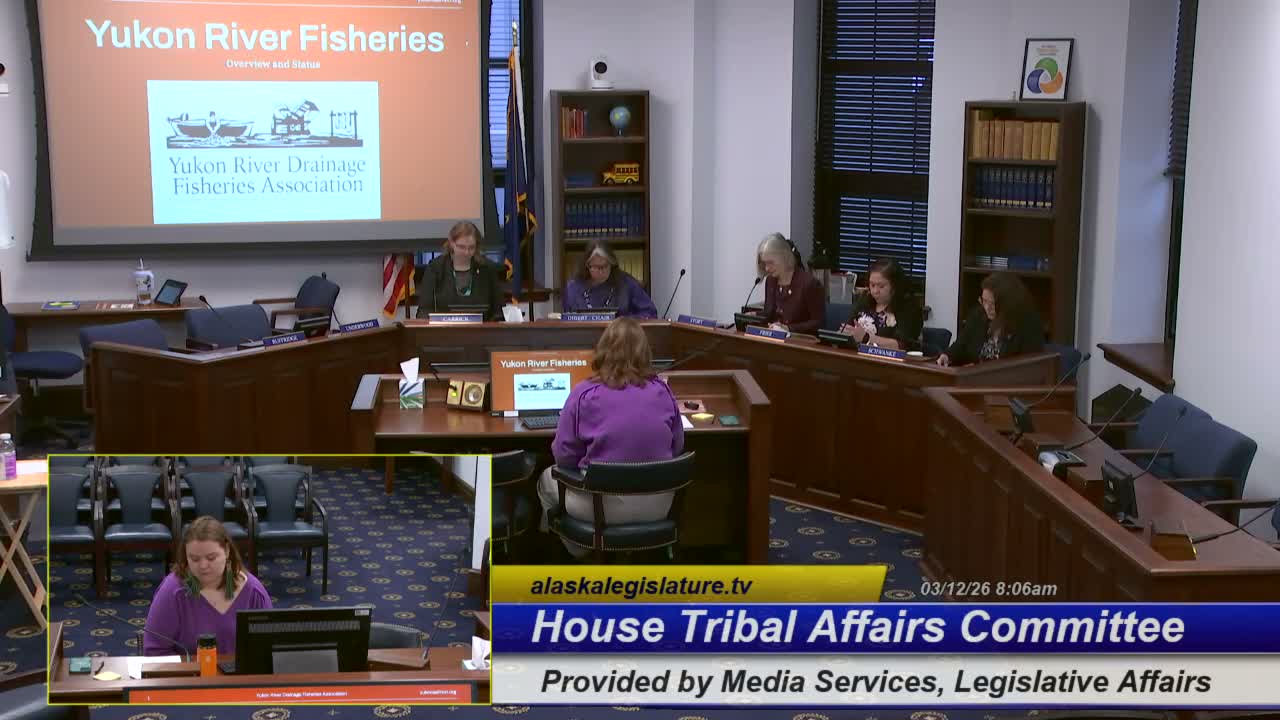
Summary
At a March 12 House Tribal Affairs hearing, the Yukon River Drainage Fisheries Association told lawmakers steep Chinook declines have left fisheries closed and data gaps after legacy weirs were decommissioned; the group described training, research and a planned drone pilot to restore local monitoring capacity.
The Alaska House Tribal Affairs Committee heard from the Yukon River Drainage Fisheries Association on March 12 about sharply reduced Chinook salmon returns, gaps in long‑standing assessment sites and YRDFA’s plans to train local residents and launch drone‑based monitoring.
YRDFA executive director Serena Ahlstrom told the committee the association’s work centers on sustaining wild salmon and supporting subsistence communities across the Yukon River drainage. "The Yukon River salmon are crucially important," Ahlstrom said, describing the fishery’s role for food security, cultural identity and local economies.
Fisheries biologist Brian McKenna said the recent runs are a fraction of historical levels. "Historically, the Chinook salmon run coming into the Yukon River annually was around 400,000," McKenna told the committee, and for 2022–2025 the total Chinook run size was roughly 37,060. He said a 2024 seven‑year agreement under the Pacific Salmon Treaty sets a border‑passage goal of 71,000 Chinook into Canada; that goal has been met only five times in the past 20 years. "If the goal is not met in a year, the fishery will remain closed," McKenna said.
Ahlstrom and McKenna described multiple YRDFA programs intended to respond to the decline and build local capacity: a 10‑day biotechnician training (capped at about 10 participants) that mixes classroom and field work, a culture‑camp program that engages youth and elders, community teleconferences and a quarterly newsletter, and a Yukon‑specific science symposium. McKenna said the organization is pursuing genetic baseline work with the Alaska Department of Fish and Game and a joint coastal life‑history project to inform management.
The presenters also laid out a practical response to assessment gaps after several long‑running weirs were taken out of service. McKenna said all three legacy weirs (including the Andreski River weir, decommissioned in 2025) faced aging infrastructure, repeated flood damage and interruptions tied to shifting river conditions, and that funding and staffing constraints contributed to reduced operation. "Those weirs experienced severe damages and blowouts and pauses in operation due to increased precipitation events and flooding," he explained.
To fill monitoring gaps, YRDFA has secured funding for a drone‑based salmon monitoring training in June and is developing a feasibility study for local drone operations. McKenna said the June training in coordination with local partners will be free to participants (travel, lodging and per diem covered) though not a paid course, and that the organization is seeking follow‑on funding to create local employment from monitoring programs.
Committee members pressed presenters on funding stability, the vacant traditional ecological knowledge (TEK) position and whether cuts to public broadcasting or delayed grants would limit outreach. Ahlstrom said YRDFA relies mostly on grants (federal, state, foundation) and donations and that a key US Fish and Wildlife Service restoration grant that supports the newsletter and other communications has been delayed, which could reduce information flow to communities.
Representative Story urged the committee to seek clarity from managers about the decommissioning of weirs and to consider keeping multiple assessment methods. "I would suggest the committee write a letter to the Department of Fish and Game and ask about the decommissioning of the three weirs and their rationale," Story said, noting that multiple measures would help avoid reliance on a single data source.
The presentation highlighted education and local‑hire goals: YRDFA said its trainings aim to prepare residents for assessment‑site jobs (sonar, weir and tower work), and that past trainees have gone on to multi‑year positions. The group also emphasized blending traditional ecological knowledge with Western science, nominating local streams for the Anadromous Waters catalog and sharing community temperature logger data with university partners.
The committee did not take formal action at the hearing. Chair Divert thanked the presenters and adjourned the meeting at 10:09 a.m.; Representative Story’s proposal that the committee request information from ADF&G and federal managers signals a likely follow‑up on assessment site decisions and data needs.