
Village public safety officers describe broad community role and urgent staffing needs at House Bush Caucus reception
Get AI-powered insights, summaries, and transcripts
Subscribe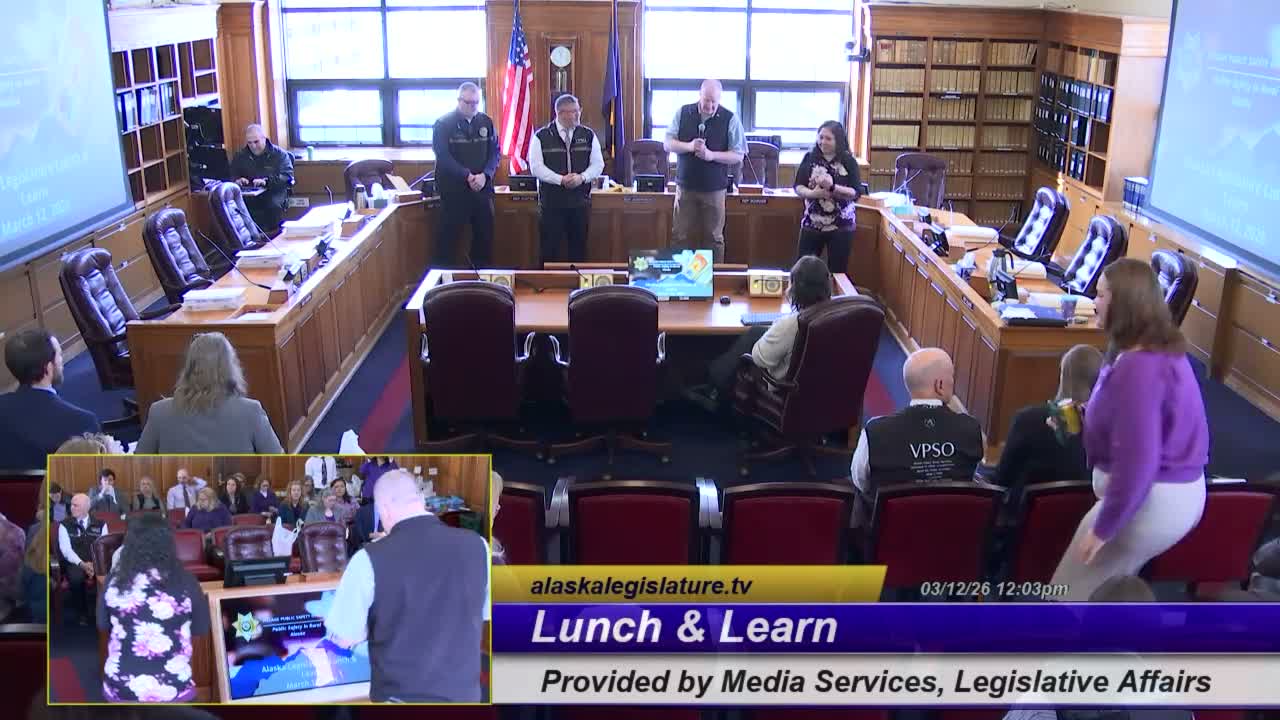
Summary
Regional public safety officers told lawmakers that Alaska's Village Public Safety Officer program provides critical local emergency response and community services but faces persistent recruitment, housing and training challenges even as supervision and training pathways are expanded.
At a special legislative reception hosted by the House Bush Caucus, regional public safety officers described the Village Public Safety Officer program's role in remote Alaska communities and urged sustained support to address recruiting and retention shortfalls.
Chris Hatch, regional public safety officer for the Northwest Arctic Borough, said the program's strength is placing trained people in community to provide immediate help during crises: "They provide an immediate response to people in a community when they're in crisis and need help." He credited local partnerships, including the Alaska State Troopers and the FBI Missing Persons Task Force, with past search efforts for missing residents and with strengthening local capacity.
Jason Wilson, BTSO coordinator for Buchanan Central Council, emphasized the breadth of duties BPSOs carry in small communities. "Every BPSO out there is 50 people," Wilson said, arguing that a single funded position often supplies many services, from emergency medical response to school-based education and search-and-rescue. Presenters highlighted that officers commonly serve as EMTs, counselors, community educators and first responders in places that lack other services.
Josh Harlow, a regional public safety officer assigned to the Department of Public Safety BTSO division, outlined training pathways and supervisory changes intended to support the field workforce. Harlow described local three-week courses, a nine-week Sitka academy track with added fire and EMS training, opportunities for federal training, and yearly in-service updates. He also described a new layer of regional supervision (regional public safety officers, RPSOs) to provide on-the-ground training oversight and allow coordinators to focus on administration.
Speakers said the program is funded for roughly 90 BPSO positions and reported being near that level of staffing, but they identified persistent obstacles: housing shortages in rural communities, lengthy training timelines, limited career advancement and the challenge of responding alone to high-risk incidents. "You have to go into a house to deal with an ongoing domestic violence disturbance," Hatch said, describing the isolation and risk officers sometimes face. The presenters urged tailored regional approaches rather than one-size-fits-all models and thanked Department of Public Safety leadership for support in expanding local representation and resources.
Panelists also addressed statutory and operational questions. Harlow explained that, according to statute, communities join the program via a memorandum of agreement with a sponsoring nonprofit or municipality and that officers receive certification from the DPS commissioner; coverage typically follows the community boundary that signs the MOA but may include authorized responses between nearby communities.
On specialized enforcement and scope, presenters said BPSOs generally defer most serious felony investigations to troopers or the Alaska Bureau of Investigation and typically pass wildlife enforcement to Alaska wildlife troopers to protect subsistence practices. They noted that traffic enforcement is not a routine duty but that officers may address immediate road hazards when required.
Panelists acknowledged limits in behavioral-health resources and training for mental-health crises; they said BPSOs receive evolving training and often rely on local behavioral-health specialists when available. Jason Wilson invited attendees to a VPSO meet-and-greet planned for later this month to meet coordinators and officers and learn more about the program.
An attendee closed by thanking Commissioner Cockrell and Department of Public Safety staff for their work establishing and supporting the Village Public Safety Officer division. The reception concluded with continued conversation and an invitation to follow-up events.