
AG's office outlines federal litigation that could affect state programs, flags DEI and Medicaid risks
Get AI-powered insights, summaries, and transcripts
Subscribe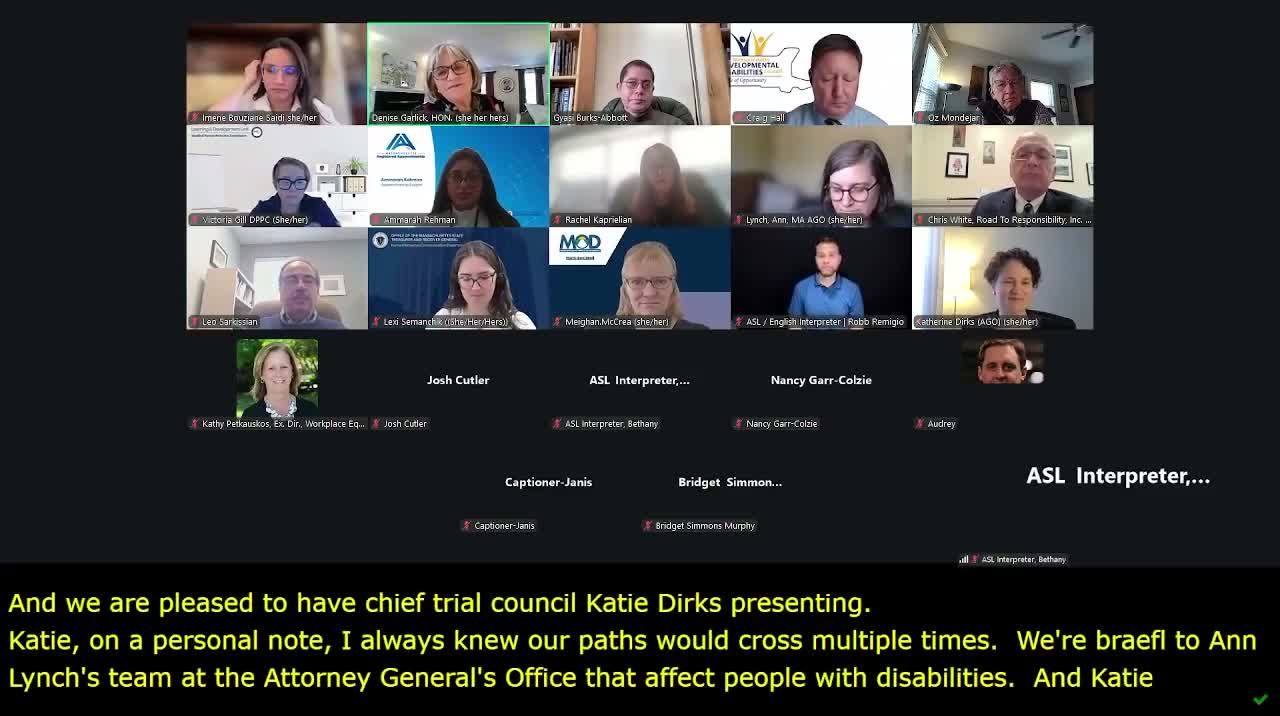
Summary
Chief State Trial Counsel Katie Dirks told the commission the Attorney General's Office has filed new suits and defended more than $3 billion in federal funds, highlighting suits over Department of Education data demands, anti‑DEI funding conditions, Haiti TPS litigation, NIH grant disruptions, and education mental‑health grant nonrenewals.
Katie Dirks, Chief State Trial Counsel at the Massachusetts Attorney General's Office, told the Permanent Commission on the Status of Persons with Disabilities that the office has been actively defending state programs from multiple federal actions and protections that could affect services for people with disabilities.
"We actually just filed our fiftieth lawsuit this morning," Dirks said, adding that the office has protected more than $3,000,000,000 in federal funding to the Commonwealth. She outlined four litigation areas of particular interest to the commission: changes to federal data demands for higher education (the IPEDS survey), federal conditions limiting diversity, equity and inclusion (DEI) grant requirements, immigration matters including the Haiti Temporary Protected Status litigation, and disruptions at the National Institutes of Health affecting research grants.
On higher education data, Dirks said the AG's office challenged recent Department of Education data requests in federal court on the grounds the survey (IPEDS) is being repurposed from a statistical tool to an individualized enforcement mechanism. "We filed that in the District of Massachusetts asking for the court to enjoin that particular use," she said.
Dirks described recent federal efforts to impose funding conditions related to DEI as vague and chilling. She said a federal judge enjoined a broad funding restriction and that Massachusetts and coalition partners were able to dismiss a related suit once a district court ruling and another court's decision ended the specific enforcement risk. "We do expect diversity issues, especially in education settings, to be a big topic in 2026," Dirks said.
On immigration, Dirks said the office has supported challenges to the termination of Haiti Temporary Protected Status through robust amicus briefs and is monitoring pending appeals; she said district court stays have preserved TPS status for now while appellate review proceeds.
On research funding, Dirks summarized litigation over NIH policies that targeted certain research topics and said a district court vacated the NIH policy but the question of reinstating terminated grants remains tied up in a jurisdictional dispute and appeals in federal court.
Finally, Dirks said the office won preliminary relief in suits challenging the Department of Education's refusal to renew certain mental‑health training grants for K–12 placements (including grants to UMass and the City of Boston), but that the federal agency has appealed and is resisting compliance with court orders.
Commissioners asked whether the AG's office is coordinating with the governor's office about CMS and House communications regarding Medicaid. Dirks said attorney general offices and governors' offices are in regular contact and that Massachusetts stands ready to litigate if federal actions cause imminent harm to state programs.
Dirks acknowledged uncertainty around what federal actors mean when they refer to "illegal DEI" and said the lack of a clear definition leads institutions to preemptively avoid activities that could be targeted. She committed to share the AG's guidance on DEI and employment initiatives with the commission.
The commission did not take formal action on Dirks's report but thanked the Attorney General's Office for the update and noted staff follow‑up to circulate the AG guidance and related resources.
The commission moved next to apprenticeship and subcommittee reports.