
Alaska DOT reports record snows, avalanche impacts and new mitigation technologies in March update
Get AI-powered insights, summaries, and transcripts
Subscribe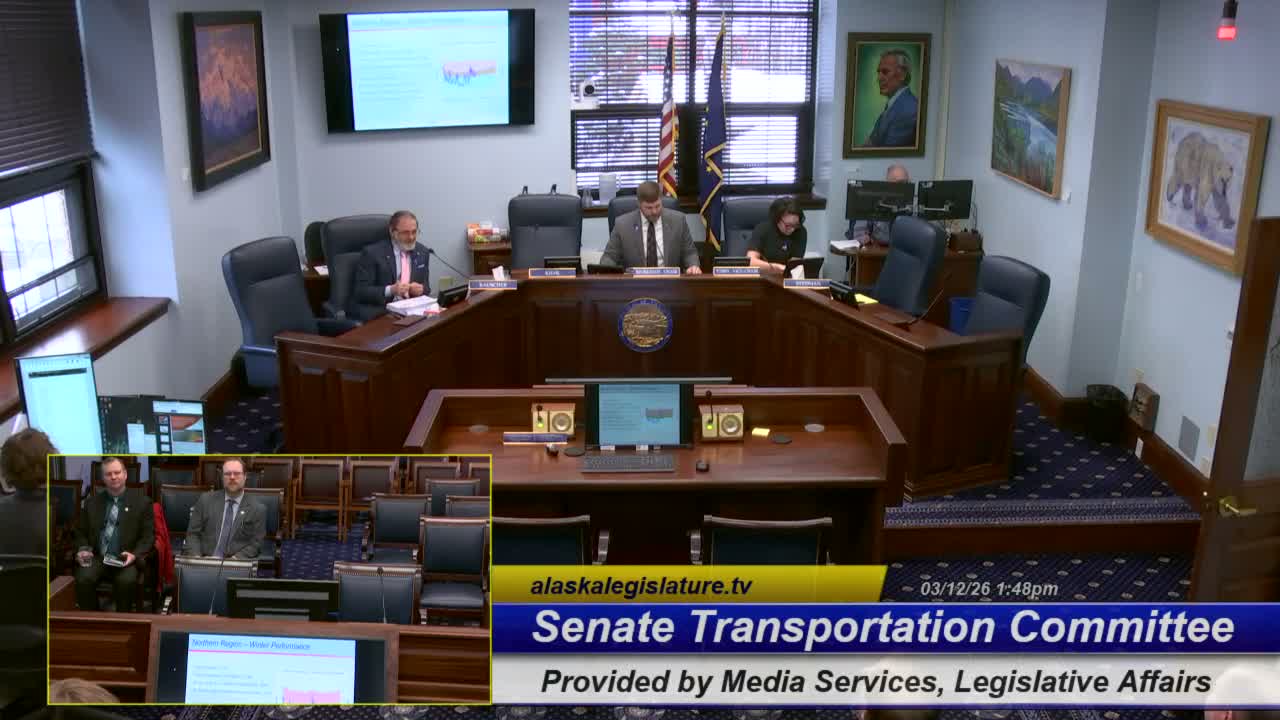
Summary
DOT&PF told the Senate Transportation Committee that unusually heavy winter storms this season led to record snowfall days, hundreds of closure hours on key highways, increased contractor spending on sidewalk and snow hauling, staffing vacancies in remote districts, and deployment of radar, infrasound and a mobile 'boom' avalanche-mitigation system.
The Department of Transportation and Public Facilities told the Senate Transportation Committee on March 12 that this winter’s extreme weather produced widespread impacts across Alaska, from record snowfall days in Juneau to long highway closures caused by avalanches and high winds.
DOT regional leaders and the department’s data modernization director described event counts, staffing challenges, contracting costs and a suite of new and tested technologies intended to reduce closure time and improve traveler safety.
Key figures and region snapshots
Northern Region: Daniel Adamczak, Northern Region maintenance and operations engineer, reported 151 winter events as of late January and said Fairbanks had its second-snowiest February with just under 40 inches in some locations. He described challenges for sidewalk recovery, use of contractors and intermediate snow storage, and said Dalton District vacancy-filling improved partly due to a 2-on/2-off schedule.
South Coast Region: Marcus Zimmerman reported 217 winter events in the South Coast Region and said the region had achieved approximately 360 of 399 target conditions (about 90%). He said Juneau sidewalk and snow-hauling contracting year-to-date totaled about $236,985 (roughly $98,000 for sidewalk removal and $138,000 for hauling).
Closures and extreme events
Zimmerman recounted a December storm that blew debris onto a Dutch Harbor runway, shutting it for about 72 hours during a major fishery opening, and said Klondike Highway closure hours reached roughly 330 hours this winter. He and other DOT staff described extended closures on Haines Highway tied to blizzards and avalanches.
Avalanche monitoring and mitigation technologies
Christine Langley, director of DOT’s Data Modernization and Innovation (DMIO) office, said since Jan. 1 the state recorded 192 avalanches, 22 of which affected roadways and caused a total of about 546 hours of closures. Langley described three detection and mitigation tools DOT has deployed or expanded this season:
• Doppler radar units positioned to detect movement in avalanche paths and trigger automated staff notifications and visible traveler alerts when warranted.
• Infrasound sensors that "listen" to snowpack movement; DOT reported at least one instance where infrasound detected an avalanche that otherwise would have been difficult to observe at night.
• A portable, propane-oxygen “mobile boom” that creates a powerful air blast to destabilize small avalanche-prone slopes; DOT described it as a faster, more mobile mitigation tool that can reduce reliance on artillery-based mitigation.
Staffing, fleet and contracting
Adamczak and other M&O leaders highlighted persistent vacancies in some districts (Valdez and parts of Western Region), while noting successful recruitment in Dalton attributed to scheduling and pay incentives. Brad Bilesma, state equipment fleet manager, told the committee that plow-truck replacement is on schedule and the department is shifting toward a 10–12 year replacement cycle to improve reliability.
Policy and operational context
DOT staff cautioned that research, procurement and deployment choices require Alaska-specific data. Andy Mills said the department is willing to work with legislative offices and community advocates on state-focused studies (for example, chloride movement into anadromous streams) and to bring pavement- and materials-focused briefings to the committee in upcoming meetings.
Ending and next steps
Committee members requested additional data on staffing exit interviews and regional cost breakdowns. DOT offered to provide more detailed figures after the hearing and to work with the committee on future pavement- and research-focused presentations. No formal votes or budgetary commitments were made during the session.