Court of Appeals hears arguments in Teamsters v. Benton County over arbitration versus civil service review
Loading...
Summary
A three-judge panel at the Washington Court of Appeals heard oral argument in Teamsters Local 839 v. Benton County about whether disciplinary actions for certain sheriff's office clerical employees must be resolved through arbitration or through local civil service commission rules and whether a court or arbitrator decides arbitrability.
A three-judge panel of the Washington Court of Appeals heard competing arguments on whether an employee disciplinary dispute involving a Benton County sheriff’s office employee must be resolved through grievance arbitration or under the local civil service commission’s rules.
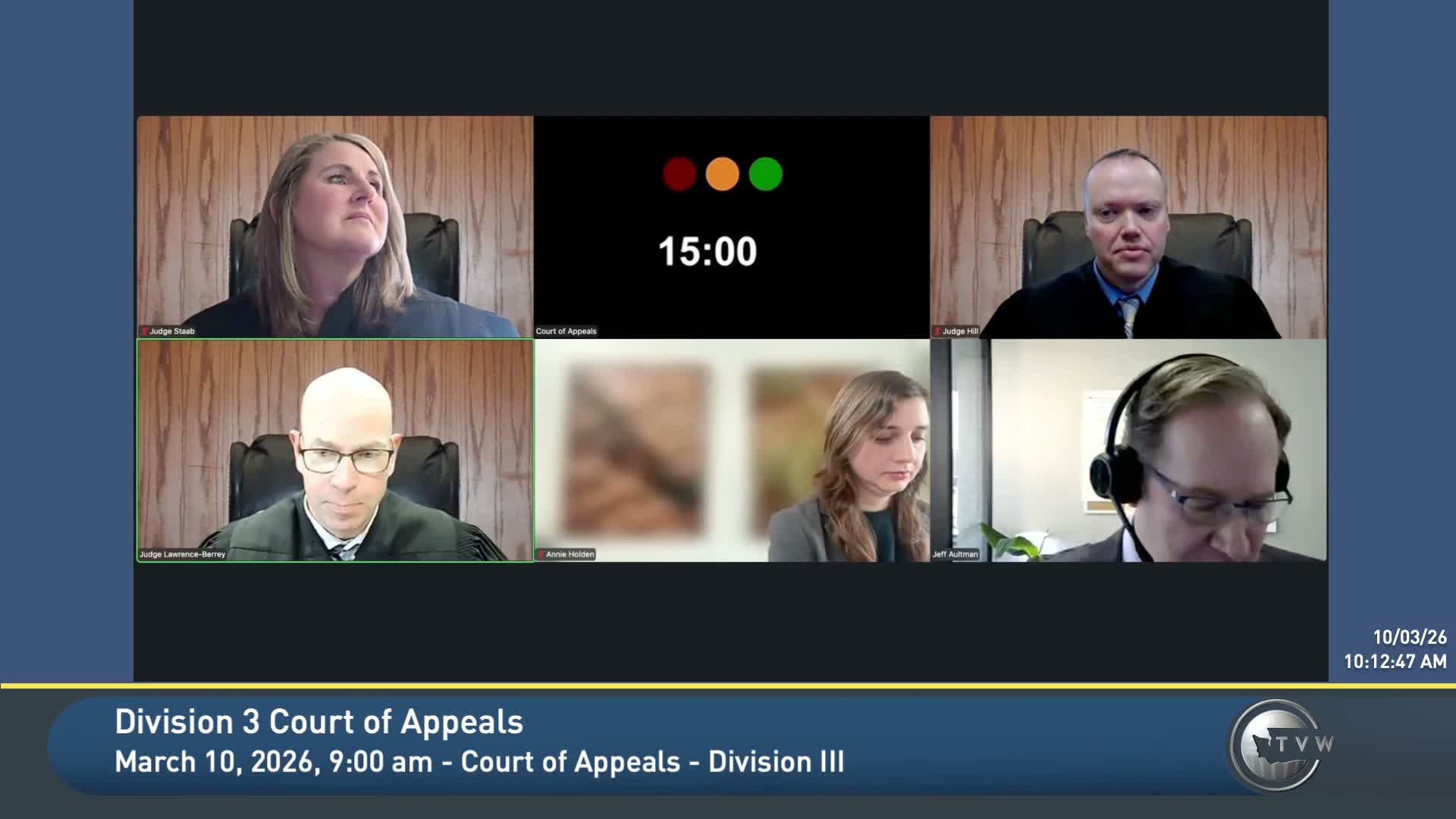
Presiding Judge Lawrence Berry opened the virtual session and identified the panel and the case, Teamsters Local 839 v. Benton County, with Benton County as the appellant. Benton County’s counsel, Jeff Altman, chief civil deputy for Benton County, argued the superior court erred by compelling arbitration instead of allowing the matter to proceed under the civil service commission procedures negotiated in the collective bargaining agreement (CBA).
Altman told the panel that the CBA provides two grievance pathways and that which path applies depends on the nature of the dispute and the employee classification. "The court here is asked to decide whether a disciplinary action should be resolved through grievance, arbitration, or appealed pursuant to the civil service commission rules as negotiated in the collective bargaining agreement," Altman said, arguing that "section 21.2 says . . . all questions or issues involving disciplinary action will be subject only to the civil service commission rules and regulation for sheriff's office employees." He pointed to RCW 41.14 and related provisions as establishing the civil service commission’s authority over suspensions and discipline for sheriff’s-office employees.
Teamsters counsel Annie Holden responded that the superior court remanded the issue to arbitration and that, under long-standing precedent favoring arbitration, courts generally "presume arbitrability and doubts are resolved in favor of arbitration." She told the panel that the arbitrator could hear defenses to arbitrability and decide whether the dispute belongs in arbitration or should proceed under civil service rules: "The arbitrator could have that authority," she said.
Judges on the panel pressed both sides on whether the superior court made a definitive ruling on arbitrability or simply sent the question to an arbitrator to decide, and whether a court must make a preliminary finding before sending procedural-arbitrability questions to arbitration. Holden cited Yakima County decisions and related authority addressing when procedural prerequisites should be decided by an arbitrator. Altman contended this case differs because the CBA and state statute (RCW 41.14) explicitly channel disciplinary matters for sheriff's-office clerical employees to civil service review.
Panel members also expressed concern about timing. Judge Lawrence Berry questioned whether deferring to arbitration could leave parties waiting years for a final merits decision and suggested the court might prefer a definitive ruling now rather than a delay of several years.
Both sides acknowledged overlap in the CBA provisions (including references to article 9.5 on work-rule complaints and article 21 and 25 on grievance/arbitration and disciplinary definitions) and disputed whether those provisions are in actual conflict or instead leave procedural questions for an arbitrator to resolve. Counsel exchanged on whether alleged disparate application of work rules (a grievance under §9.5) necessarily converts a disciplinary matter into a civil-service matter under article 25 or whether the arbitrator should interpret the contract.
The panel indicated the matter had been fully argued and submitted. The court said it might request supplemental briefing on the statutory civil-service issue (RCW 41.14 and related subsections) before issuing a decision.
The case record shows the primary legal themes on appeal are (1) whether statutory civil-service protections for sheriff’s-office employees supersede or coexist with CBA arbitration clauses and (2) whether questions of procedural arbitrability must be decided by a court or an arbitrator under applicable Washington precedent. The court did not announce a ruling at the end of the session; the matter was submitted for decision and may be held for supplemental briefing on statutory issues.