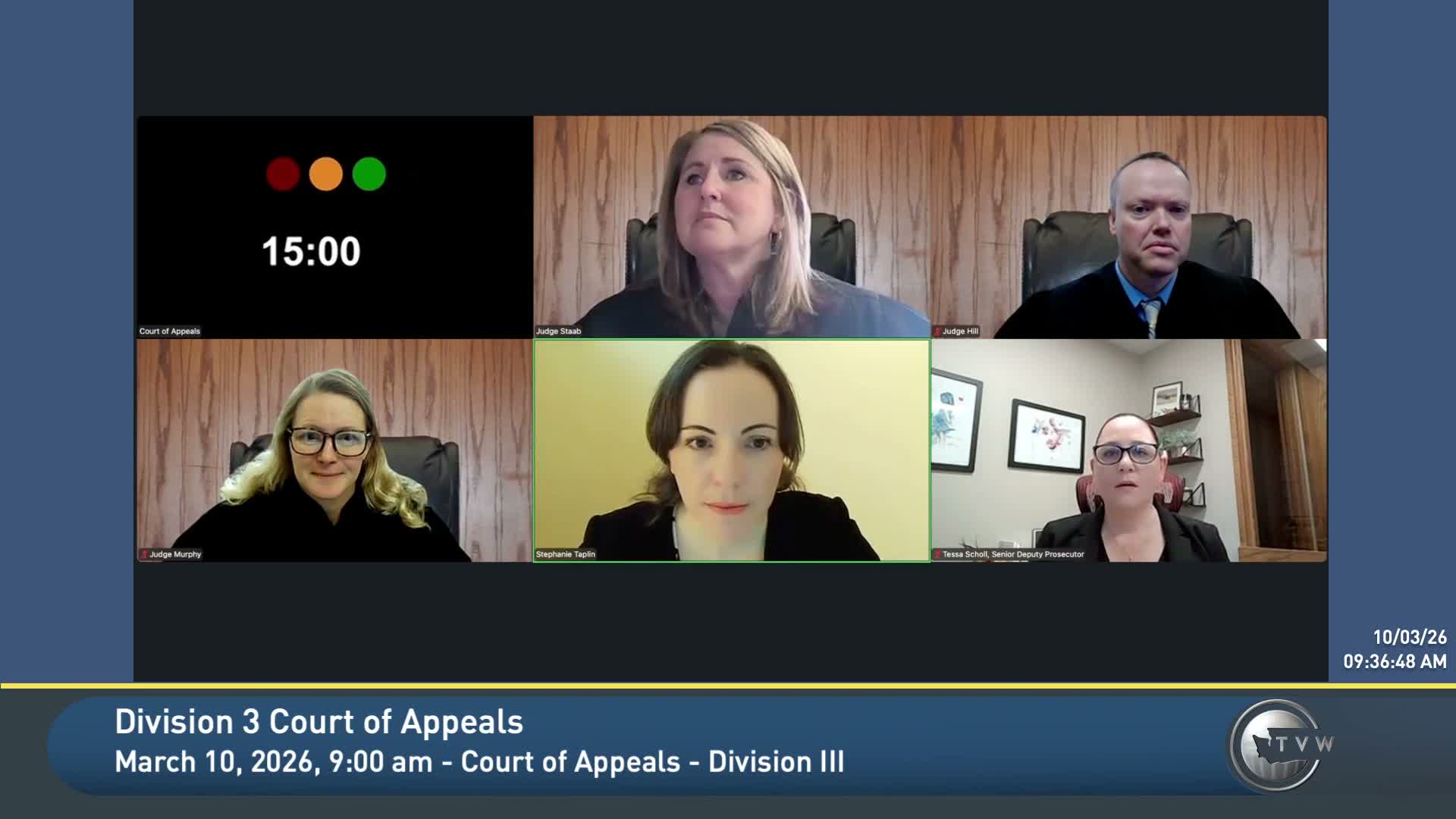
Appellate panel hears argument over whether 'compensation' in RCW 9A.68.030 includes sexual favors in State v. Tarver
Loading...
Summary
An appellate panel heard competing legal theories over whether Washington’s receiving-unlawful-compensation statute covers non-monetary benefits such as sexual favors and whether 'transaction' encompasses assisting with child-visitation; counsel disputed precedent and statutory context and the court recessed with no immediate decision.
An appellate panel on March 14 heard oral argument in State v. Tarver, case no. 405032, over whether the Washington statute prohibiting receiving unlawful compensation (RCW 9A.68.030) applies when a public servant accepts non-monetary benefits, including sexual favors, in exchange for assisting in a dependency and visitation matter.
Appellant’s counsel Stephanie Taplin told the court that Robert Tarver’s conviction should be reversed because RCW 9A.68.030 is unambiguous and does not criminalize the conduct at issue; she added that if the statute is ambiguous it must be construed in Tarver’s favor under the rule of lenity. "Mr. Tarver did not commit the crime of receiving unlawful compensation," Taplin said, arguing the term "compensation" in the relevant statutory scheme should be read as money or other property readily convertible to money and not as sexual favors.
Respondent counsel Scholl asked the court to affirm the conviction, arguing it would be absurd to read the statute as excluding sexual favors and that the legislature used "compensation" as a catchall to criminalize public servants accepting anything of value in exchange for exercising official discretion. "It would be absurd to believe that the legislature intended for public officials in exercising their discretion to do so in exchange for sexual acts or sexual favors," Scholl said, noting the trial court found testimony that the complainant had been told she would engage in such acts in exchange for assistance with her dependency case.
The panel pressed both sides on textual and contextual points. One judge asked whether the charging statute should be read differently from the closely related statute that uses the narrower term "pecuniary benefit," with Taplin urging consistency across the Criminal Code and pointing to a Court of Appeals decision, State v. Clark, that she said limits "transaction" to items similar to "bill, contract, [or] claim." Taplin argued Clark supports reading "transaction" more narrowly and therefore excluding non-monetary sexual favors from the statutory term "compensation." She also noted the state could have charged other offenses, such as official misconduct, but chose the statute now at issue.
Scholl disputed relying on Clark, saying the division’s analysis was limited and not binding, and emphasized that public servants exercise official discretion in ways not confined to money or formal contracts. Scholl urged the panel to consider the trial court’s factual findings and the testimony presented at trial, arguing the evidence was sufficient to support the conviction under the statute as the lower court applied it.
Counsel acknowledged they had not briefed a stand-alone sufficiency-of-the-evidence challenge on appeal and agreed that if the court accepted the narrower definitions urged by the defense, questions could arise about whether the evidence, as charged, met the statutory elements. The panel thanked counsel for a "lively debate" and recessed, noting a panel change; no ruling was issued from the bench at the conclusion of argument.
The case focuses on statutory interpretation and precedent rather than disputed underlying facts: counsel for the appellant said the facts are not contested for purposes of the appeal, while respondent counsel relied on trial findings that the complainant testified she had been told she would engage in acts in exchange for assistance. The court did not announce whether it would adopt the defense’s textual reading, follow the state’s broader construction, or identify any resolution date.
The court recessed after argument; the panel indicated it would change, and no decision was announced from the bench.