
Appellate panel hears challenge to $10,000 substitution condition in Stevens v. Falk
Get AI-powered insights, summaries, and transcripts
Subscribe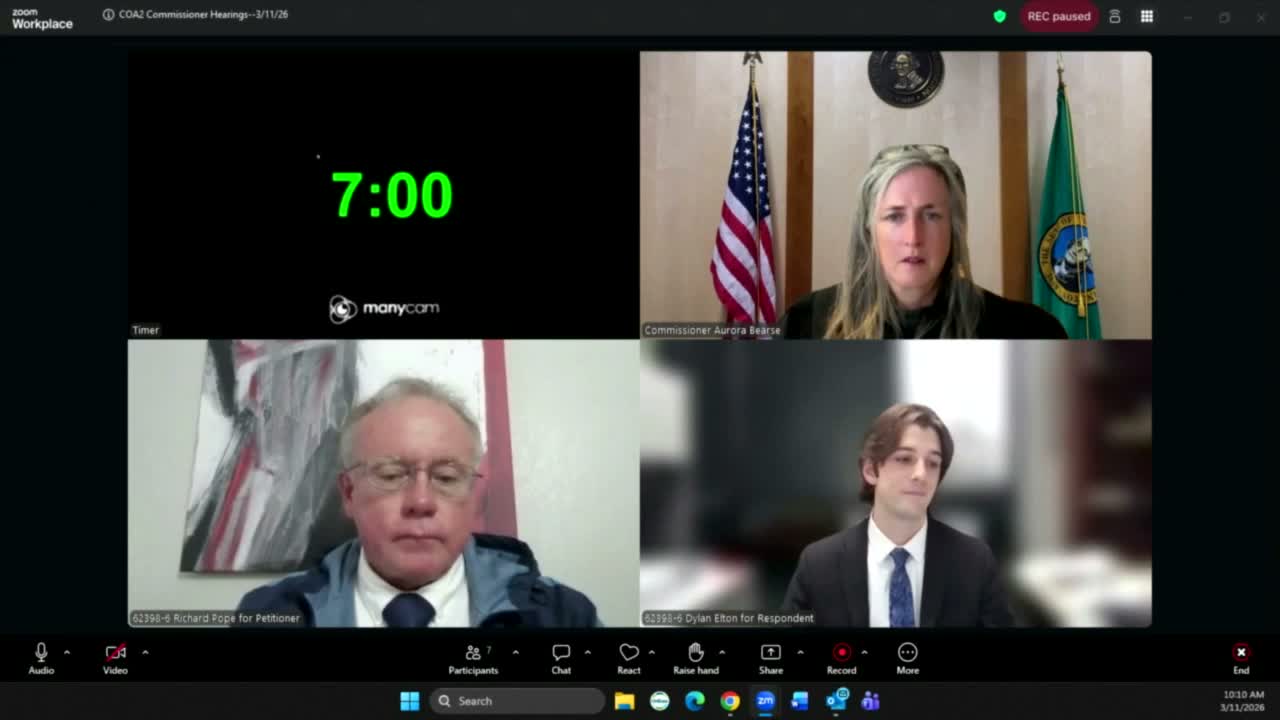
Summary
An appellate commissioner heard arguments March 11 over whether a trial judge properly conditioned substitution of a party in a foreclosure dispute on payment of $10,000 in attorney fees; counsel for the would‑be substitute called the condition an obvious error, while opposing counsel defended it as an equitable case‑management measure. A written ruling was reserved.
An appellate commissioner heard oral argument March 11 over whether a trial court improperly required payment of $10,000 as a condition for substituting a party in an ongoing foreclosure dispute.
Richard Pope, attorney for the appellant Ron Steve, told the court the trial judge’s condition was “an obvious error” that conflicts with civil‑procedure rules governing substitution and intervention. Pope said the quitclaim deed transferring the property to Mr. Steve occurred in November 2024 and that a foreclosure sale followed in March 2025; he argued that substituting the proper party under CR 25(c) should not be conditioned on paying another party’s attorney fees, and he asked the court to grant discretionary review to remove the requirement.
Dylan Elkins, an associate at Romero Park P.S. representing respondent Carey Falk, replied that the substitution motion had been granted but that the trial judge imposed the $10,000 condition to avoid prejudice to Falk after lengthy litigation. Elkins told the court the standard for discretionary review under RAP 2.3 is narrow and that the order did not meet the criteria (obvious error, futility of further proceedings, substantial alteration of the status quo, or departure from the usual course of proceedings). Elkins said the judge’s wording (using “may” and discretionary language in CR 25) supported the view that the condition was within the trial court’s discretion.
Pope emphasized practical impacts, noting the court’s order set a payment deadline (November 25, per the transcript) and that defendants had not moved to dismiss the underlying file; he said Mr. Steve is of modest means and that staying the order or consolidating separate litigation would be inefficient. The parties agreed there were no active trial dates while the discretionary‑review motion was pending.
The presiding judge did not announce a decision from the bench. “I will issue a written ruling,” the judge said at the close of argument, and the court concluded the commissioner’s March 11, 2026, motion argument calendar.
Why it matters: The court’s decision could clarify whether a trial court may condition substitution of the proper party on payment of the opposing party’s attorney fees in foreclosure and substitution disputes, a question that the moving counsel said has no clear Washington precedent.
What the transcript records: The transcript identifies the participants as Richard Pope (counsel for the appellant), Dylan Elkins (counsel for the respondent), the presiding judge, and a court clerk. The case caption in the transcript is recorded as Priscilla Stevens v Carey Falk; the respondent’s surname is spelled “Carrie” in one counsel’s introduction later in the record and “Carey” in the caption; this article uses the case caption spelling as read at the start of the hearing and notes the variant in the transcript.