
Defense asks court to require proof that defendant knew of prior conviction in unlawful-possession case
Get AI-powered insights, summaries, and transcripts
Subscribe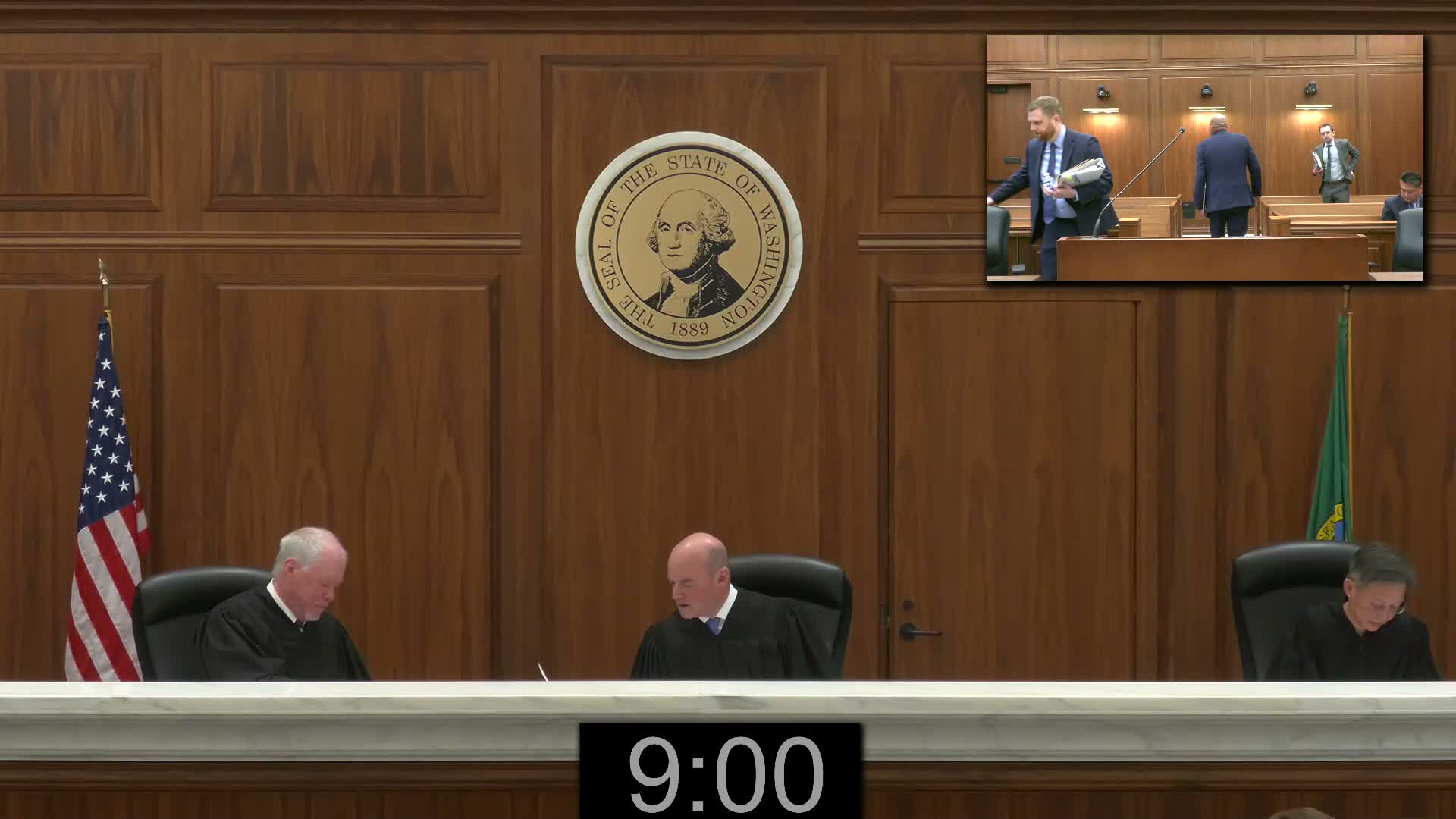
Summary
In oral argument in State v. Stanley at Other Court, defense counsel urged the court to read a knowledge requirement into the first-degree unlawful-possession statute so juries must find a defendant knew of a prior serious conviction; the state countered that the statute and procedural safeguards already provide notice.
Edward Wicksler, attorney with the Washington Appellate Project, told Other Court during oral argument that the state must prove a defendant knew of a prior serious conviction to sustain a charge of first-degree unlawful possession of a firearm. "Did the individual know for purposes of first degree, unlawful possession that they had previously been convicted of a serious offense?" Wicksler asked the panel, pressing the court to treat knowledge of the prior conviction as an essential element of the offense rather than a mere procedural fact.
Wicksler said the court should follow a line of authority that reads a culpable mental state into silent statutes when a fact distinguishes lawful from unlawful conduct. He cited the state Supreme Court's reasoning in Williams and decisions from the U.S. Supreme Court to argue that knowledge should attach both to possession and to the status that makes possession unlawful. "I am not asking this court to find that the state is required to prove beyond a reasonable doubt that a person knew that their possession of a firearm was unlawful," he said, "I am asking this court only to find that it is an essential element of the offense." He urged reversal of Mr. Stanley's conviction on the ground that the charging information did not put the defendant on adequate notice of the alleged knowledge element.
Ross Bridal, deputy prosecuting attorney for King County, responded that the unlawful-possession statute does not, on its face, require knowledge of a prior conviction and that longstanding procedural safeguards give defendants notice of ineligibility. "Jonathan Stanley shot Tony Cannon with a gun he knew full well he was ineligible," Bridal told the court while summarizing the case history; he noted Stanley waived a jury on the unlawful-possession count, the jury acquitted on the murder charge, and the judge found Stanley guilty of unlawful possession. Bridal emphasized that courts are statutorily obligated to put convicted defendants on explicit oral and written notice of firearm ineligibility following a qualifying felony disposition and that defense did not raise an affirmative defense tied to any claimed notice failure.
The bench questioned both sides about the scope and limits of federal precedent. A justice asked whether the U.S. Supreme Court's decision in Rehaef (discussed in argument as "Rahaf/Rehaef") and later federal decisions require reading a knowledge element into every statutory circumstance; counsel agreed those federal cases are influential but disagreed about their reach in state law. Counsel also debated whether subsequent federal rulings such as Greer v. United States expanded the reasoning beyond immigration-related facts, and the panel discussed state precedents including Anderson and Moreno and whether those cases are limited to knowledge of possession rather than status.
Neither side asked the court to adopt a broad mistake-of-law defense. Wicksler framed the requested rule narrowly, seeking only that jurors be required to find knowledge of the prior conviction as an element of first-degree unlawful possession; Bridal argued that imposing that requirement would be an unprecedented judicial enlargement of the statute. The argument concluded with Wicksler repeating his request that the court reverse Stanley's conviction because, he said, the information was legally defective for failing to allege the knowledge element.
The court thanked counsel and adjourned.