
Appellate panel hears dispute over Washington social worker’s firing; lawyers clash on pretext and timing
Get AI-powered insights, summaries, and transcripts
Subscribe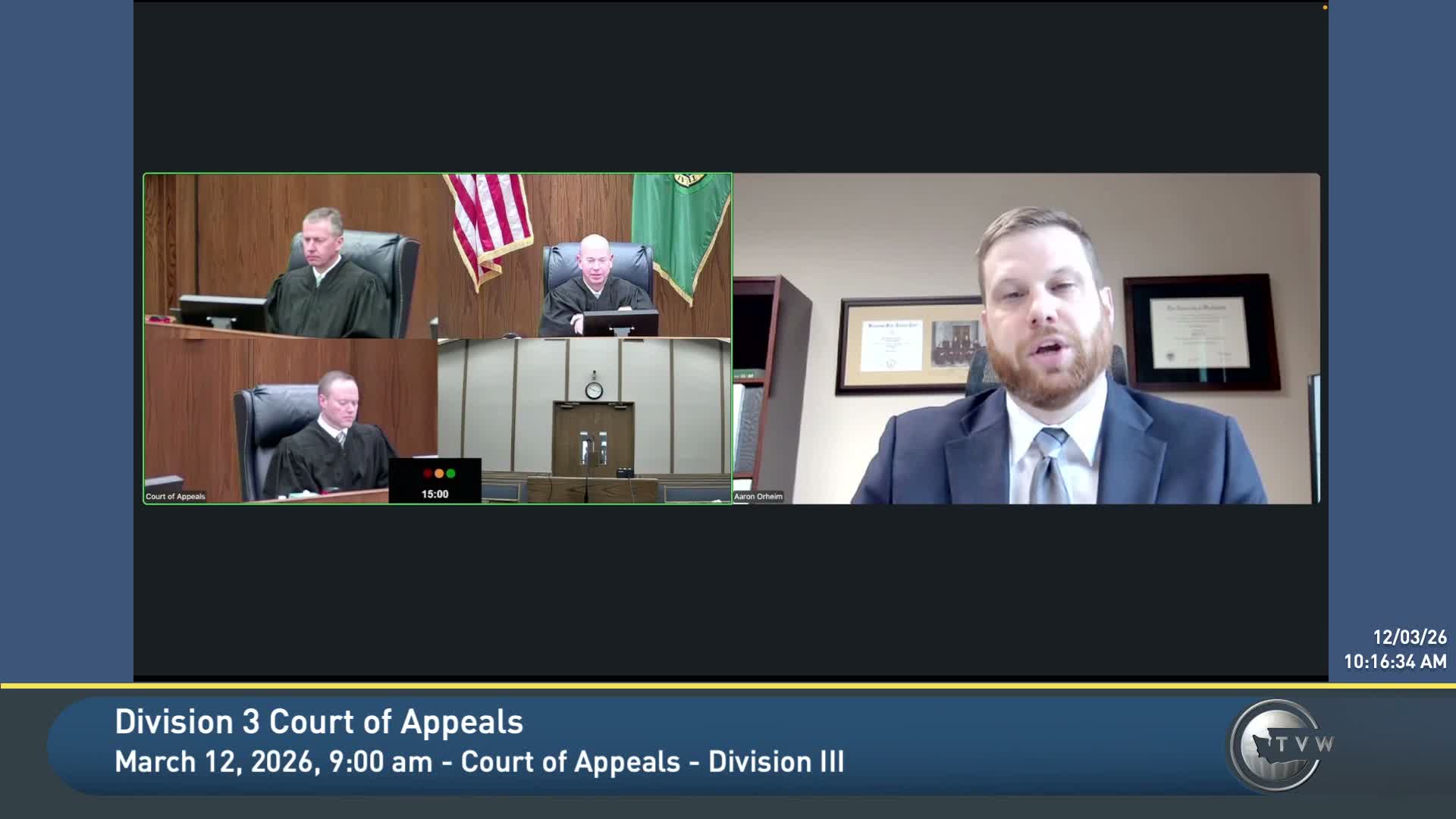
Summary
At oral argument, counsel for Sylvia Zarate said her 2020 firing by the Department of Children, Youth, and Families was pretextual and tied to union activity; DCYF counsel and PERC defended the termination as based on a lengthy investigation, forensic audit and a founded child-abuse finding. The three-judge panel submitted the case after questioning preservation and timing issues.
A three-judge appellate panel heard arguments on the administrative appeal of Sylvia Zarate on Monday, as lawyers contested whether the Washington Department of Children, Youth, and Families lawfully terminated her employment.
"This case is about pretext and it's also about the proper legal standard that must be applied when evaluating pretext," Aaron Orheim, counsel for appellant Sylvia Zarate, told the court, arguing Zarate had made a prima facie showing of discrimination and that the correct inquiry is whether the employer's stated reasons were pretextual or whether union animus substantially motivated the adverse action. Orheim reserved five minutes for rebuttal.
Orheim pointed to several record features he said show pretext: shifting explanations from a supervisor, the timing of the termination (he said the decision occurred about 14 days after purportedly protected union activity), and a smiling-face emoji that appeared on disciplinary correspondence. "It's about as smoking gun as it gets," Orheim said of the combination of timing, shifting explanations and the emoji.
Sarah Wilmot, representing the Department of Children, Youth, and Families, said the agency had a nondiscriminatory basis to separate Zarate. "Zarate was terminated by DCYF for accessing restricted files for personal gain and for being disqualified from her job," Wilmot said, summarizing what she described as a multi-month workplace investigation and a 681-page final report that documented repeated unauthorized access to restricted records and a founded child-abuse finding arising from a January 2020 intake.
Wilmot told the panel the agency ordered a forensic audit and completed a workplace investigation that supported three substantiated charges: two for accessing restricted files without a business need and one based on the founded finding and related criminal charge. She said the investigation report was completed on Oct. 14, a predisciplinary letter issued on Nov. 2, and department drafting on a termination letter began Nov. 18 — all before the protected activity cited by the appellant on Nov. 30.
Chad Stanford, counsel appearing for the Public Employment Relations Commission (PERC), said PERC was the neutral body below and did not consider separate constitutional due-process claims. "PERC has no authority to examine other claims in the context of what is an unfair labor practices proceeding," he told the court, urging the panel to confine review to whether PERC properly dismissed Zarate's unfair labor-practice complaint.
Judges on the panel repeatedly pressed counsel on legal standards and on whether the appellant had preserved a separate due-process argument before the agency. A judge asked whether Orheim was conflating the prima facie causal showing with the distinct pretext inquiry; another asked for authority showing constitutional issues can be raised for the first time on appeal in PERC matters.
In rebuttal, Orheim emphasized Zarate's long service, asserted that supervisors other than the one whose credibility was questioned said they would work with her again, and pointed to COVID-related delays that he said impeded her ability to overturn the founded finding before termination. He noted the criminal charges were dismissed "just a few months after" the department terminated her.
After argument from both sides and follow-up questions from the bench, the panel submitted the case for decision.
The court did not announce a ruling at the argument session. The appeal will be resolved on the record and briefs unless the court requests further filings or supplemental authority.