State tells appellate court staffing agency can be liable for asbestos training; Tradesman says training is site‑specific
Loading...
Summary
At an appellate oral argument in Labor and Industries v. Tradesman International LLC, the state argued that a WAC training requirement is a generalized asbestos‑awareness rule that makes staffing agencies liable when they control pre‑assignment training; Tradesman's counsel said the two‑hour course is class‑4, site‑specific training and Tradesman lacked control of the jobsite.
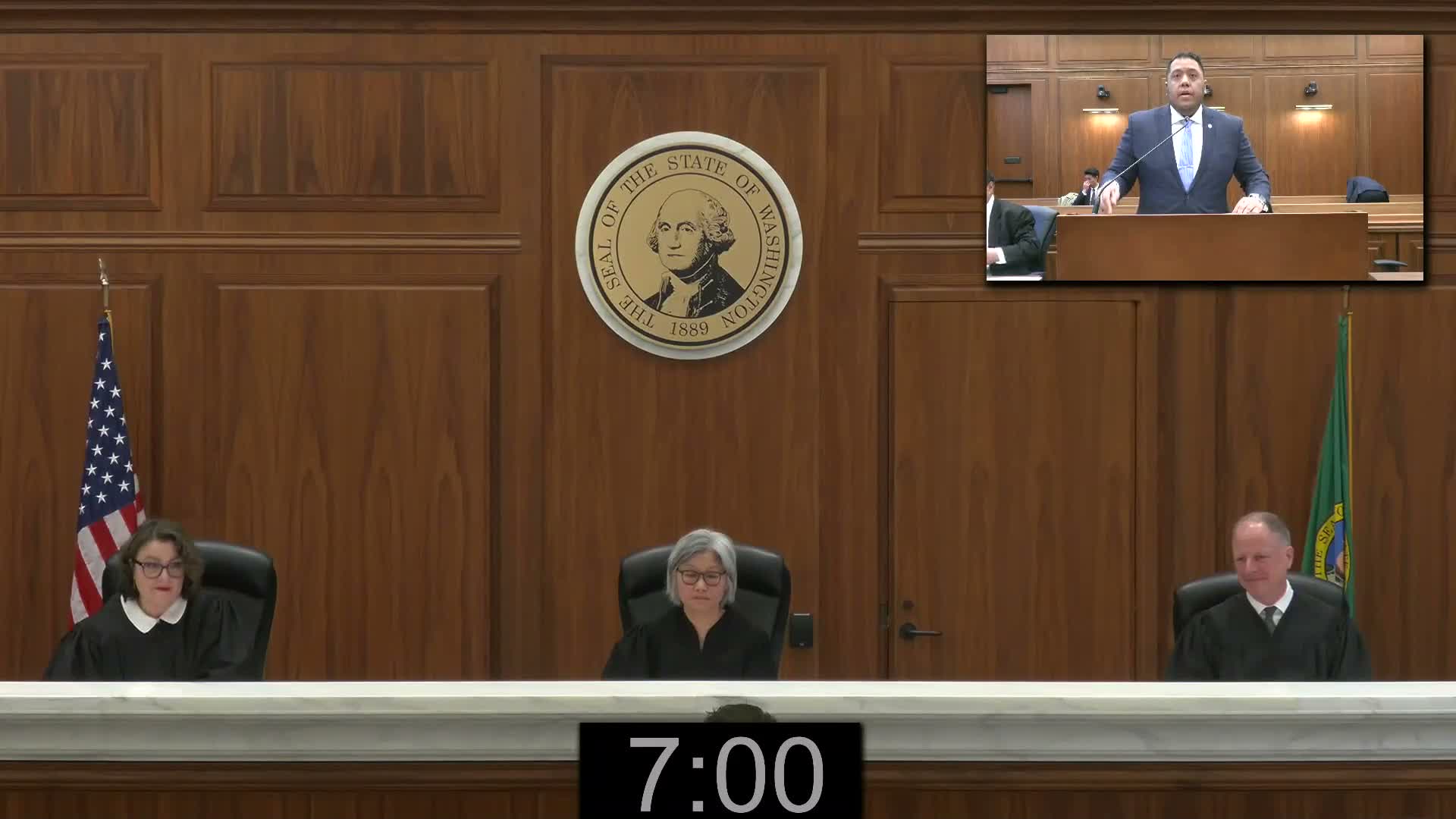
At oral argument before an appellate panel, Daniel Shea, an assistant attorney general for the Department of Labor and Industries, told the court that when a staffing agency "has control over the pre assignment training of the individuals at issues, they are by necessity a liable employer for WICIA purposes." Shea argued the Board of Industrial Insurance Appeals erred by treating the applicable Washington Administrative Code provision as site‑specific rather than a generalized training requirement that applies to non‑asbestos‑removal construction workers.
The department asked the court to reverse the board and reinstate the original citation. Shea pointed to testimony from the department inspector and to the department's reading of WAC subsection 1(c), saying the subsection "specifically states that that training requirement is for all individuals who are not doing asbestos removal work" and that the provision’s purpose is preparatory training to help workers identify presumed asbestos‑containing material and avoid disturbing it.
Counsel for Tradesman International, Aaron O'Water, urged the court to affirm the board. O'Water said Tradesman "did not have control over the job site" and told the panel that "the 2 hour asbestos awareness training is not a generalized training course. It's specifically for class 4 asbestos work." He described the factual sequence at the Doane residence: a certified face survey and laboratory sampling, hiring a certified abatement contractor (identified in the record as "AAA and D abatement company"), completion and clearance sampling reported on 09/01/2017, and then turnover to Pacific West Construction for subsequent building repairs.
The judges pressed both sides on precedent and record‑review procedure. One judge asked whether the court could remand with instructions to apply the 2021 Tradesmen standard to the 2019 BIA record or whether proceedings must be reopened to supplement evidence. Shea answered that the existing record is sufficient for review and that the board’s discussion section is dicta while the specific findings of fact are the proper basis for substantial‑evidence review. O'Water countered that certain findings of fact (the board’s findings 4, 5, 8 and 9, as cited in the record) demonstrate that Pacific West controlled the workers and jobsite and therefore support affirming the board.
Both sides framed their arguments around two precedents discussed at length in briefing and at oral argument: the 2021 Tradesmen opinion (described by counsel as fact‑specific on site control and scaffold issues) and the Labor Works decision (framed as focused on preventive education and post‑assignment recordkeeping demonstrating control). The court repeatedly noted those cases require fact‑specific inquiry into who was in the best position to abate hazards and whether the evidence here shows control by the host employer or by the staffing agency.
Shea closed by repeating that Tradesman already provides generalized safety training and personal protective equipment and that site supervisors at hearing could not confirm whether a site survey had been done, which the department said supports reversal. O'Water closed by stressing the class‑specific nature of asbestos training and the record evidence of abatement and clearance sampling, asking the court to affirm.
The transcript ends with argument concluded; the court's decision is not recorded in the provided excerpt.