Get Full Government Meeting Transcripts, Videos, & Alerts Forever!
Get email alerts on the Sand Relocation topic
No spam. Unsubscribe anytime.
Nags Head staff outline sand-relocation rules, emphasize dune protection and turtle safety
Summary
Town planners detailed requirements for sand-relocation permits, work-hour limits, stabilization triggers (1,000 sq ft or 2,700 cu yd), and sand-fence spacing; applications open Nov. 1 and work may begin Nov. 17 for the 2025–26 season.
Nags Head Town planners laid out the town’s sand-relocation rules at a preseason meeting, telling homeowners and contractors how to apply, where sand may be placed and the limits designed to protect dunes and nesting habitat.
Greg Daisy, a planner for Nags Head Town, described the program as aimed at clearing sand off structures while minimizing disturbance to dune vegetation. “The stronger the application, the more information you provide in your application, the quicker we can process it,” Daisy said, urging applicants to submit complete site sketches and volume estimates.
Daisy said applications are submitted via the town web portal and typically include homeowner and contractor information, a project sketch showing property lines, dune crest and deposition area, and depth and yardage estimates. On-site meetings with staff are part of the authorization process; if the site visit matches the application, work may proceed once the signed authorization letter is carried on-site.
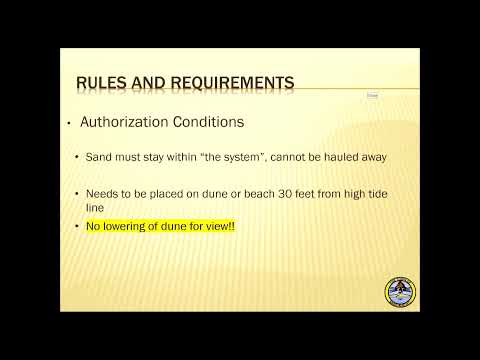
The town requires stabilization when projects move more than 1,000 square feet or 2,700 cubic yards of sand; allowed stabilization methods include sand fencing and planting (spraying) vegetation. Daisy said the program forbids lowering existing dunes for view enhancement and limits excavation to no more than one foot below walkways or structures.
Work under the program is generally allowed Monday–Friday, 8:30 a.m. to 5 p.m., with very limited exceptions for emergencies. Daisy said previously allowed 'beach-push' bulldozing is no longer permitted under the sand-relocation program and moving sand waterward to push it back onto dunes is not allowed.
Technical limits for sand fences include a maximum 10-foot toe-of-dune work band, 10-foot fence sections and a minimum of 7 feet of spacing between fence sections to preserve pedestrian access and wildlife movement. Daisy illustrated the wildlife concern with a photo of a turtle nest that could be blocked by improperly placed fencing.
Sand placement must remain within the property system and be no closer than 30 feet to the normal high-water line; use of town beach-access drives for equipment requires prior authorization. Daisy also warned that deposits containing debris must be cleaned before placement to avoid persistent debris piles downwind.
Enforcement measures include final inspections; three minor violations or one severe violation can remove a contractor from the town’s approved list and may trigger town and (as mentioned in the meeting) state coastal-permitting penalties. Daisy said applications open Nov. 1, staff aim to authorize complete applications within about three to four days, permitted work can begin on Nov. 17, applications are accepted through April 15, 2026, and work must be finished by April 30.
The meeting concluded with staff directing contractors and homeowners to the town’s online “sand removal and relocation guidance” materials and offering staff contact cards for follow-up questions.