
WDFW staff brief Habitat Subcommittee on local land‑use engagement, data tools and enforcement limits
Get AI-powered insights, summaries, and transcripts
Subscribe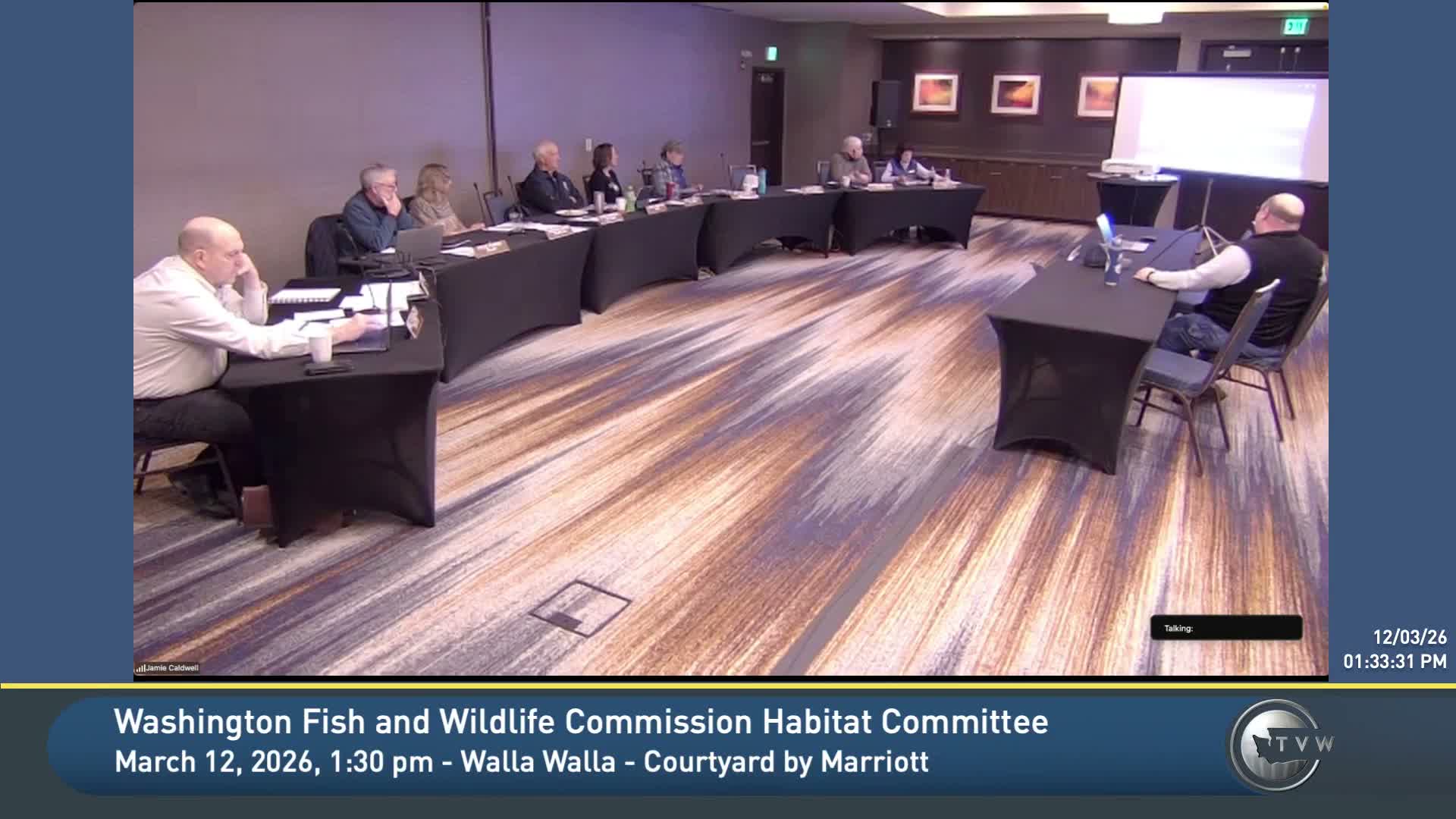
Summary
Washington Department of Fish and Wildlife staff told the Habitat Subcommittee March 12 that the agency provides technical recommendations, maps and guidance for local land‑use planning but has no direct regulatory authority; commissioners pressed for better outreach, updated public tools and clarity about enforcement and mitigation.
Molly Linville, chair of the Habitat Subcommittee of the Fish and Wildlife Commission, opened the March 12 meeting by inviting staff from the Washington Department of Fish and Wildlife (WDFW) to explain how the agency engages with cities and counties on land‑use planning.
"We are here to talk with you about how WDFW engages with local governments on land use planning," Julia Michalik, section manager for the Priority Habitats and Species (PHS) section, said as she began the presentation. Michalik outlined two statutory frameworks — the Growth Management Act (GMA) and the Shoreline Management Act (SMA) — that guide local governments’ designation and protection of critical environmental areas.
Michalik said the PHS program produces four main products for planners: a PHS list of priority species and habitats, spatial mapping data, management‑recommendation documents, and direct technical assistance. "We provide spatial data and technical assistance to help planners designate and protect critical fish and wildlife habitat," she said, adding that WDFW "has no regulatory authority in this space" and that jurisdictions retain final permitting and enforcement powers.
The presenters described recent mapping and data work, including statewide riparian management‑zone mapping, updated shrub‑steppe layers, a Columbia Plateau biodiversity and corridors map, and a modeled breeding‑habitat layer for a raptor species. Non‑sensitive PHS spatial data are available for download on geo.wa.gov and through an interactive "PHS on the web" tool that can flag priority habitats on a parcel; requests for sensitive data follow a controlled process and require a data‑sharing agreement.
Cara Whitaker, land use, conservation and policy section manager, described LUCP’s outreach structure: regional land‑use leads handle long‑range planning and area habitat biologists support current planning and project review across 281 cities and 39 counties. Whitaker urged jurisdictions to consider adopting PHS recommendations by reference or to demonstrate why they depart from them using best available science.
Commissioners used the question period to probe practical limits and needs. Commissioner Roland asked how WDFW initiates contact with jurisdictions that do not seek the agency’s advice; Whitaker said staff use regional leads, phone outreach and existing relationships and that responsiveness varies across counties and across the GMA periodic‑update cycle. When Roland asked about counties not required to plan under the GMA, staff said WDFW still engages those counties because they must have critical areas ordinances (CAOs).
Commissioner Parker urged stronger protections for "production" habitats and asked whether counties generally cooperate with WDFW guidance. "The most counties are receptive," Whitaker replied, "but there are others that prefer to work more independently," and she noted WDFW sometimes participates in appeals or hearings when adopted local measures do not meet no‑net‑loss expectations.
Chris Conklin, Habitat Program Director, cited recent examples where WDFW recordmaking was used in challenges: in one case the Growth Management Hearing Board agreed with WDFW’s analysis and required the county to work further with the agency. Conklin said the department tries to avoid a regulatory posture but recognizes the balance local jurisdictions must strike under GMA.
On mitigation, staff told commissioners the permitting jurisdiction usually approves mitigation proposed by project proponents, and WDFW provides recommendations and may weigh in on adequacy. "At the end of the day, it's the jurisdiction that's in charge," Conklin said, adding that parties can challenge those decisions.
Commissioners also asked how to raise the program’s public profile and which resources would most help. Staff said updating the "PHS on the web" platform, creating story maps to explain habitat work to the public and investing in more systematic species data collection would improve outreach and technical accuracy.
The subcommittee added connectivity and net‑ecological‑gain topics to future agendas (connectivity is scheduled for April) and asked staff to return with examples and budget/legislative wish lists.
The meeting adjourned with staff and commissioners agreeing to continue the discussion in upcoming subcommittee sessions.