
Trueclusion and partners launch Washington reparative-action study; survey opens April 10
Get AI-powered insights, summaries, and transcripts
Subscribe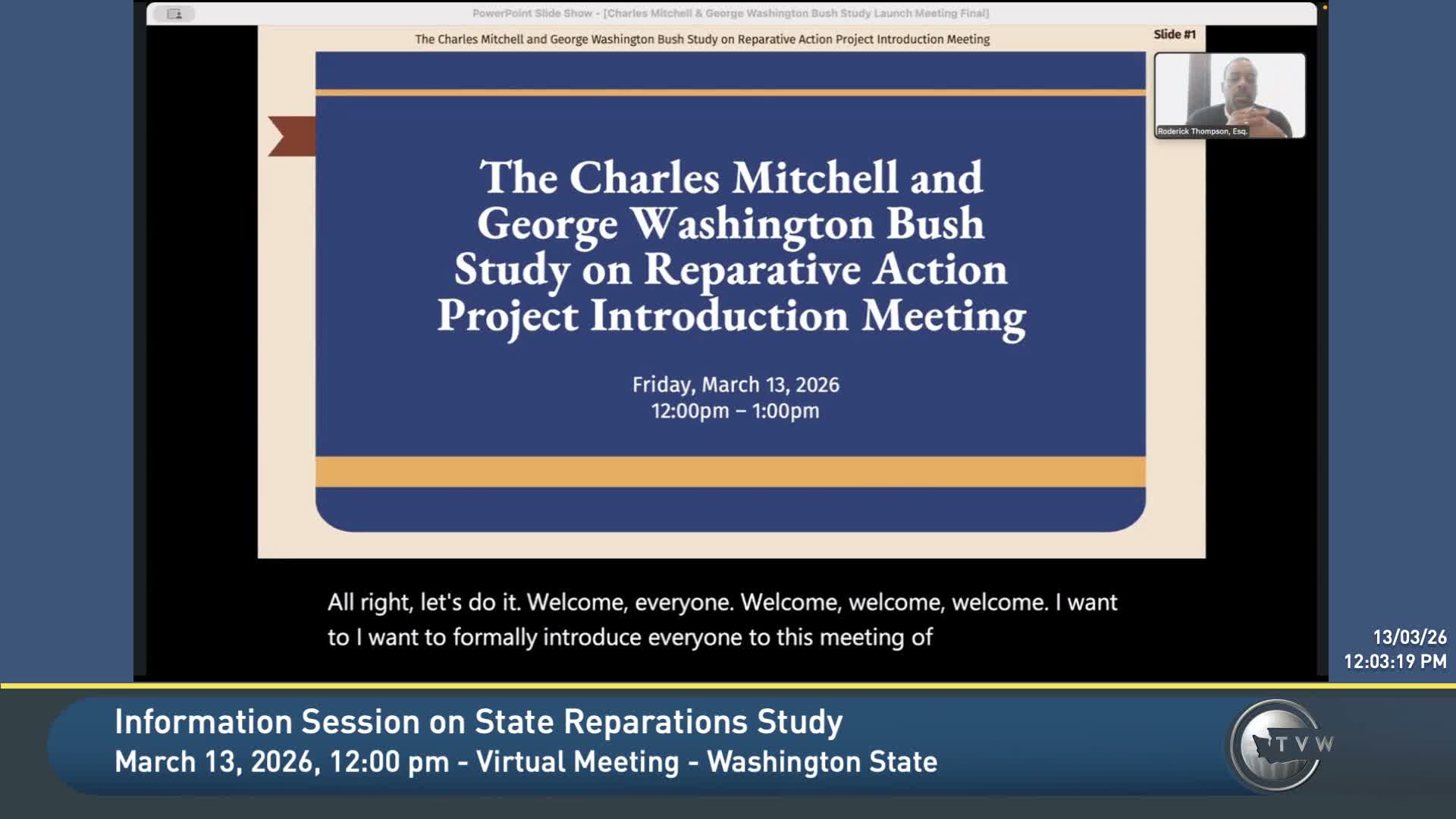
Summary
Trueclusion, with the State Department of Commerce and the Commission on African American Affairs, held a virtual kickoff for the Charles Mitchell and George Washington Bush reparative-action study, introduced a multi‑phase workplan and announced a community survey launching April 10 that will inform legislative recommendations due May 7, 2027.
Trueclusion and its partners opened a virtual kickoff meeting to launch the Charles Mitchell and George Washington Bush study on reparative action, introducing a research team that the project lead said will produce data-driven recommendations intended to translate into legislation.
At the meeting, Roderick Thompson, general counsel at Trueclusion, said the project — carried out in partnership with the State Department of Commerce and the Commission on African American Affairs — aims to engage communities across Washington and deliver policy recommendations grounded in rigorous research.
"One goal is to provide data-informed recommendations that are firmly grounded in rigorous research, and ultimately, we hope it leads to reparations legislation being passed," said Dr. Ashley Gardner, project principal for Trueclusion, who outlined a three-phase workplan running through May 2027.
Gardner described the team and its roles: a historical research stream compiling records back to 1848; a community research stream to gather residents’ preferences; an evaluation and policy team to develop draft recommendations; and a genealogy team to verify lineage. Key team members introduced included Marvin Slaughter (evaluation/valuation lead), Thomas Kramer (valuation and policy co-lead), Ariel Davis (community engagement specialist) and Micah Anders (genealogy lead, absent).
The project will proceed in three phases: Phase 1 (February–April) for initial historical compilation and survey preparation; Phase 2 (May–October) for analysis, listening sessions and draft policy work; and Phase 3 (November–May) for town halls, final recommendations and submission to the legislature by May 7, 2027. Gardner said the community survey will launch April 10 and remain open through August, and that monthly virtual informational sessions will be held at noon on the second Friday of each month.
On methods, Slaughter and Kramer described multiple valuation approaches the team may apply — including income- and asset-based models, difference-in-difference comparisons and tort- or contract-style frameworks — while stressing the need to center the perspective of those harmed. "Reparations without the discussion of cash payments isn't reparations," Slaughter said, arguing that cash should be among the remedial options considered.
Gardner said the genealogy team will trace lineage for a sample of community members statewide and provide tools so others can pursue their own genealogical research. The team also described plans for listening sessions hosted by community organizations, summer town halls and options for organizations to host informational sessions.
Panelists said all survey data will be anonymous and that questions and answers from the kickoff, along with slides and the work plan, will be posted on the project's website. Shelly Seacrest, regional president of the Seattle‑King County NAACP, said the NAACP will support outreach to ensure broad representation and community buy‑in.
Thompson closed by thanking partners — the Commission on African American Affairs, the State Department of Commerce and the NAACP — and reminding attendees that the project will continue with monthly updates and public engagement opportunities. The team committed to posting materials and a question‑and‑answer record online and to statewide outreach, including Eastern Washington.
The next substantive milestone is the survey launch on April 10; the team plans to post the full slide deck and Q&A on its website and to collect input through listening sessions and town halls that will inform the May 7, 2027 submission of draft legislative recommendations.