
WDFW seeks delegation to finalize CWD‑related rule changes for captive cervids
Get AI-powered insights, summaries, and transcripts
Subscribe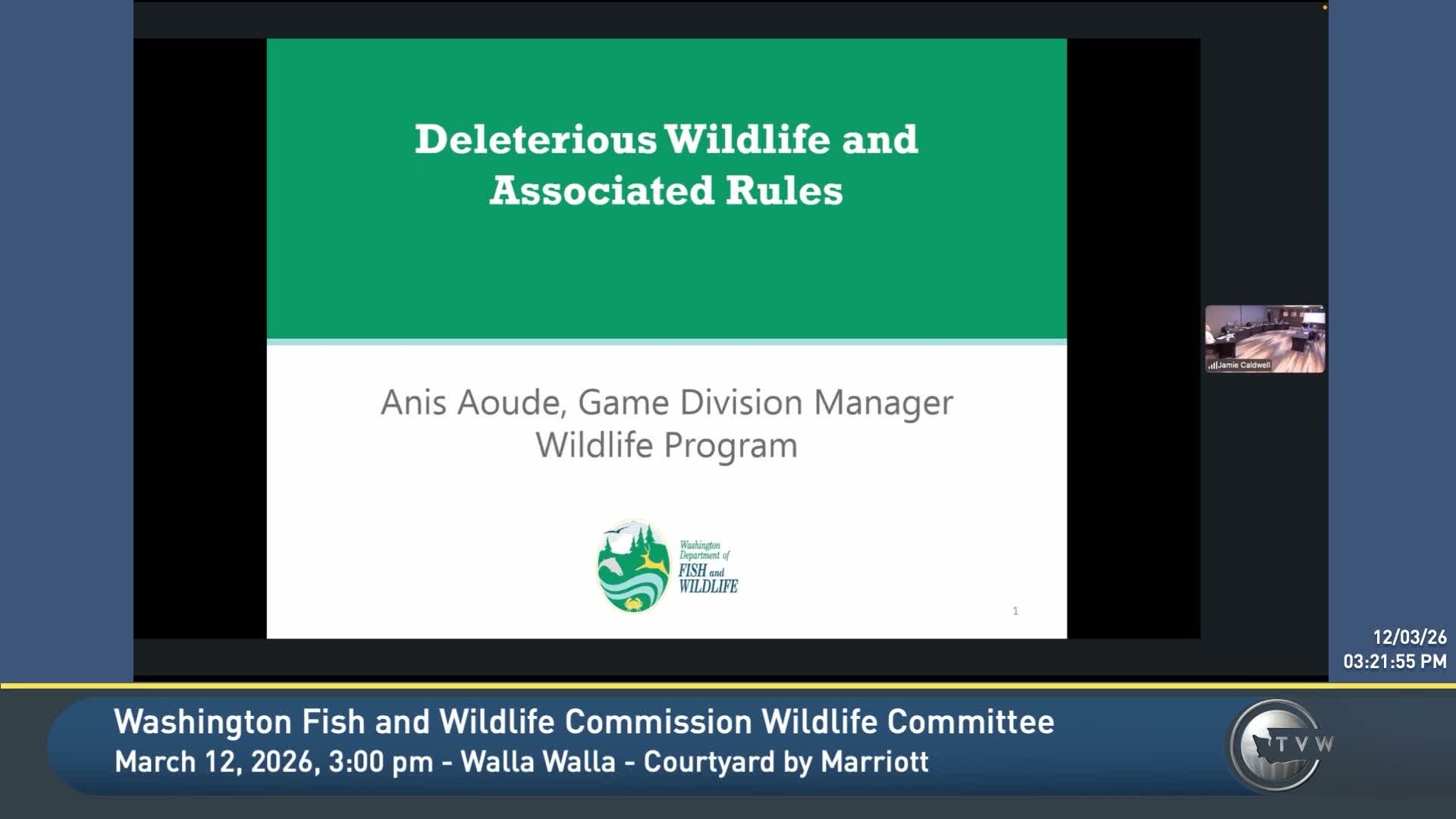
Summary
Agency staff proposed removing outdated 'pre‑1992' language, carving the deleterious exotic wildlife rule into separate chapters, and requiring postmortem CWD testing for captive cervids; committee members signaled support to draft a delegation motion to the director.
Department staff told the wildlife committee they are preparing rule changes related to chronic wasting disease (CWD) and captive cervids and asked whether technical rulemaking should be delegated to the director.
"Movement of infected live cervids is considered the greatest risk factor to the introduction of or establishment of CWD to a new geographical area," said Anise Audi, the GAIM Division Manager, summarizing the CWD plan adopted in 2021. Anise said the presentation focused on rules the department administers and not rules administered by the Washington State Department of Agriculture (WSDA).
Anise outlined two principal rule actions. First, the department proposes to remove language in WAC 2 24 50 030 that references native cervids in captivity prior to 1992 (language that allowed previously captive native cervids to live out their lives). Anise said there should be no remaining captive native cervids from that era and the wording is now housekeeping language.
Second, the agency recommends splitting the current deleterious exotic wildlife chapter (02/26/4200) into a new chapter that (a) designates which species are considered deleterious and (b) creates separate, detailed rules for captive‑cervid requirements — fencing, marking, disease testing, reporting and inspection. As proposed, fallow deer and reindeer would remain the only cervid species currently permitted in captivity, but the department said that policy could be revisited later in consultation with industry and the Department of Agriculture.
On testing, Anise said there is no validated live CWD test for cervids; the rule change would require postmortem testing when captive animals die. "We would require CWD testing of captive cervids that die in captivity for any reason," she said.
Commissioners asked whether the changes would affect zoos (Anise said zoos are covered under different permitting processes and would not be subject to the same captive‑cervid rule language), whether fallow deer are vectors for other parasites or pests, and whether surveys have established whether other deleterious species still exist in the state (Anise said the last known comprehensive survey was in 2016 and found none other than fallow deer and reindeer in captivity).
On the procedural question, several committee members indicated they favored delegating the technical rulemaking to the director and asked Anise to provide draft motion language the committee could bring to the full commission. Anise agreed to email draft language to staff (Jamie) for review and transmittal to the commission meeting.
No formal rulemaking filings were made at the committee meeting; staff said a CR-102 package had not yet been filed and that next steps will include drafting the CR-102 and SEPA materials if the commission confirms the approach.