
Executive Ethics Board approves multiple employee settlements, updates policies and files scrivener rule change
Get AI-powered insights, summaries, and transcripts
Subscribe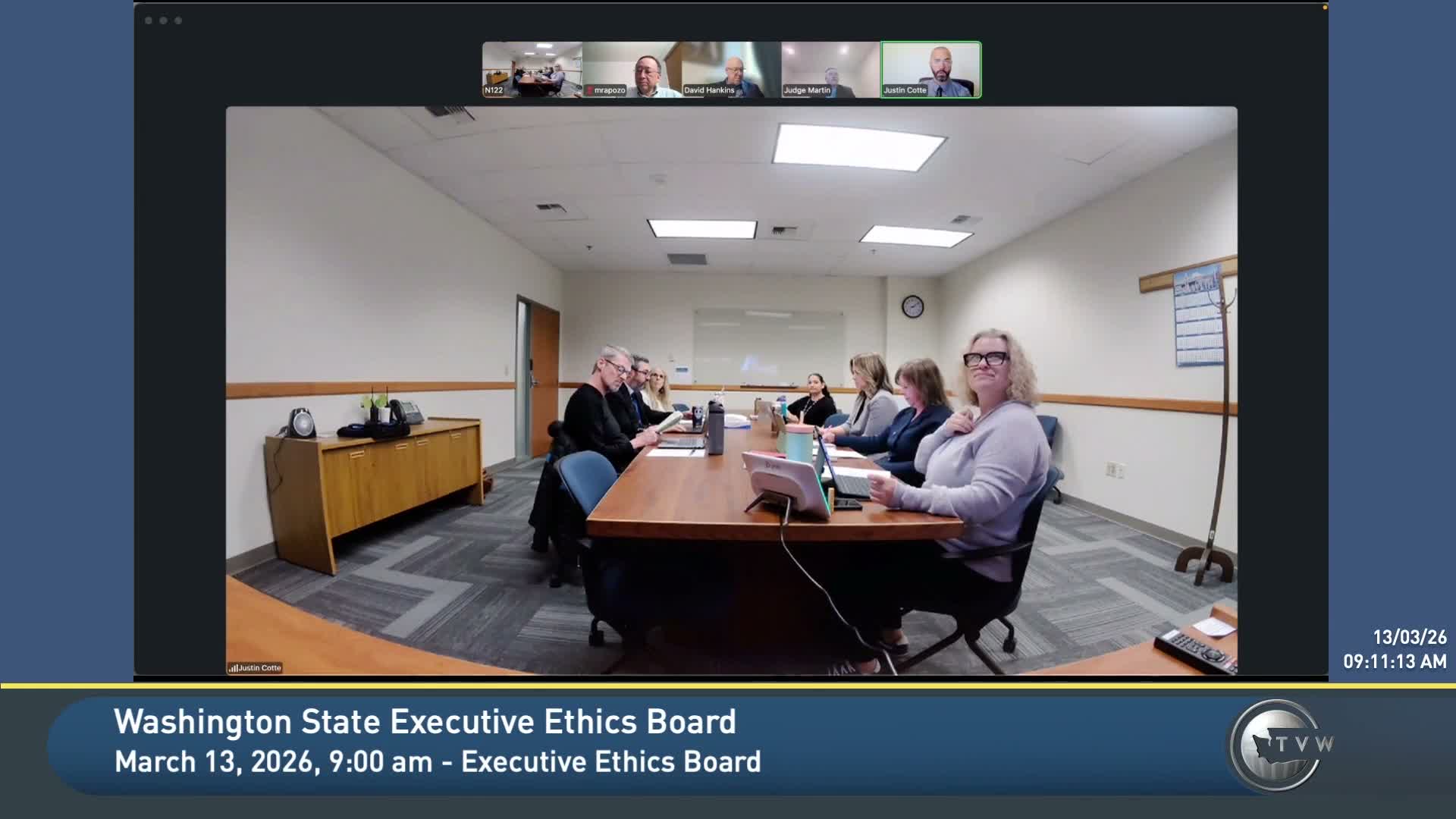
Summary
On March 13, 2026 the Executive Ethics Board approved settlement stipulations imposing fines in multiple state-employee cases, voted to file an expedited CR-105 to update its address, and reviewed agency ethics policies (including the Office of the State Treasurer and the Environmental and Land Use Hearings Office). Several stipulations carried civil penalties ranging from $375 to $4,500 (with some amounts partially suspended).
At its March 13, 2026 meeting, the Washington State Executive Ethics Board accepted a series of settlement stipulations and took administrative actions, including approving an expedited rule filing to update the agency address and completing a large package of agency policy reviews.
After hearing staff summaries and asking targeted questions about comparables and mitigating factors, the board accepted multiple stipulated penalties and conditions. Selected outcomes announced on the record when the board reconvened included: Case 2024010 — civil penalty $3,000 (stipulation accepted); Case 2023095 (Kelsall/ECY) — $4,250 payable within 45 days; Case 2024012 (Rivard) — modified stipulation imposing $4,000 with $1,000 suspended on compliance conditions; Case 2024037 (Sessions/WSDA) — $4,500 with $2,000 suspended (net $2,500 payable); Case 2024067 (Jovra/Bellevue College) — $2,000; Case 2025064 (Wenstrom/AGO) — $375 fine; Case 2025077 (Freeman/DOC) — $2,500 with $1,250 suspended. The board recorded a number of additional findings of reasonable cause, dismissals as unfounded, and routine reasonable‑cost determinations across many docketed matters.
Board staff also requested the board approve filing a CR-105 (an expedited rulemaking) to change the board’s address and public‑records contact information after a building move; the board approved the filing and staff noted the rule would become effective roughly 30 days after filing. During policy review, staff presented updated ethics policies from multiple agencies, including the Department of Agriculture (gift-law updates), the Employment Security Department (fundraising for charitable web purposes), the Environmental and Land Use Hearings Office (first formal submission to the board), and a 10-policy package from the Office of the State Treasurer. Board members flagged typographical edits, requested tighter language clarifying disclosure of confidential information, and suggested adding a defined reference for “beneficial interest” where appropriate.
Why it matters: The accepted stipulations resolve a set of alleged violations of the Ethics in Public Service Act (RCW 42.52) and impose civil penalties and compliance conditions affecting state employees across agencies. The expedited rule filing will update the board’s public records routing and mailing address following an office move, and the policy approvals bring multiple agencies’ ethics guidance into alignment with recent gift-law changes.