
Sensing Guideline Commission approves expanding Option B eligibility to include some Assault II cases for youth aged 14 and older
Get AI-powered insights, summaries, and transcripts
Subscribe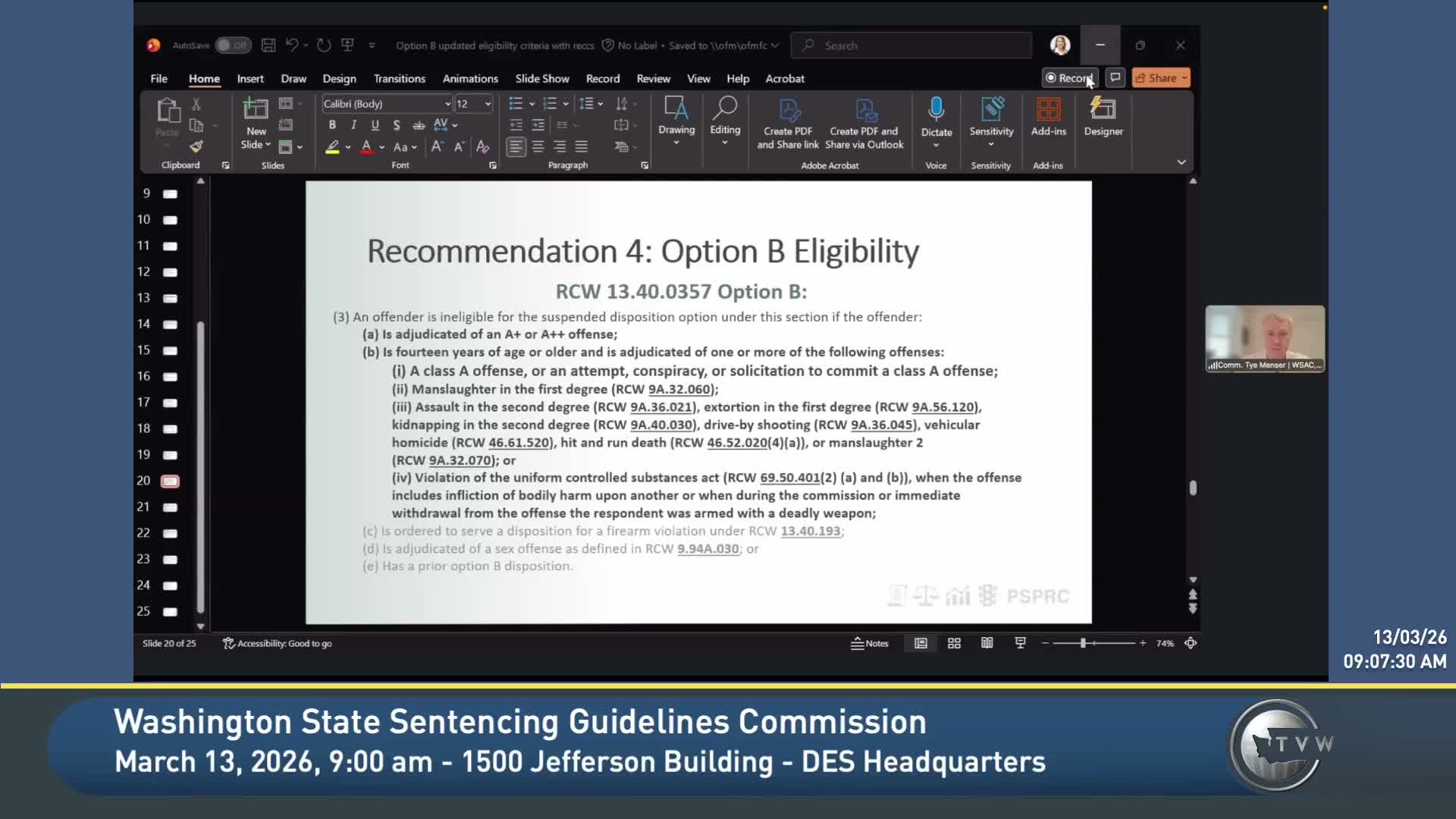
Summary
On March 13, 2026, the Sensing Guideline Commission voted to adopt a juvenile committee recommendation to allow judges discretion to apply Option B to Assault II adjudications for youth aged 14 or older; the motion passed 7–3 with 6 abstentions after lengthy debate over discretion, court enforceability and available services.
The Sensing Guideline Commission voted March 13 to adopt a recommendation that would allow judges to consider Option B—a suspended sentence with community supervision and services—for certain Assault in the Second Degree (Assault II) adjudications when the youth is age 14 or older.
The recommendation, brought by the juvenile committee and presented by Carrie Anne, does not mandate Option B in such cases but makes Assault II adjudications eligible so judges may use their discretion in individual cases. Lauren, presenting adjudication data, said that from Fiscal Year 2005–2024 the commission’s dataset identified about 249 historically eligible Assault II cases for younger defendants and that roughly 15–16 percent of those had received an Option B disposition. Expanding eligibility to 14 and older increases the ceiling of potentially affected Assault II adjudications to about 1,800 over the examined period, she said, while noting figures are likely overestimates because other disqualifiers apply.
Supporters argued that the change restores parity and preserves judicial discretion. Miss Brandes, who moved the recommendation for Assault II, said the record shows judges already exercise restraint—only a small percentage of eligible cases receive Option B—and that expanding eligibility would not automatically open the floodgates to community placements. "Judges are not going to grant it in every case," she said.
Opponents and cautious voices emphasized differences between diversion (a prosecutor‑led program requiring prosecutor consent) and Option B (a judicial decision). Representative Davis said, "Diversion and Option B are two different things," urging the commission to recognize that one depends on prosecutorial consent while the other rests with judicial discretion and that court rules limiting enforcement could blunt Option B’s effect. Judges on the panel countered that judicial discretion is public and accountable and that judges have tools—such as making a record under juvenile court rule 7.16—to justify enforcement actions when community safety is at stake.
The commission debated whether to carve narrow exclusions—for example, cases involving substantial bodily harm or firearms—versus keeping the eligibility broad and relying on judicial decision‑making. Several members referenced statutory precedents (for therapeutic/drug courts) that use element‑based exclusions as a possible model for limiting eligibility in specific, higher‑harm circumstances.
After discussion and a short recess, the commission voted on a motion limited to the Assault II portion of the juvenile committee recommendation. The chair reported the motion carried, 7 in favor, 3 opposed, with 6 abstentions. The commission said the adopted recommendation will be included in the committee’s report and that staff may propose program evaluation language to study Option B outcomes in the future.
The commission also acknowledged a lack of conclusive research specific to Option B’s effectiveness for violent offenses and discussed recommending a program evaluation. Carrie Anne offered that the commission could request an evaluation (separately) to examine outcomes before any broad statutory changes were advanced.
The commission deferred the related first‑time offender waiver presentation to the next meeting to ensure adequate time for discussion.
The vote—the first substantive policy adoption of the meeting—will be recorded in the commission report and forwarded as part of the group’s set of recommendations to legislators and stakeholders.