
Commission hears proposed changes to livestock compensation rules after producers' complaints about delays
Get AI-powered insights, summaries, and transcripts
Subscribe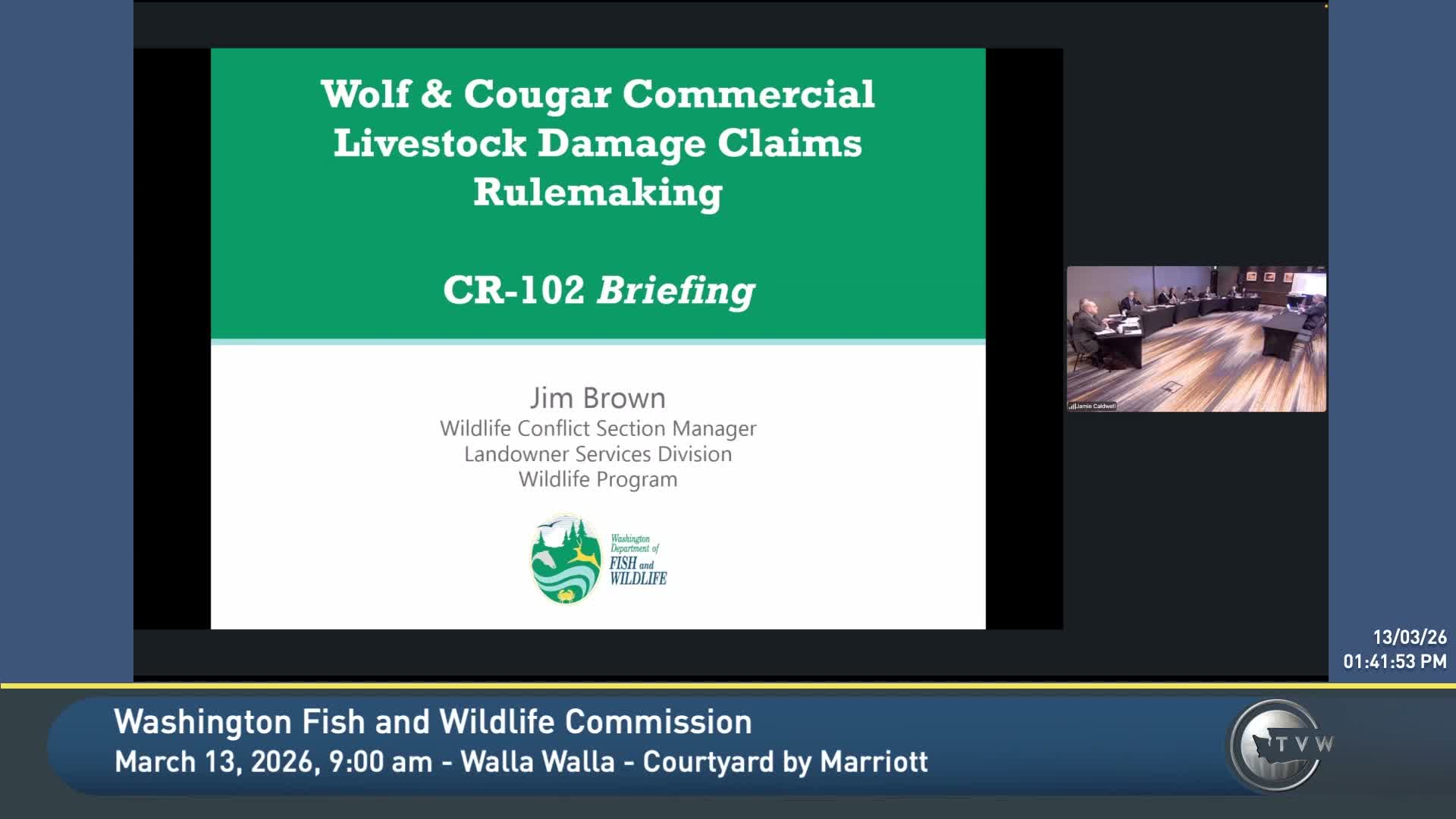
Summary
WDFW presented a CR 102 package to clarify definitions, expand acceptable valuation records, add a 120'day hardship option, and raise the administrative payout ceiling to match RCW (up to $30,000) without appeal; ranchers urged faster processing and conservation groups asked for careful wording on what counts as an "attack."
At the March meeting the Commission heard a detailed briefing and public hearing on proposed changes to the Livestock Compensation rules (CR 102). Jim Brown, WDFW's Wildlife Conflict Section Manager, presented the rule package and answered commissioners' questions.
Brown said the rule amendments aim to simplify and clarify existing language, establish a definition of "commercial livestock," add a working'dog definition tied to commercial operations, expand the types of records the department will accept to establish livestock value, and align WAC language with statutory RCW limits. "We want to give the agency authority and rule to go all the way to the 30,000 if we agree to it without an appeal," Brown said, referring to the statutory $30,000 maximum that currently requires appeal when the WAC referenced an older $10,000 limit.
Key process changes Brown described: additional flexibility for producers to submit records (including a 120'day hardship process for extraordinary circumstances such as wildfire or medical issues), clarified definitions (including commercial status and large pasture thresholds), and elimination of an unused Livestock Appeals Committee in favor of the existing Office of Administrative Hearings process. Brown said the rewrite is intended to make the rules more navigable for producers and to speed payment when the department and claimant agree.
Public testimony split along expected lines. Rancher Jamie Kibler of Walla Walla urged faster processing and said long delays have been financially painful: "We've had claims take nearly two years," Kibler said, asking that the new rules be posted and clearly available. Francisco Santiago Avila of Washington Wildlife First asked the Commission to narrow a proposed definition of "attack" so it requires physical or imminent contact; he warned that a loose definition applied across WACs could broaden circumstances in which wolves may be killed under other rules.
Defenders of Wildlife's Kristin Botzet said her organization supports administrative clarifications and the hardship provision but recommended separating procedures for wolf claims and bear/cougar claims within the WAC for clarity, and asked staff to explain exactly how the added "attack" language will interact with existing WACs like the Collie (Coddenby) Act provision the Commission will later consider.
Brown said many WAG (Wolf Advisory Group) recommendations were incorporated, and that the proposed restructuring includes more usable bullets and an expanded menu of acceptable valuation sources so producers are not caught by 'impractical record'requirements. He acknowledged that claims are often delayed because claimants and the department are waiting for supporting documentation or because a case enters appeal. Brown said that if the department has completed a claim and the claimant does not appeal or respond within a set period, the department will follow payment procedures similar to those used for crop claims rather than automatically denying livestock claims. He also emphasized that some statutory constraints limit changes the department can make without RCW updates.
What's next: public comment on CR 102 remains open through March 16. Staff will review comments and return to the Commission with a decision request at the April meeting. Brown said staff will also use the Commission's mailing list to ensure producers who have previously filed claims can review the proposed changes before the comment window closes.
If adopted, the rules aim to reduce the need for routine appeals, accelerate payments where the department and claimant agree, and provide clearer, more auditable pathways for valuing and processing both direct and indirect livestock claims.