
WDFW director warns $10 million in new state cuts will reduce hires and programs
Get AI-powered insights, summaries, and transcripts
Subscribe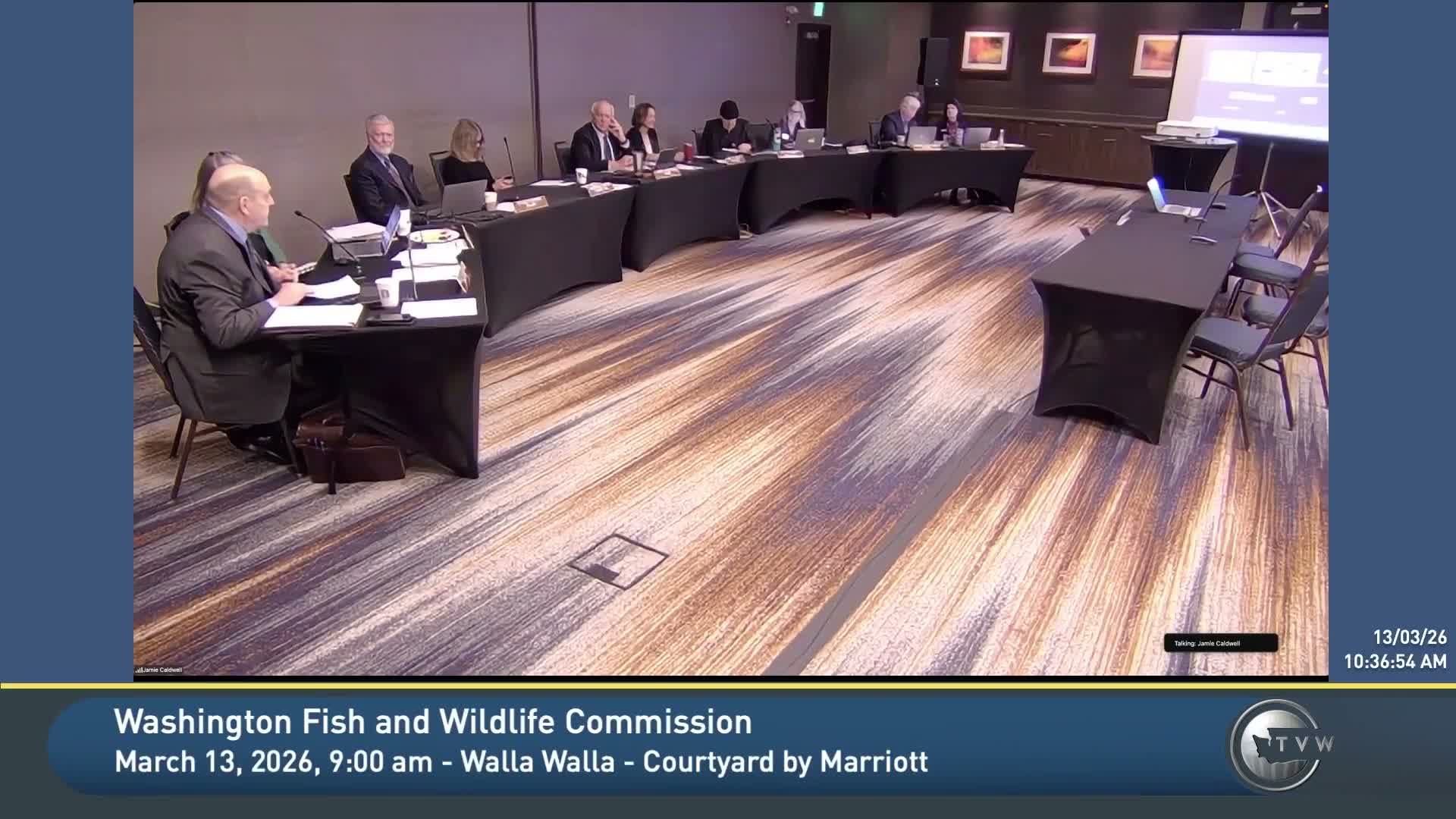
Summary
Director Kelly Suswin told the Washington Fish and Wildlife Commission that about $10 million in new state budget cuts will fall across business services, fish monitoring, wildlife programs and lands maintenance, forcing hiring freezes, FTE reductions and scaled-back work unless funding is restored.
Chair Jim Anderson convened the Washington Fish and Wildlife Commission in Walla Walla on March 13, where Director Kelly Suswin told commissioners the department faces about $10 million in new cuts in the state budget that will reduce staffing and program capacity.
Suswin briefed the Commission on interagency work and fisheries planning before turning to the budget. "On budget, the bottom line is, bad for us, frankly," Suswin said, summarizing a package of cuts the department has been unable to reverse in conference committee. He said the reductions are both one'time and ongoing and that the department will distribute the impact across programs to maintain core functions.
The Commission packet and Suswin's presentation broke the reductions down by program areas: roughly $1.5 million from business services (internal operations such as IT), about $1.7 million from fish program monitoring and a $1 million cut to fish program operations, approximately $1.9 million directly from the wildlife program, and additional reductions in lands maintenance that together produce an ongoing $1.2 million annual shortfall for lands upkeep. He also described an approximate $300,000 administrative cut to Regional Fish Enhancement Groups and a $1 million-a-year reduction to biodiversity funding compared with prior expectations.
Suswin said the combined reductions total on the order of $10 million and will have operational effects, including an estimated 11 FTE reduction in enforcement hiring capacity because the agency will not be able to fill vacant positions. "By the time you do recruitment, testing, academy and a year of field training, it's a couple years to get an officer on the ground," Suswin said, warning of long'term consequences to enforcement capacity if vacancies are used to meet reductions.
Commissioners pressed staff about the distribution and duration of the cuts. Suswin said some reductions are one'time and others are permanent and that the agency is exploring long'term funding options, including models used in other states (for example, lodging tax mechanisms and dedicated sales tax approaches) to reduce reliance on a volatile general fund. He also noted federal funding shortfalls and declining federal staffing as compounding factors.
Suswin identified particular program impacts: fewer monitoring resources for fish programs, less capacity for biodiversity work, and less money for lands maintenance and enforcement recruitment. He said the department will send an all'staff message with more detail and will work with the Commission and its Budget Policy Advisory Group on long'term options.
The Commission discussed possible near'term responses, including communicating with the governor's office and the Legislature and leaning on the Budget Policy Advisory Group to explore durable funding models. Commissioners underscored the need to protect core enforcement and lands maintenance while acknowledging the constrained fiscal environment.
The Commission did not take formal action at the meeting but directed staff to keep commissioners updated and to bring further options to the budget advisory group and to the full Commission in coming months. The agency plans to continue outreach to stakeholders and explore funding models that are less vulnerable to general'fund cycles.
What's next: Suswin said staff will return with more detailed numbers and options for restoring or mitigating reductions, and the Commission flagged the 2027 biennial budget cycle as a focus for longer'term restoration planning.