
Clemency Board Unanimously Recommends Pardon for John Smith, Citing Youth and Community Service
Get AI-powered insights, summaries, and transcripts
Subscribe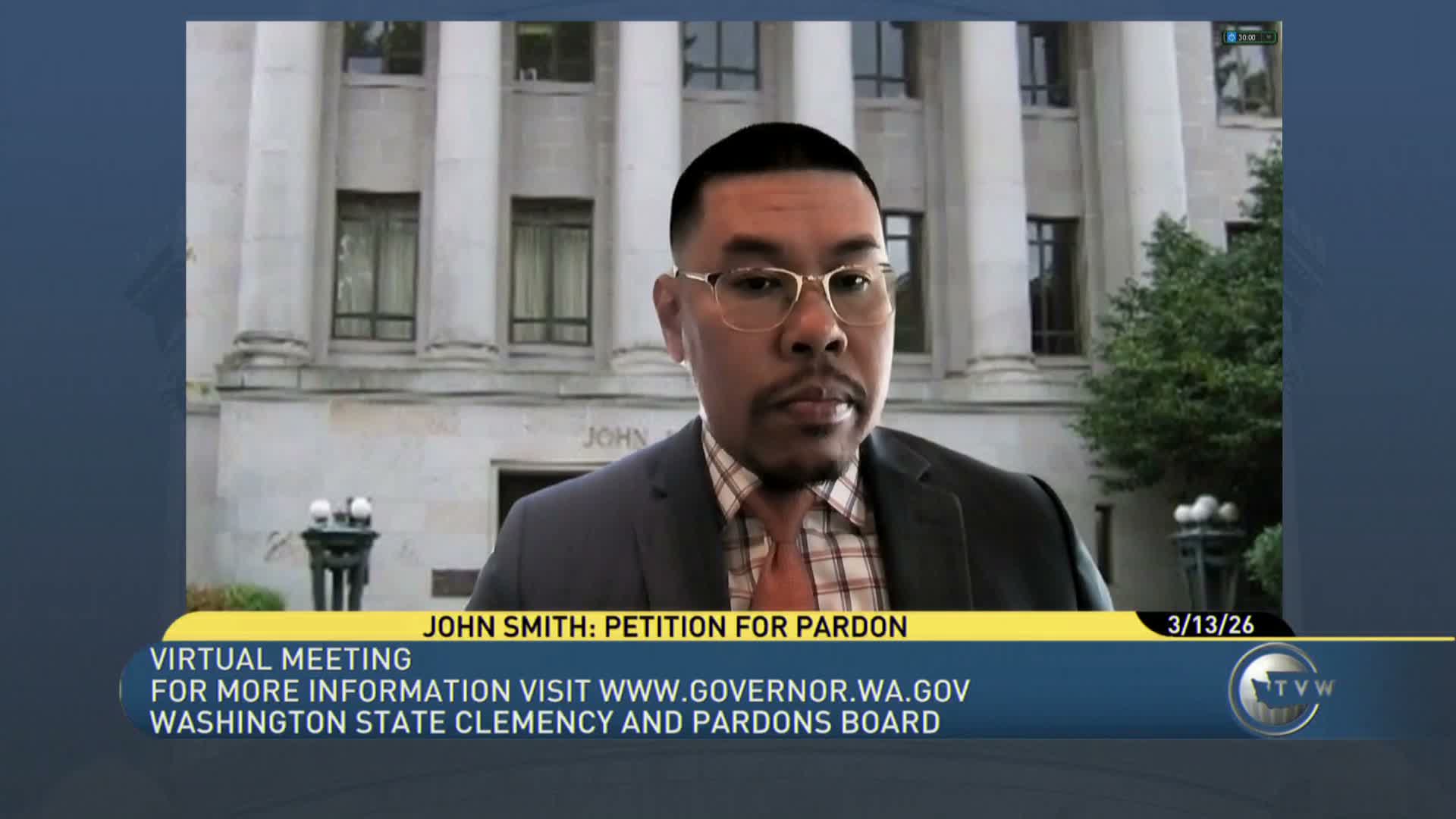
Summary
On March 13, 2026, the Washington State Clemency and Pardons Board voted 5–0 to recommend a pardon for John Smith, citing his offense at age 16, sustained community service, and extensive mentorship work that petitioners said would be hindered by his felony record.
The Washington State Clemency and Pardons Board unanimously voted March 13, 2026, to recommend that Governor Inslee grant a pardon to John Smith.
Smith told the board he was 16 at the time of his offense more than 20 years ago and described a multi-year effort to rebuild his life. He described founding a barbershop-based mentorship program, 757 We Care, and said the felony record continues to limit his ability to reach youth in juvenile detention centers and other institutions. Supporters including William Livingston and Jeremy Lawrence testified that Smith’s programs run back-to-school drives, career fairs and community-service projects, and that his involvement has tangible local benefits.
Pierce County prosecutor Crystal Maria told the board the prosecutor's office submitted a written opposition and noted “pardon is a high bar saved for extraordinary cases,” but acknowledged Smith’s community work was commendable. Board members — citing Smith’s youth at the time of the offense, a sustained record of rehabilitation and demonstrable community impact — concluded the circumstances were extraordinary and motioned to recommend a pardon.
Vice Chair Doug Baldwin moved the recommendation; Board Member Rhonda Salvesen seconded. The board voted 5–0 to recommend a pardon. Chair Raymond Delas Reyes reminded Smith the board’s action is advisory and the governor will make the final determination.
Background: Smith said he now runs a seven-chair barbershop and a nonprofit mentorship program in the Hampton Roads (757) region, and that he has logged thousands of community-service hours. Supporters said his felony record blocks institutional access, constraining the reach of his programs. The prosecutor reiterated the material in the office’s written submission opposing a pardon but praised Smith’s community service.
Next step: The board will transmit its unanimous recommendation and the hearing record to the governor's office for consideration. If the governor approves the pardon, Smith’s record would be cleared as provided by the state process.