Get Full Government Meeting Transcripts, Videos, & Alerts Forever!
Get email alerts on the Walnut Creek Expansion topic
No spam. Unsubscribe anytime.
Austin Water to seek $1.5 billion authorization for Walnut Creek plant expansion
Summary
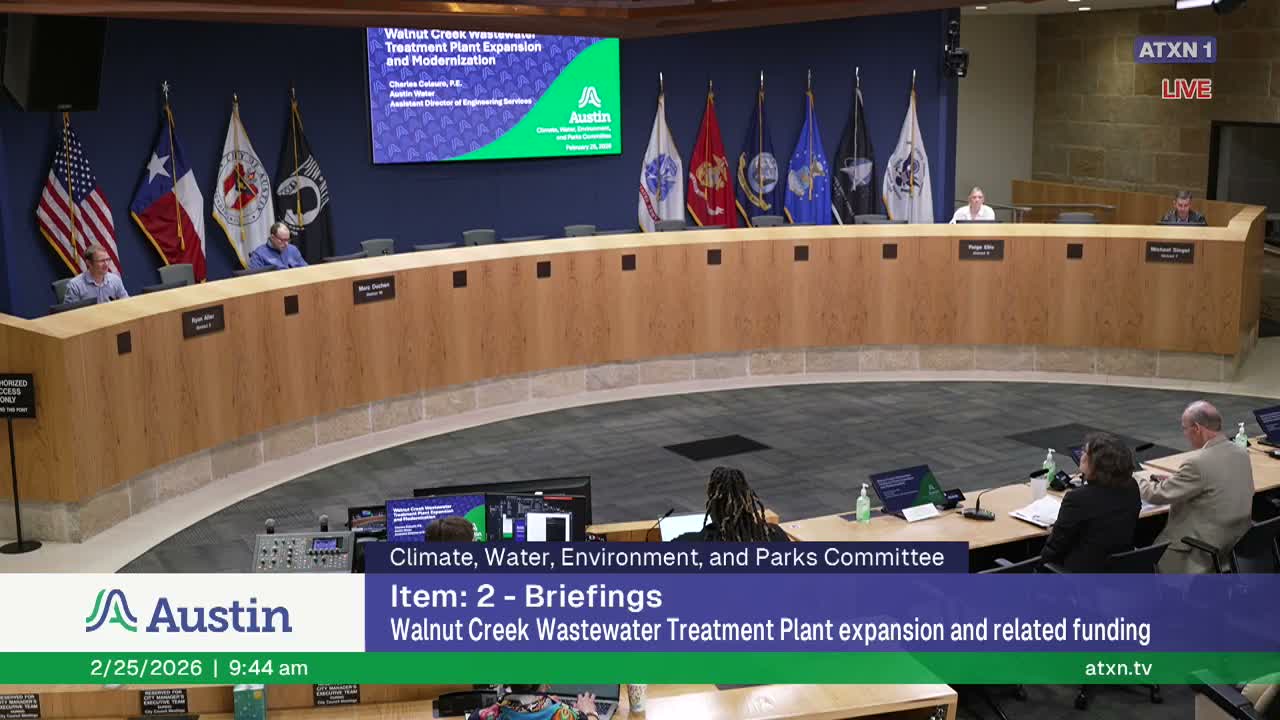
Austin Water briefed the committee on plans to modernize and expand the 50-year-old Walnut Creek wastewater treatment plant, and said it will ask City Council on March 12 to authorize increased construction and loan amounts that bring the project estimate to $1.5 billion while preserving the adopted five-year rate plan.
Austin Water told the Climate, Water, Environment, and Parks Committee on Feb. 11 that it will ask City Council on March 12 to authorize an increase to the Walnut Creek wastewater treatment plant construction contract that would bring the project construction authorization to $1.5 billion.
"We will be coming forward to city council in March for an overall cost for this project of $1,500,000,000," Director Shay Rawls Rolfson said during the briefing. Charles Solaro, Austin Water’s delivery and implementation lead for capital projects, described the work as both an expansion and a generational modernization of the 50-year-old facility.
The Walnut Creek plant, which began operation in 1977 and is rated at about 75 million gallons per day (MGD), serves much of North Austin. Austin Water said the scope includes a 25 MGD expansion element, conversion to biological nutrient removal to reduce nutrient discharges to the Colorado River, ultraviolet disinfection to reduce chemical use, upgraded odor control, and a new flood wall because part of the site sits in a 100-year floodplain.
Solaro said the project is being delivered using a construction-manager-at-risk (CMAR) approach. MWH Constructors joined the project in May 2024 and helped refine designs and construction sequencing; four Guaranteed Maximum Price (GMP) packages are now in construction after GMP 1 began in October 2025. "That method helped us to help mitigate the risk of delivery of this project," Solaro said.
Staff described a multi-source financing plan tied to the March council authorization: Austin Water will request a WIFIA (EPA) loan authorization increase to $1.0 billion (requesting an additional $553 million), is securing a Texas Water Development Board Clean Water State Revolving Fund loan of $59 million that was recently approved, and expects the remainder to be funded through Austin Water revenue bonds. Tina Romero, interim assistant director of financial services, said WIFIA has set aside funding and staff expects loan closing in June contingent on council authorization.
Council members pressed staff on cost certainty and whether the $1.5 billion figure is an upper authorization limit or a firm contract price. Solaro said the $1.5 billion represents the construction cost authorization the department will ask council to approve based on more detailed design and updated construction estimates; it reflects both identified cost escalation since 2022 and project-specific complexities. "We have seen escalation of cost for goods and services," he said, adding that the contractor has also identified more than $100 million in cost-saving opportunities during preconstruction.
Staff emphasized phasing and constructability strategies to maintain uninterrupted service at the active plant. Solaro and Rolfson said the work is being sequenced so that the plant remains operational and that the department continues value-engineering through final GMP packages to hold costs down. They also said the department is not proposing a change to the council-adopted five-year rate plan at this time.
The committee did not take a vote on the construction authorization; staff said the formal action will be requested at City Council on March 12. Members asked for additional detail on cost drivers, loan terms, and what items (if any) might be deferred; staff committed to providing more detailed council materials ahead of the March hearing.